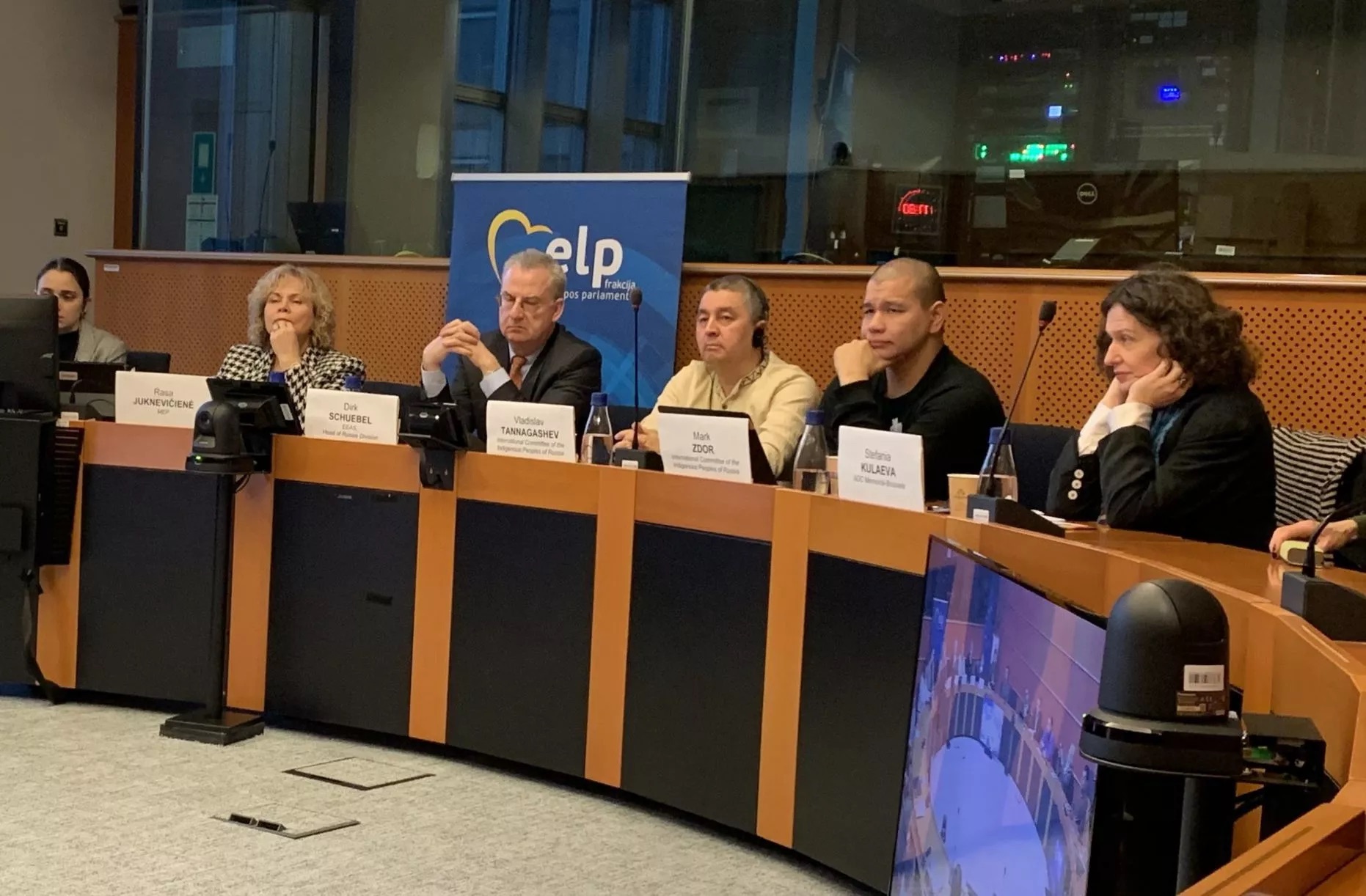
On February 4, 2025, the European Parliament in Brussels hosted a discussion titled “Land Exploitation, Oppression of Peoples: Discrimination and Persecution of Indigenous Peoples of Siberia, the North, and the Far East.” This event was organized by the Anti-Discrimination Center “Memorial” (Brussels) in collaboration with Lithuanian MEP Rasa Juknevičienė. It continued the partnership initiated on October 25, 2023, during the event “Resisting Russian Colonial Pressure: Voices of Different Peoples” held in the European Parliament.
Moderated by Rasa Juknevičienė and Stefania Kulaeva from ADC “Memorial,” the discussion featured speakers including Vladislav Tannagashov, a founding member of the International Committee of Indigenous Peoples of Russia (ICIPR); Mark Zdor, a native of Chukotka, ICIPR member, and anti-war activist; Dirk Schuebel, Head of the Russia Division at the European External Action Service; and Anastasia Crickley, an expert on minority rights and former chair of the UN Committee on the Elimination of Racial Discrimination. The event began with a screening of the first part of the documentary “Shor Gold.”
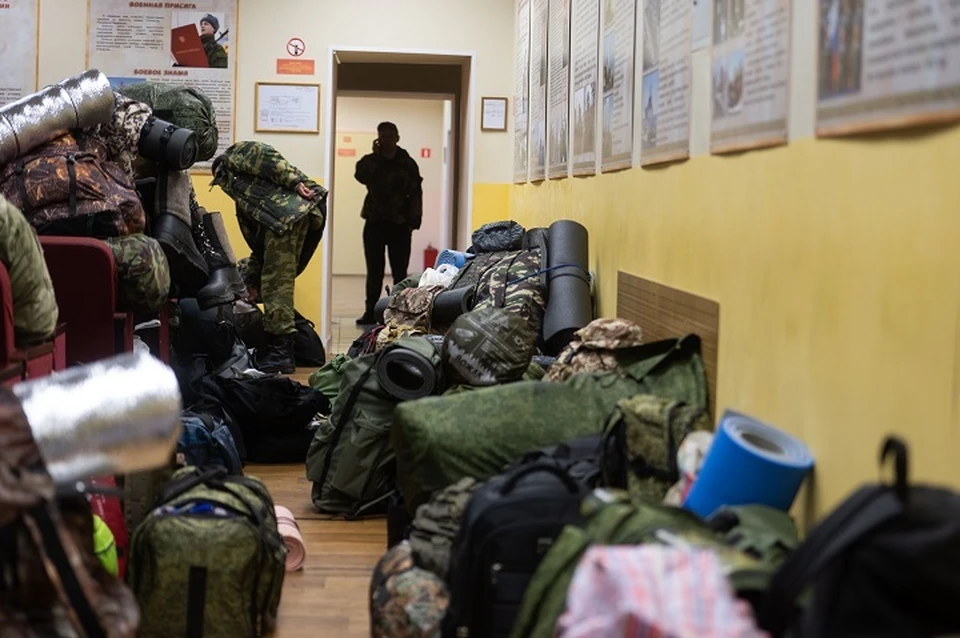
Speakers highlighted their support for Ukraine and condemned Russian aggression. They detailed how Russian authorities are destroying the habitats of indigenous peoples, repressing protesters, and decimating male populations in native villages through mobilization, turning residents into “cannon fodder.” Both primary speakers and other participants emphasized the discriminatory nature of Russia’s national policies, including the suppression of the cultures, languages, and religions of minority peoples.
Dirk Schuebel expressed support for Ukraine and activists opposing Russian aggression, affirming readiness to back such initiatives. MEP Rasa Juknevičienė discussed a European Parliament resolution emphasizing historical responsibility and the connection between history and current issues. She shared her personal experience overcoming Russia’s imperial influence on the Baltic states, fighting for Lithuania’s liberation, and thanked Ukraine for its courage in battling for independence and democracy.
An ADC “Memorial” expert discussed protecting indigenous rights as part of anti-discrimination efforts, expressing support for organizations like the ICIPR, which have been labeled as extremists and terrorists in Russia merely for peaceful advocacy. ADC “Memorial” unequivocally condemns such repression of indigenous rights defenders and minority rights advocates, expressing solidarity with their principled human rights and anti-war stance.
On November 22, 2024, Russia’s Supreme Court designated 172 indigenous groups as “terrorist” organizations, alleging their involvement in promoting secession and supporting Ukraine’s military efforts, as announced by the Prosecutor General’s Office.
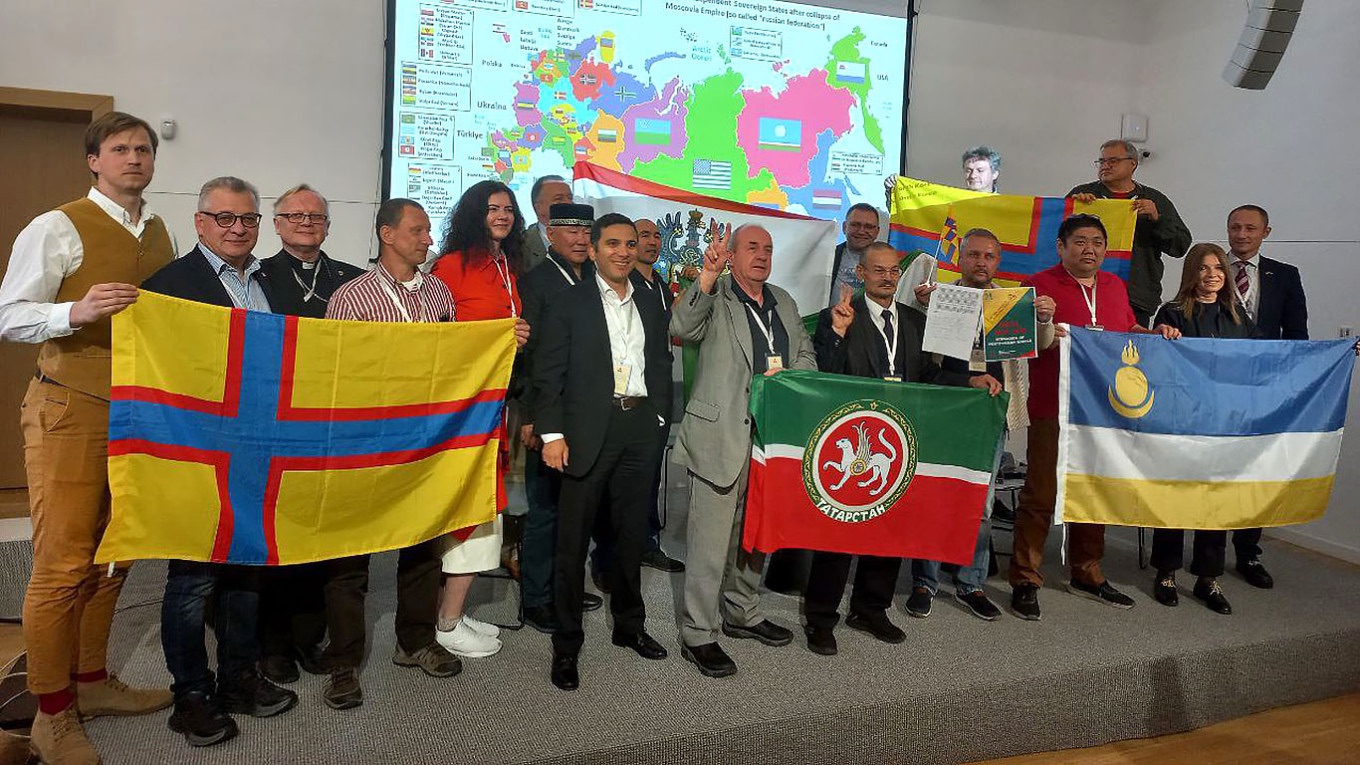
Authorities assert that these groups function as “structural subdivisions” of the Free Nations of PostRussia Forum, a Poland-based entity established in 2022. This forum identifies itself as a platform advocating for the decolonization and division of Russia into 41 independent states.
The Prosecutor General’s Office stated that the organization is led by self-proclaimed leaders of national-separatist movements who have fled abroad, aiming to fragment Russia into smaller states under the influence of “unfriendly countries.”
Previously, in 2023, the Prosecutor General’s Office labeled the Free Nations of PostRussia Forum as an “undesirable organization,” citing threats to Russia’s constitutional order and security, thereby criminalizing any interaction with the forum.
The Supreme Court was scheduled to review the request to classify the forum as a “terrorist organization” on November 14, 2024.
Among the groups listed in the recent ruling are the Baltic Republican Party, the Ingria movement, and the Free Yakutia Foundation—three organizations already labeled “extremist” by Russia’s Justice Ministry earlier this year.
Sargylana Kondakova, co-founder of the Free Yakutia Foundation, an Indigenous rights group from the republic of Sakha (Yakutia), refuted the authorities’ characterization of her organization. She emphasized that the foundation is not part of the Free Nations of PostRussia Forum and does not identify as a nationalist separatist movement. Instead, the foundation focuses on advocating for the rights of Indigenous people in Sakha and combating propaganda within the republic. Kondakova added that while they consider themselves a decolonial movement, their goal is not the partitioning of the Russian Federation into multiple states.
In June 2024, the Supreme Court banned a vaguely defined “anti-Russian separatist movement” as “extremist,” though rights groups have noted the absence of any formally established organization by that name.
Subsequently, Russia’s Justice Ministry labeled 54 Indigenous groups and the U.S.-based Free Russia Foundation as “extremist” organizations.
These actions have raised concerns among Indigenous rights advocates and international observers regarding the suppression of Indigenous movements and the potential infringement on the rights of minority groups within Russia.
In the summer of 2024, human rights advocates from the “Public Radar” project appealed to Russian authorities with a proposal to amend legislation allowing industrial companies to exploit lands traditionally used by Indigenous peoples. This initiative stemmed from complaints by residents of the Khanty-Mansi Autonomous Okrug – Yugra, where oil companies have been building infrastructure on ancestral lands for decades without the owners’ consent.
These ancestral lands, legally known as territories of traditional nature use, are granted to Indigenous peoples for activities like reindeer herding, fishing, and gathering berries and mushrooms. However, these communities do not have ownership rights over the land.
Oil companies, by contrast, operate with few restrictions. Although regional laws require them to coordinate with Indigenous representatives before establishing infrastructure, refusal is not an option. The federal agency Rosnedra issues oil extraction licenses without considering the Indigenous stance. Therefore, negotiations often focus on compensation rather than consent.
If any Indigenous community members refuse compensation and simply ask that no oil extraction occur on their land, the drilling proceeds regardless. The dissenters are told to file complaints, where the legal machinery of the oil corporations works against them.
As a result, many Indigenous communities have resigned themselves to the situation. The bravest only fight for fair compensation, as the oil infrastructure not only occupies their land but often malfunctions, leading to oil spills. In places where oil contaminates the soil, reindeer cannot graze, and berries won’t grow.
A correspondent from “Kedr” visited the ancestral lands in the Surgut district of Yugra to document how corporations are displacing Indigenous peoples from their territories.
This article discusses the current struggles of the Indigenous peoples of Khanty-Mansi Autonomous Okrug: what they are fighting for and their current demands.
We previously covered how the Khanty fought to protect their lands and way of life in past years, even pushing for a referendum to ban the expansion of oil drilling, only to be suppressed by the authorities, in our report “Oil – The Provider”.
Forbidden Territory
“You need to warn me to stop; I might forget and drive you straight to the checkpoint, and no one will get through. Russians aren’t allowed at the camps unless they’re oil workers,” said Anatoly Vandymov, a Khanty man, driving an old car through the taiga. We were headed 150 km from the village of Nizhnesortymsky to Anatoly’s ancestral lands, where he lives with his family and where his two dozen reindeer graze.
Our party included Vandymov, me, and a guide named Oksana, with whom I would navigate the forbidden area. In the 2000s, the company Surgutneftegaz set up checkpoints and began restricting non-Indigenous residents from accessing oilfields and ancestral lands. Initially, this was done at the request of the Khanty themselves, who were frustrated by outsiders hunting and fishing. But over time, these restrictions turned against the Indigenous people: now, the Khanty need Surgutneftegaz’s permission even to visit neighboring ancestral lands where oil is being extracted.
The journey from Nizhnesortymsky to the camp takes about two hours, a trip Vandymov makes several times a week to buy supplies. Anatoly, aged 40, is short and, like many Indigenous people, looks younger than his years. At home, his four children and wife wait for him, while his eldest son has already grown up and found a bride.
Vandymov, like nearly everyone here, works for Surgutneftegaz as an inspector, checking for pipeline ruptures. According to Anatoly, locals are rarely promoted to higher positions within the company, and there’s no other work in Nizhnesortymsky that allows them to maintain their traditional lifestyle. Anatoly adds with a grin that he took the job at Surgutneftegaz to keep an eye on the oil workers and what they do on his land.
In his spare time between shifts—two weeks on, two weeks off—Vandymov fishes, tends to his reindeer, and hunts.
To enter Khanty ancestral lands, we had to pass through the oil company’s checkpoint, located halfway between the village and Vandymov’s lands.
“The guards at the checkpoint are often rude to locals. There was an incident with my younger brother; they wouldn’t let him onto our lands because he was traveling with another Indigenous man whose lands are elsewhere. When my brother asked to see their documents, they told him he ‘wasn’t grown enough to ask for documents’—he’s 22! When he threatened to report their behavior, one of the guards said that if nothing happened after the complaint, he’d beat my brother up. How can they act like this? Whenever we complain or speak to the media, security becomes stricter, and the guards’ rudeness increases,” says Anatoly.
Eventually, the security staff received a disciplinary talk, according to the company. Surgutneftegaz responded to Anatoly’s complaint by saying, “We conducted a preventative conversation with the security guards regarding inappropriate behavior towards citizens.”
Non-Indigenous people who do not work in the oil industry are not allowed past the checkpoint—even to visit Khanty friends. The Khanty believe Surgutneftegaz fears environmentalists or journalists might infiltrate oil extraction zones. Indigenous people from other areas cannot pass the checkpoint without permission from the company’s Indigenous Affairs engineer.
The car stops a couple of kilometres before the security checkpoint. From here, Oksana and I continue on foot through the burned forest, where a fire swept through last year. Our feet sink into the deep moss.
Suddenly, a reindeer appears among the blackened trees. It has strayed from its herd and looks around nervously. Oksana tells me we must catch up and photograph it to find its owner, but the reindeer allows only a distant snapshot before fleeing at the slightest movement.
Reindeer are not just livestock for the Khanty. Their hides are used for clothing, and they pull sleds through deep snow into the taiga.
“Reindeer can live without humans, finding their food, like lichen. But they must be supplemented with grain or fish, and in summer, smoke is used to drive away mosquitoes,” says my guide.
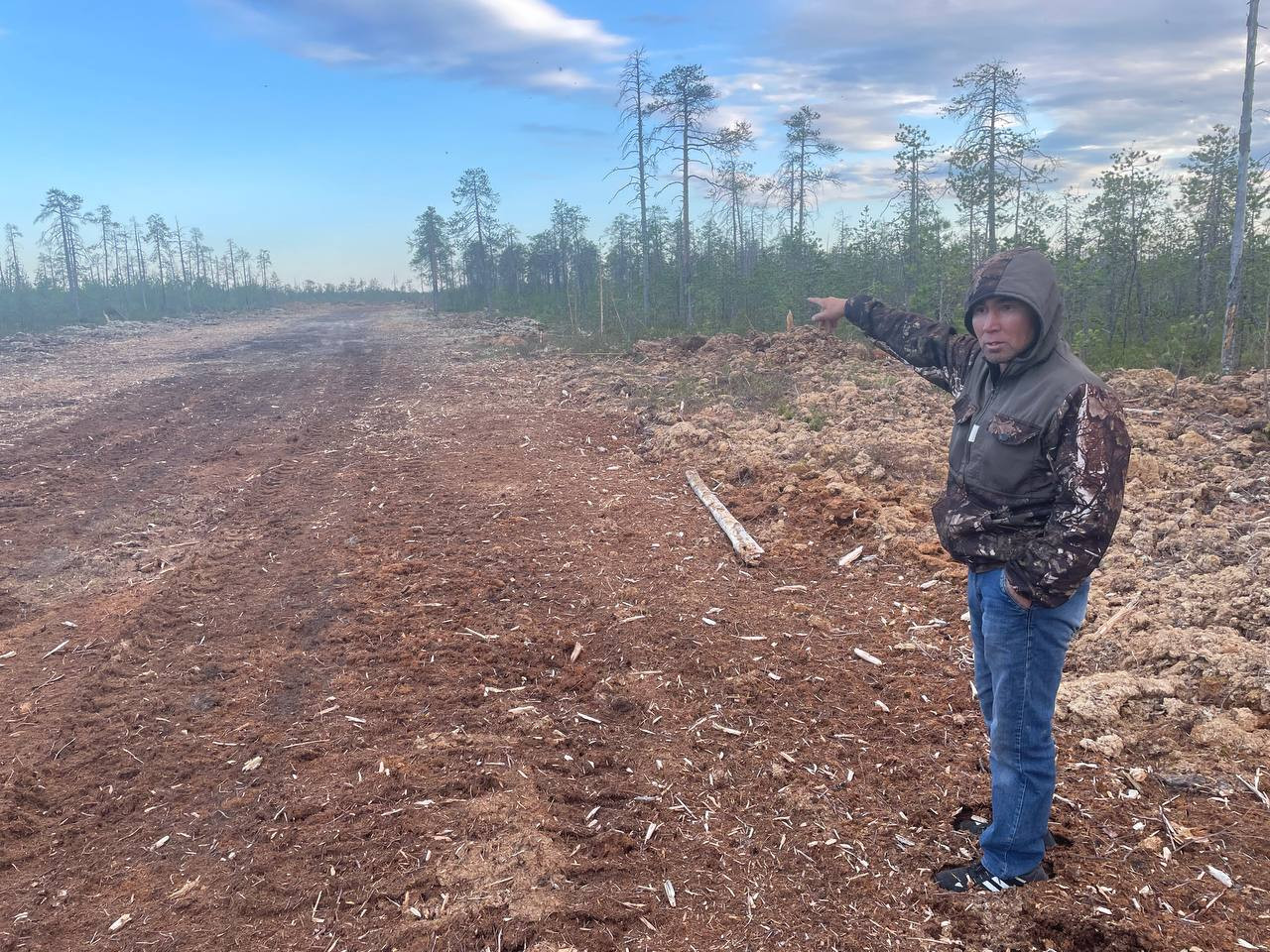
We eventually reach the road where Anatoly is waiting. The drive continues for another hour and a half. This industrial road was built by Surgutneftegaz, and the oil workers often remind locals that they benefit from it, though it wasn’t built for the herders but to transport employees and oil. There are about a hundred exploration wells, cluster pads, oil and gas extraction workshops, pipelines, and gas turbine power stations on Vandymov’s ancestral lands.
Anatoly’s family has held these lands for three generations. He and his wife, mother, and brother’s family tend a herd of twenty reindeer. However, herding is becoming increasingly difficult due to expanding oil extraction.
“We have few reindeer, but it’s hard to manage them because of the roads where they are often hit by cars, and the pollution. We’re forced to move farther away, but we have less and less land.”
The oil workers bury domestic waste and spilled oil products near the well pads. During accidents, oil leaks are supposed to be cleaned up and removed, but the companies cut costs. When there’s a spill, they scrape off the top layer of soil and bury it nearby, contaminating the groundwater, explains Anatoly.
Date: October 8, 2024 Time: 13:30-14:30 Location: Hotel Sofitel Victoria, Warsaw, Opera Room
This event will focus on the severe challenges facing Indigenous peoples in the Arctic zone of Russia, including state repression and environmental devastation by mining companies.
The discussion will be led by Ilya Shumanov, head of the NGO Arctida, alongside independent experts from the Indigenous peoples’ movement. Shumanov will present recent findings from his team, revealing how GONGOs (government-organized NGOs) funded by mining companies like Nornickel, in collaboration with corrupt Indigenous representatives, are lobbying for the removal of international sanctions on these corporations.
Independent experts will provide insights into the real situation on the ground, where traditional lifestyles in the Tundra and Taiga are under threat. Mining operations are destroying the environment, polluting water and air, and making it impossible for Indigenous peoples to continue their traditional practices of hunting, fishing, and gathering. Despite the vast wealth generated by these companies in the Arctic, none of it reaches the Indigenous communities. Those who speak out against this exploitation and destruction are criminalized and branded as extremists by the Russian state.
On August 1, 2024, a study was published by the publication “Important Stories” and the independent analytical group Conflict Intelligence Team. Based on data about payments to military personnel and their families, both teams managed to calculate the number of contract soldiers and mobilized personnel recruited from autumn 2022 to April 2024.
According to these calculations, 4,496 people were mobilized in Khabarovsk Krai.
How many of them were representatives of the region’s indigenous peoples?
We can find the answer to this question in the speech of the President of the Association of Indigenous Peoples of the North of Khabarovsk Krai Lyubov Odzyal. She delivered this speach at an event called “Special military operation: Contribution of the Indigenous Peoples of the North and Far East”, which was held in Moscow on April 30, 2024, as part of the XIX international exhibition and fair “Treasures of the North”. Lyubov Odzyal stated that 200 representatives of the indigenous peoples of the Khabarovsk Territory were mobilized.
According to the 2021 census, the population of the Khabarovsk Territory is 1,292,944 people. The indigenous peoples (Nanai, Negidal, Nivkh, Oroch, Udege, Ulchi, Evenki, Evens) number 21,129 people.
This means that the number of mobilized from the non-indigenous population of the region is approximately 34 people per 10 thousand residents.
As for the indigenous population the number is about 95 per the same 10 thousand.
The numbers speak for themselves. Representatives of the indigenous peoples were indeed taken much more often.
The consequences of this are already visible. In the Udege village of Gvasyugi, only 211 people live according to the census. Five of the mobilized people are now known to have died.
War and disproportionate mobilization are a direct threat to the future of the indigenous peoples of Khabarovsk Krai.
The Russian government talks all the time about the colonialism of IP in other countries but has never said that the IP of the North, Siberia and the Far East were also colonized and continue to suffer. The everyday reality of the Indigenous Peoples of Russia is profoundly different from the rights described by Russian government and some of non-independent Indigenous representatives from Russia.
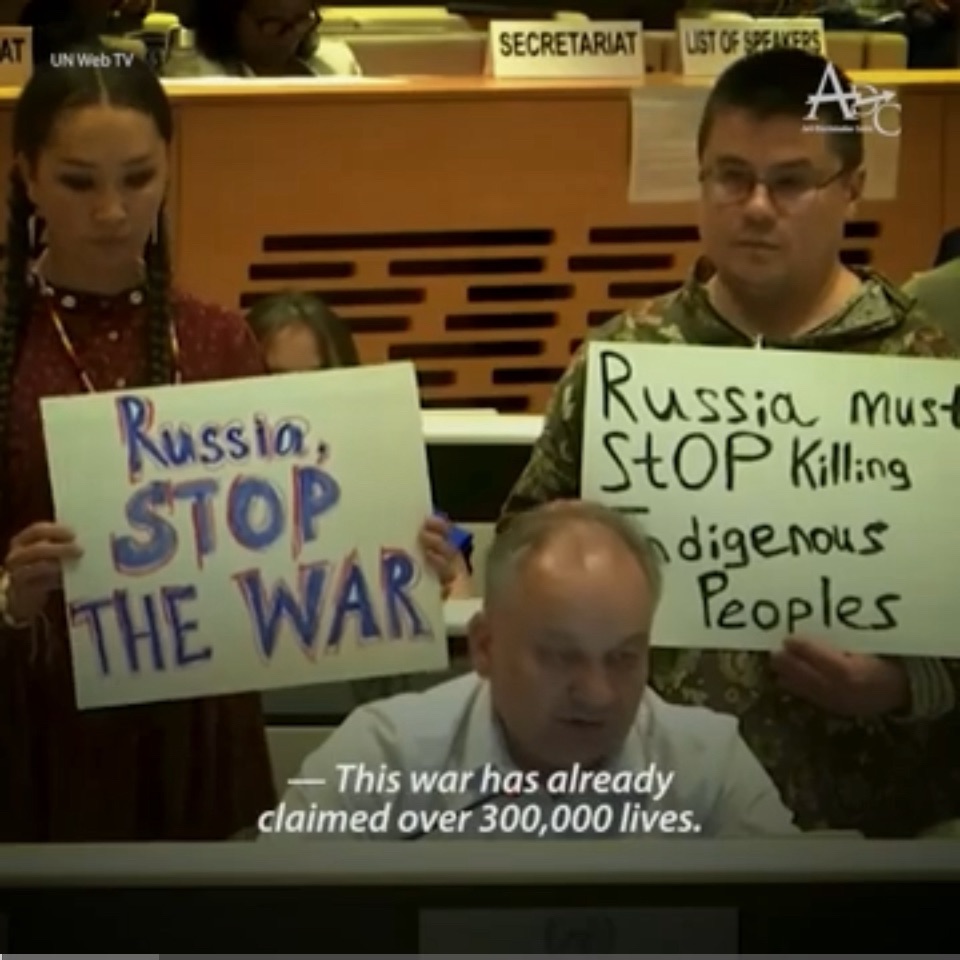
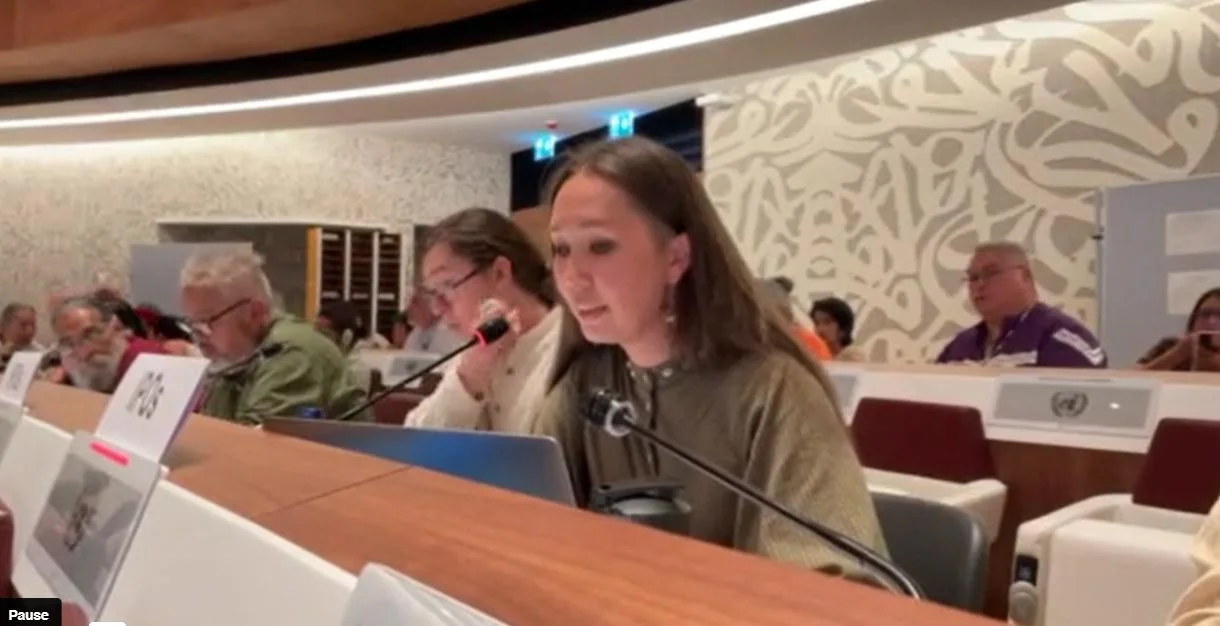
At this time, I am going to speak on behalf of three Indigenous women (Buryat and Sakha Indigenous Peoples of Russia) who applied to attend this session, but for unknown reasons, unfortunately, were denied at the same time and were unable to travel to Geneva, although their tickets had already been purchased. These three strong activists represent anti-war organizations working on decolonial issues and drawing attention to violations of Indigenous rights in Russia and the impact of the war in Ukraine on their communities.
I will read their message.
We, the undersigned Indigenous activists of Russia, are deeply concerned about the current tendency at the UN of Russia’s introducing its representatives into international human rights and Indigenous Rights mechanisms, and we are also very concerned about the exclusion of independent Indigenous voices from Russia from mechanisms such as the UN EMRIP and the PFII.
We were not allowed to attend the 17th session of the EMRIP, but we hope that our voices will still be heard loudly. We believe that preventing independent representatives of Indigenous Peoples of Russia from attending UN sessions is a strong influence of the Russian Federation. Russia is trying to spread its propaganda in every possible way. Those who manage to participate in UN sessions are being pressurized by the Russian authorities in every possible way.
Russia needs the natural resources of Indigenous Peoples. By selling it, the country earns billions of dollars to wage wars, to maintain a high level in the capital, to generously feed the power structures and keep the oligarch class and the elite loyal. Unfortunately, some Indigenous People’ representatives fall under such influence. Such Indigenous representatives become a tool of Russia’s propaganda.
We call on the EMRIP, the PFII, the VF, UN treaty bodies, and the Special Rapporteur on the Rights of Indigenous Peoples to pay special attention to the representation of Indigenous Peoples of Russia, and we ask for ensuring the full and unhindered participation of independent Indigenous representatives in all future processes. It is very strange that the Association of the IP of Yamal made the same statement twice today. But nobody from independent indigenous from Russia.
We believe in the independence and commitment of UN mechanisms to freedom, inclusiveness, universality in the protection of Human Rights and the Rights of Indigenous Peoples.
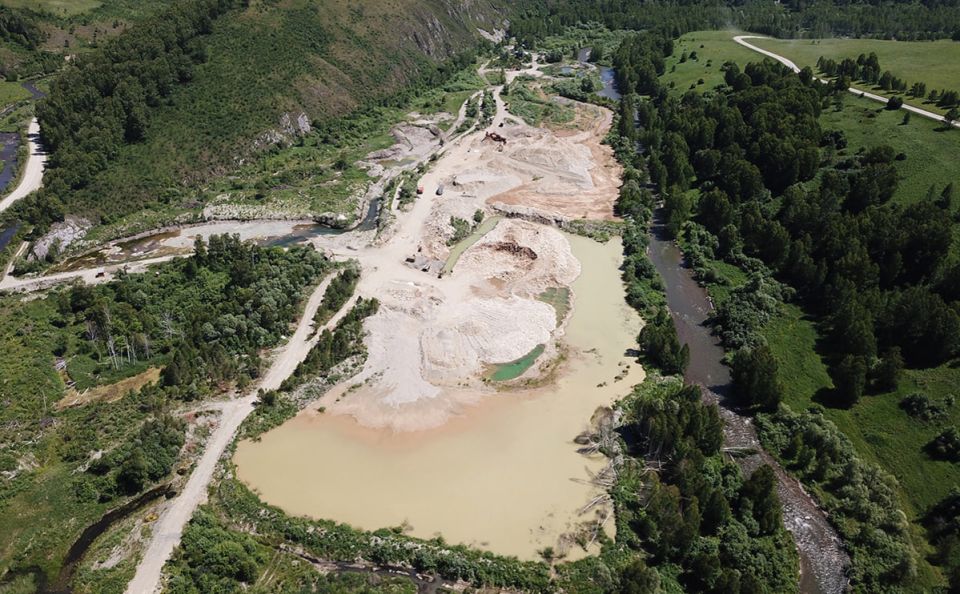
In June, 231 cases of river pollution caused by suspended substances downstream from placer gold mining sites were documented on the Siberian and the Far East rivers. This pollution extended over 10,761 kilometres, as reported in an interim analysis by the Center for Satellite Monitoring and Civil Control (CSMiGK) available to the “Zolotari” project. Environmentalists describe it as the most extensive pollution from gold mining activities observed in recent years.
As mentioned by Kedr.Media and AlexanderKolotov, the satellite images decrypted and analyzed by CSMiGK specialists revealed that between June 1 and June 30, there were 105 cases of river pollution in the Amur region, spanning 3,352 kilometres; 43 cases in Krasnoyarsk Krai, covering 2,750 kilometres; 36 cases in the Kemerovo region, covering 2,909 kilometres; 27 cases in Zabaykalsky Krai, spanning 1,444 kilometres; 14 cases in the Jewish Autonomous Region, covering 266 kilometres; and 6 cases in Khabarovsk Krai, spanning 40 kilometres.
“The extensive nature of these environmental violations on the gold-bearing rivers of Siberia and the Far East clearly shows that greed is triumphing over nature, and the state has yet to counter this,” commented Alexander Kolotov, director of the “Conservation of Siberia and the Far East” foundation, regarding the satellite monitoring results. “If hundreds of gold mining licenses are issued each year without the ability to monitor their use, the outcome is predictable: isolated inspections and fines simply lose their effectiveness.”
Kolotov explained that as placer gold mining became highly profitable due to rising gold prices, gold miners largely ignored environmental restrictions, assuming that the potential profits would more than cover any fines. “This is why we see murky streams stretching downstream from gold mines for tens of kilometres almost without interruption in the satellite images,” noted the environmentalist. “This situation can only occur when gold mining waste is intentionally discharged into the river without regard for environmental oversight by the state.”
From May 15 (the start of satellite monitoring) to June 30, the Center for Satellite Monitoring and Civil Control recorded a total of 308 instances of river pollution with suspended substances downstream from placer gold mining sites, with the total length of identified pollution reaching 13,544 kilometres.
Also, it is important to heed this observation by environmentalists: “Murky streams extend downstream from gold mines for tens of kilometres almost uninterrupted,” as noted by the environmentalist. “This is only possible when gold mining waste is intentionally discharged into the river without any consideration for environmental oversight by the state.” Another significant statement is: “Gold miners have largely stopped complying with environmental regulations because they anticipate that potential profits will outweigh any fines.”
This means a long-term loss of drinking water and fish in these rivers for indigenous peoples. And not just during the years when gold mining cooperatives are active on the rivers, but for hundreds of years. Fish cannot reproduce in murky streams. As is well known, the fish stocks of Alaska’s gold-bearing rivers that do not flow into the sea have not recovered since the gold rush.
Therefore, it is no surprise that Rosprirodnadzor (Federal Service for Supervision of Natural Resources of the Russian Federation) imposed such a large fine on Norilsk Nickel, with the largest portion attributed to potential damage to aquatic biological resources.
It’s easier to deal with a large violator who is always in the public eye. But gold mining cooperatives are only fined small amounts, and only after the discovery of some pipe discharging waste into the river. This is one of thousands of such pipes. And it’s generally difficult to detect and prove the mass instances of machinery entering the rivers.
However, the Center for Satellite Monitoring and Civil Control has recorded hundreds of violations and thousands of kilometres of murky water in rivers downstream from licensed sites.
This is a serious reason for indigenous peoples, along with concerned local populations, to appeal to the Government and the State Duma with a demand to improve the relevant laws on placer gold mining. These laws should regulate the issuance of hundreds of licenses and prevent the mass pollution of rivers, which causes enormous and potentially long-term damage to aquatic biological resources and the nation’s food security.
Many regional indigenous organizations and local environmental groups from Murmansk to Kamchatka could support such a public initiative.