Tag: repressions

  • Dmitry Berezhkov. A Time of Cowards and Scoundrels

    Dmitry Berezhkov. A Time of Cowards and Scoundrels

    Photo by Sergey Gavrilov

    We are living in strange times.

    Today, what was used to be an unquestionable truth—such as the slogans “No to war” or “Peace to the world”—is now called a crime by many. What was once considered an absolute priority—respect for the individual and for human rights—is today portrayed by many as an anachronism, a relic of the past, or a liberal conspiracy.

    What was once regarded as a moral duty—to stand up for those subjected to political repression—is now declared a violation of state foundations. Silence and obedience to political diktat are presented as “responsibility.” Refusal to help those unjustly persecuted is framed as a “balanced position.”

    Murderers are turned into “heroes.” Scoundrels and villains become moral authorities.

    A few days ago, after a month and a half of silence, Alexander Novyukhov, President of RAIPON—the Association of Indigenous Small-Numbered Peoples of the North, Siberia and the Far East of the Russian Federation—finally commented on the December arrests in Moscow of Indigenous human rights defenders.

    Among those arrested was Daria Egereva—a person widely known in the international Indigenous community for its consistent human rights work within the United Nations system, including on climate change, biodiversity, and the rights of Indigenous women.

    Today, Daria is in prison. Essentially, for the fact that for many years she openly, in good faith, and professionally did her job—defending the rights of Indigenous small-numbered peoples, one of the most vulnerable and marginalized groups in Russia.

    I have known both Dasha and Sasha Novyukhov for many years. Once, we all began as young activists in the Indigenous movement: Dasha in Tomsk, Novyukhov in Khanty-Mansiysk, and I in Kamchatka. We were full of enthusiasm and hope that we—the young generation of Indigenous peoples—could change life for the better, could ensure that our peoples would be able to live fully the way of life passed down to us by our ancestors: freely fishing, hunting, herding reindeer on ancestral lands, without the oppression of state bureaucracy, without constant humiliation by officials and predatory businessmen.

    Twenty-five years ago, RAIPON was a unifying political force for the Indigenous small-numbered peoples of the Russian North. It was an organization that took a principled stand in defense of Indigenous rights—both within Russia and at the international level.

    We, representatives of what was then the young generation of Indigenous peoples, lived in a time when Russia still adopted federal laws that did not diminish our peoples’ rights, but rather systematically developed their legal status in line with international law.

    However, Alexander Novyukhov already stood out back then from us—young activists who entered the Indigenous movement out of conviction. From the very beginning, he chose a different path: combining public activism with building a career within the state power structure.

    This path is indeed rational for a careerist: participation in public movements provides visibility and access to high-ranking officials, while a state career, in turn, strengthens one’s position within Indigenous organizations themselves. Judge for yourself:

    • 1999–2001:  Deputy Chairman of the Committee for Indigenous Peoples of the North, Berezovsky District Administration, Khanty-Mansi Autonomous Okrug–Yugra
    • 2001–2003:  Head of the Department for Regulation of Relations with Subsoil Users, Committee for Indigenous Peoples of the North, KhMAO–Yugra
    • 2003–2008:  Assistant to the Deputy Chairman of the Government of KhMAO–Yugra on Indigenous Affairs, Governor’s Administration
    • 2008–2011:  Assistant to the Deputy Chairman of the Government of KhMAO–Yugra, Governor’s Office
    • 2011–2016:  Advisor to the First Deputy Governor of KhMAO–Yugra
    • 2016–2021:  Deputy of the Duma of KhMAO–Yugra from the  United Russia  party
    • 2021–present:  Member of the Federation Council of the Russian Federation from KhMAO–Yugra

    And in parallel:

    • President of the regional Indigenous organization  Saving Yugra  (2001–2016)
    • Vice President of RAIPON (2016–2021)
    • First Vice President of RAIPON (2021–2025)
    • President of RAIPON since April 2025

    A perfect bureaucratic ladder in Putin’s Russia. Novyukhov has always consistently voted at meetings—no matter which ones—in favor of all government initiatives, and has successfully blocked public initiatives that displeased the authorities.

    In addition, he successfully built financial relationships with oil companies in the Khanty-Mansi region—the richest oil-producing region in Russia.

    But his most terrible crime is not even this.

    Alexander Novyukhov bears direct responsibility for the war in Ukraine and for the deaths of hundreds of thousands of people, including thousands of Indigenous people on both sides. As a senator of the Federation Council, Novyukhov voted  in favor  of the invasion in February 2022— “Russia Votes to Use Troops Abroad After Separatist Recognition” .

    Moreover, the leadership of RAIPON—where Novyukhov was First Vice President at the time—went even further and issued a separate statement supporting President Putin’s decision to invade Ukraine, titled  “RAIPON supports the decision of President Putin to start the war in Ukraine ,” which was also signed by Alexander Novyukhov.

    And today, this man—whose hands are stained with the blood of innocents, women, children, and his own Indigenous kin killed in this war—lectures us about the “presumption of innocence and fair decisions”? About his work “to ensure sustainable development and the protection of special constitutional rights of Indigenous peoples of Russia”?

    There is hardly any point in analyzing Novyukhov’s statement regarding Daria Egereva’s arrest in detail—almost every line of it is false and propagandistic, turning into truth and truth into lies. One example is enough: the claim that  “Indigenous peoples have freely developed within the Russian state for many centuries” —as if centuries of colonial domination of Siberia and the Arctic by the Russian Empire never existed.

    However, I want to dwell on one particular moment—Novyukhov’s assertion that  “the Association has no moral right to defend people suspected of ties with organizations officially recognized as extremist.”

    In July 2024, Russian authorities designated  55 organizations  working in the field of Indigenous and minority rights as extremist, falsely labeling them as “branches” of a fabricated  “Anti-Russian Separatist Movement.”  The same tactic was previously used with the fictitious  “International LGBT Movement.”

    Once again: such organizations  do not exist . They were entirely invented by the Russian Ministry of Justice and the FSB to facilitate mass repression.

    Our organization—the  International Committee of Indigenous Peoples of Russia (ICIPR) —was included in that list. We issued a public statement and, together with dozens of Indigenous organizations worldwide, submitted an appeal to the UN stating that the mass criminalization of Indigenous organizations constitutes a blatant violation of international law and opens the door to further repression.

    Later in 2024, the list was expanded:  172 organizations , including ICIPR and the Indigenous activist network  Aborigen Forum , were reclassified as terrorist organizations.

    Many of these organizations, operating abroad, openly speak about independence from Russia and about Russia’s continued imperial nature.

    We never did.

    Even today, as political exiles forced to flee Russia, ICIPR members have  never  advocated independence. On the contrary, Pavel Sulyandziga—one of the most well-known Indigenous leaders—has repeatedly stated that he does not support separatism or the “collapse of Russia.”

    Yes, we speak of  self-determination . As all Indigenous peoples of the world do. This principle is enshrined in core UN documents.

    Russia abstained from voting on the UN Declaration on the Rights of Indigenous Peoples—but voted  in favor  of the 2014 UN General Assembly Outcome Document on the World Conference on Indigenous Peoples, thereby recognizing the Declaration and committing to its principles.

    This is what self-determination means: consultation, consent, respect for Indigenous ways of life. For a city dweller, a pipeline is just a line on a map. For a reindeer-herding community, it can be a death sentence.

    This is what we spoke about. This is what  Aboriginal Forum  spoke about at the UN.

    And Novyukhov knows all of this perfectly well.

    He knows that the Russian authorities deliberately lumped together Indigenous activists inside Russia with political movements abroad simply to find scapegoats—unable to reach some, they struck the most vulnerable.

    And making his lying, immoral statement, the scoundrel and villain Alexander Novyukhov knew exactly what he was doing.

    We live in a time of scoundrels and villains. And that is our tragedy.

    Dmitry Berezhkov

    Source

  • Russia’s Supreme Court designated 172 indigenous groups as “terrorist” organizations
    Russia’s Supreme Court designated 172 indigenous groups as “terrorist” organizations

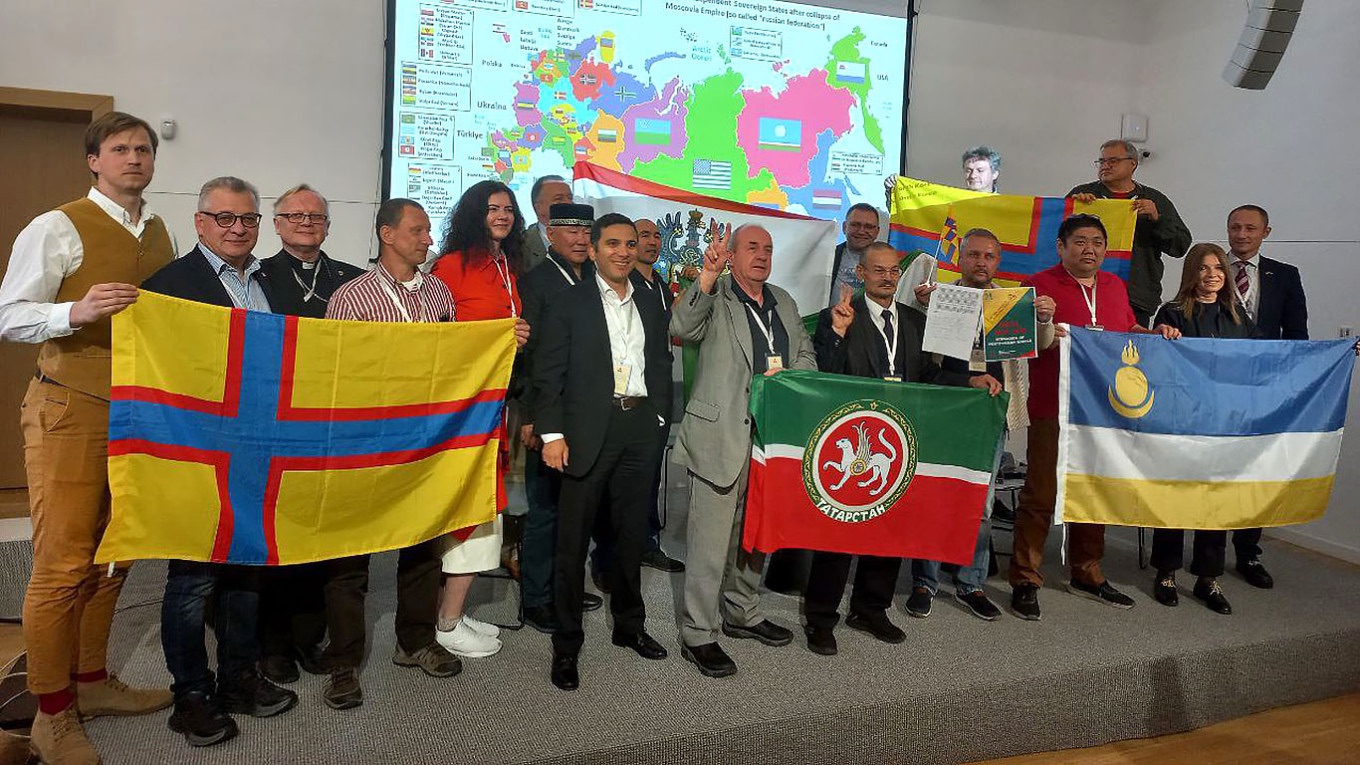
    On November 22, 2024, Russia’s Supreme Court designated 172 indigenous groups as “terrorist” organizations, alleging their involvement in promoting secession and supporting Ukraine’s military efforts, as announced by the Prosecutor General’s Office.

    Authorities assert that these groups function as “structural subdivisions” of the Free Nations of PostRussia Forum, a Poland-based entity established in 2022. This forum identifies itself as a platform advocating for the decolonization and division of Russia into 41 independent states.

    The Prosecutor General’s Office stated that the organization is led by self-proclaimed leaders of national-separatist movements who have fled abroad, aiming to fragment Russia into smaller states under the influence of “unfriendly countries.”

    Previously, in 2023, the Prosecutor General’s Office labeled the Free Nations of PostRussia Forum as an “undesirable organization,” citing threats to Russia’s constitutional order and security, thereby criminalizing any interaction with the forum.

    The Supreme Court was scheduled to review the request to classify the forum as a “terrorist organization” on November 14, 2024.

    Among the groups listed in the recent ruling are the Baltic Republican Party, the Ingria movement, and the Free Yakutia Foundation—three organizations already labeled “extremist” by Russia’s Justice Ministry earlier this year.

    Sargylana Kondakova, co-founder of the Free Yakutia Foundation, an Indigenous rights group from the republic of Sakha (Yakutia), refuted the authorities’ characterization of her organization. She emphasized that the foundation is not part of the Free Nations of PostRussia Forum and does not identify as a nationalist separatist movement. Instead, the foundation focuses on advocating for the rights of Indigenous people in Sakha and combating propaganda within the republic. Kondakova added that while they consider themselves a decolonial movement, their goal is not the partitioning of the Russian Federation into multiple states.

    In June 2024, the Supreme Court banned a vaguely defined “anti-Russian separatist movement” as “extremist,” though rights groups have noted the absence of any formally established organization by that name.

    Subsequently, Russia’s Justice Ministry labeled 54 Indigenous groups and the U.S.-based Free Russia Foundation as “extremist” organizations.

    These actions have raised concerns among Indigenous rights advocates and international observers regarding the suppression of Indigenous movements and the potential infringement on the rights of minority groups within Russia.

  • THE STATEMENT OF THE INTERNATIONAL COMMITTEE OF INDIGENOUS PEOPLES OF RUSSIA (ICIPR) REGARDING THE INCLUSION OF 55 ASSOCIATIONS IN THE LIST OF “EXTREMIST ORGANIZATIONS”
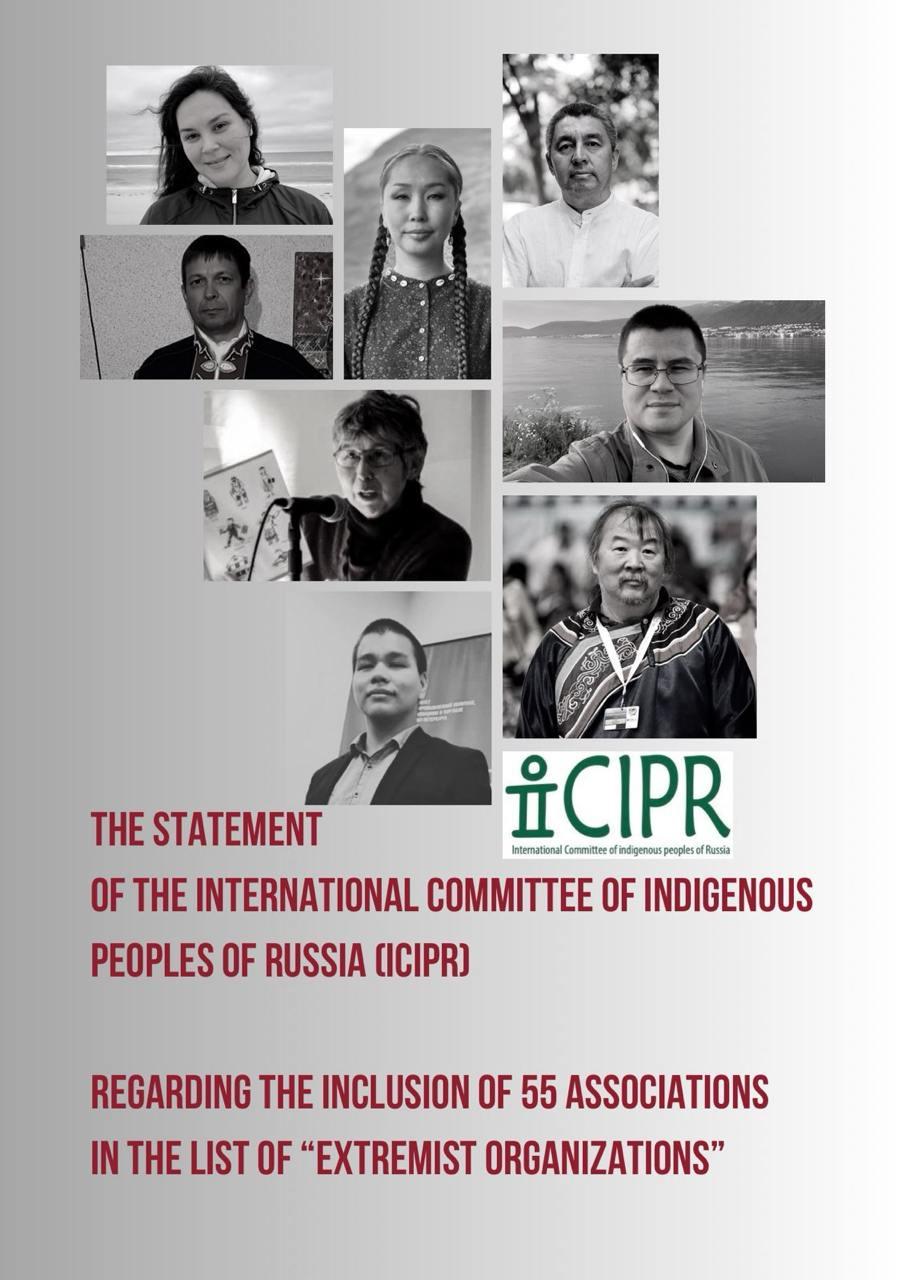
    THE STATEMENT OF THE INTERNATIONAL COMMITTEE OF INDIGENOUS PEOPLES OF RUSSIA (ICIPR) REGARDING THE INCLUSION OF 55 ASSOCIATIONS IN THE LIST OF “EXTREMIST ORGANIZATIONS”

    The International Committee of Indigenous Peoples of Russia (ICIPR) expresses extreme concern and indignation over the inclusion of 55 indigenous peoples’ organizations, national minorities, decolonial, and other associations in the list of “extremists” by the Ministry of Justice of the Russian Federation.

    Aborigen-Forum, an informal association of independent experts, activists, leaders, and public organizations of the indigenous small-numbered peoples of the North, Siberia, and the Far East, also appeared in the list.

    The list also includes the International Committee of Indigenous Peoples of Russia (ICIPR), according to the publication on the website of the Ministry of Justice of the Russian Federation.

    Earlier, we expressed concern when, on June 7, the Supreme Court of Russia, at the request of the Ministry of Justice of the Russian Federation, recognized the so-called “Anti-Russian Separatist Movement” as an extremist organization. We feared that, since such an organization does notify exist and the wording is very broad, any organization criticizing the Russian authorities could be included under this decision.

    Now it is evident how this decision is being implemented. The organizations defending the rights of indigenous peoples are being included into the list of the “extremist” organizations.

    Andrey Fedorkov, the lawyer who collaborates with the human rights project Support for Political Prisoners. Memorial, comments for Idel.Realii:

    Currently, anyone who displays any symbols of their region, used by any organization advocating for the freedom and independence of their region, is at risk. This includes anyone who distributes relevant materials or provides links related to this topic.

    We can see how absurd the application of the law is. My prediction is that a significant number of criminal cases will follow based on these articles.

    Our committee also sees this as a reaction from the Russian government to the participation of indigenous movements in international platforms, such as the UN.

    Just two weeks ago (July 8-12, 2024), a session of the UN Expert Mechanism on the Rights of Indigenous Peoples (EMRIP) concluded in Geneva, where members of our organization raised issues of human rights violations against indigenous peoples in Russia, as well as Russia’s influence on UN bodies.

    Additionally, shortly before the UN session, ICIPR published a report on the Association of Indigenous Peoples of the North, Siberia, and the Far East of the Russian Federation (RAIPON), which is controlled by the Russian government.

    • It is important to note that immediately after the EMRIP session in 2022, Russia blocked our website iRussia.

    • In 2023, after the EMRIP session, ICIPR member and indigenous human rights defender Pavel Sulyandziga was added to the list of foreign agents.

    • And now, in 2024, after the EMRIP session, we have been included in the “extremist” list.

    WE SEE THAT THE REPRESSIVE MACHINE IS GATHERING MOMENTUM.

    THE METHODS OF PERSECUTION AGAINST INDIGENOUS RIGHTS ACTIVISTS ARE INTENSIFYING.

    The International Committee of Indigenous Peoples of Russia (ICIPR) is an international organization of indigenous peoples, established in March 2022 as a response by several leaders and activists of indigenous peoples of Russia to the onset of the war in Ukraine.

    All founding members of ICIPR were previously activists or community leaders of indigenous peoples in Russia and were forced to leave the country for various political reasons.

    The aim of ICIPR is to promote the rights of indigenous peoples of the Russian Arctic, Siberia, and the Far East to their traditional lands, resources, and self-determination at national and global levels during wartime and amidst political repression in Russia.

    WE, representatives of the indigenous small-numbered peoples of the North, Siberia, and the Far East, are deeply alarmed by our inclusion in the “extremist list.” We express our extreme concern regarding the protection of indigenous peoples’ rights in this situation.

    WE, as representatives of the indigenous peoples of Russia, stand in solidarity with other associations that have also been included in this list.

    WE call upon all international organizations, NGOs, as well as intergovernmental, scientific, and human rights bodies, including the UN, the Council of Europe, and the Arctic Council, to CONDEMN the decision of the Ministry of Justice of the Russian Federation to include 55 organizations in the “extremist” list.

    WE ASK FOR SUPPORT IN THE STRUGGLE OF THE INDIGENOUS PEOPLES OF RUSSIA FOR THEIR RIGHTS.

    Translated from