UN summit in New York hears how resources needed for sustainable energy threaten Indigenous land and people
World Indigenous leaders meeting this week at an annual UN summit have warned that the west’s climate strategy risks the exploitation of Indigenous territories, resources and people.
New and emerging threats about the transition to a greener economy, including mineral mining, were at the forefront of debate as hundreds of Indigenous chiefs, presidents, chairmen and delegates gathered at the 22nd United Nations Permanent Forum on Indigenous Issues.
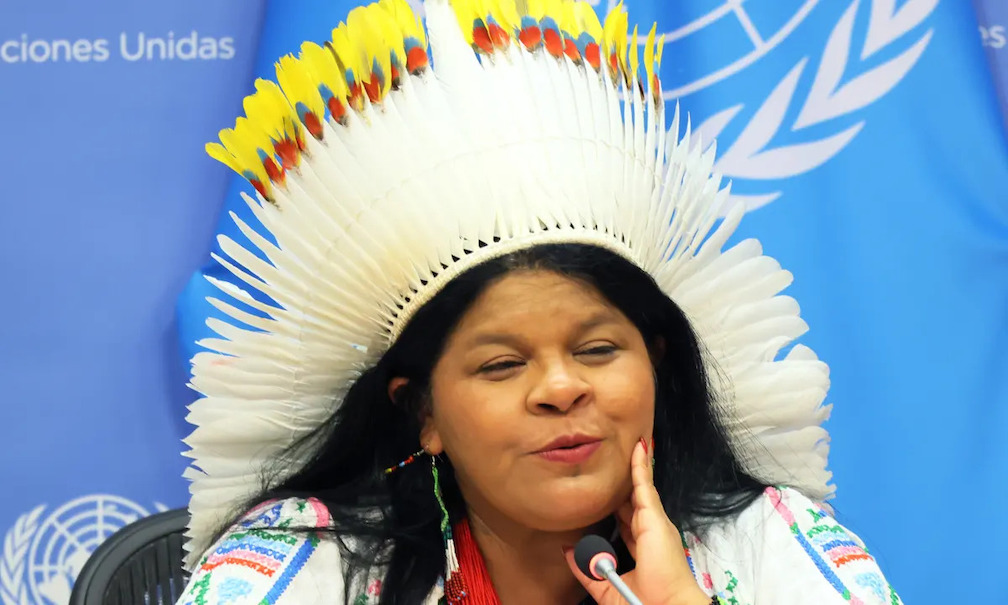
“It is common to hear the expression to ‘leave no one behind’. But perhaps those who are leading are not on the right path,” the forum’s chairman, Dario Mejía Montalvo, told delegates on Monday as the 12-day summit opened in New York in the first full convening since the pandemic outbreak.
The longtime advocacy group, Cultural Survival, in partnership with other organizations, highlighted how mining for minerals such as nickel, lithium, cobalt and copper – the resources needed to support products like electric car batteries – are presenting conflicts in tribal communities in the United States and around the world.
As countries scramble to uphold pledges to keep global warming to 1.5C (2.7F) above pre-industrial levels by 2030, big business and government are latching on to environmentally driven projects such as mineral needs or wind power that are usurping the rights of Indigenous peoples – from the American south-west to the Arctic and the Serengeti in Africa.
Let us not forget that climate is the language of Mother Earth
Dario Mejia Montalvo
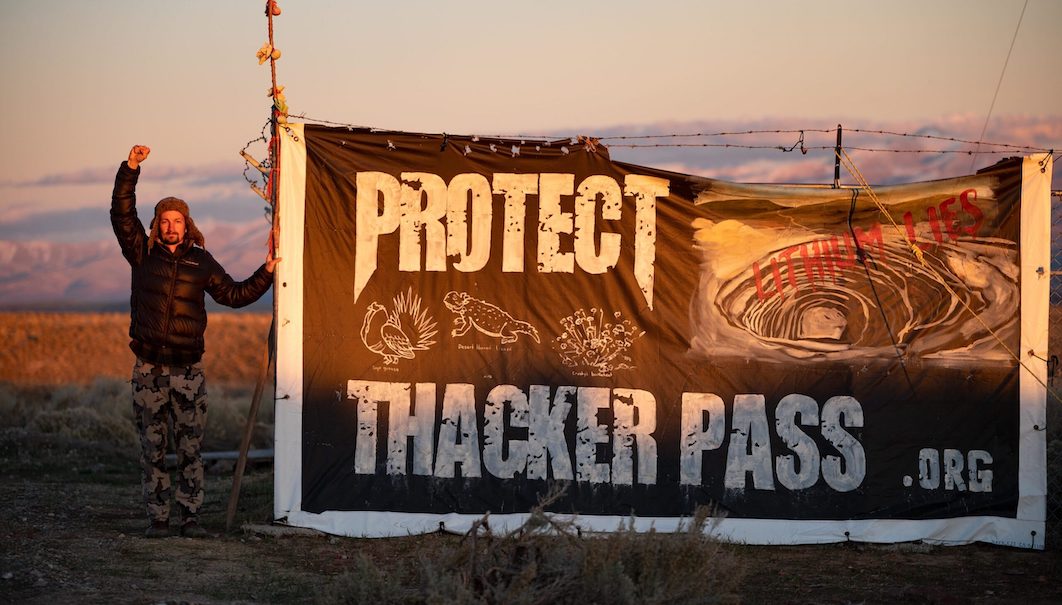
Brian Mason, chairman of the Shoshone-Paiute Tribes of the Duck Valley Indian reservation in Nevada said that the 70 or so lithium mining applications targeting Paiute lands have come without free, prior and informed consent – what is considered the cornerstone of the UN Declaration on the Rights of Indigenous Peoples. He described the lithium extraction efforts as being on a “fast track” to supply the Biden administration’s net-zero strategy to create a domestic supply of EVs . “It’s kinda just being rammed down our throats,” he said. “At the cost of Indigenous peoples once again.”
During a special panel discussion, Edward Parokwa, executive director of the Pastoralists Indigenous Non-Governmental Organization (Pingo’s Forum), said a mass migration has ensued of thousands of Maasai violently displaced from their Tanzania homelands to make way for a luxury game reserve – and under suspicions and fear of mobile phone surveillance by the United Arab Emirates. A UAE-based company is believed to be behind the big game hunting operation. “And it’s happening in the name of conservation,” Parokwa said, accusing the Tanzanian government of trying to deflect global criticism for the project, particularly ahead of Cop28 UN climate talks slated for later this year in Dubai.
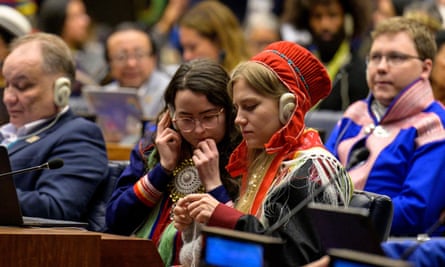
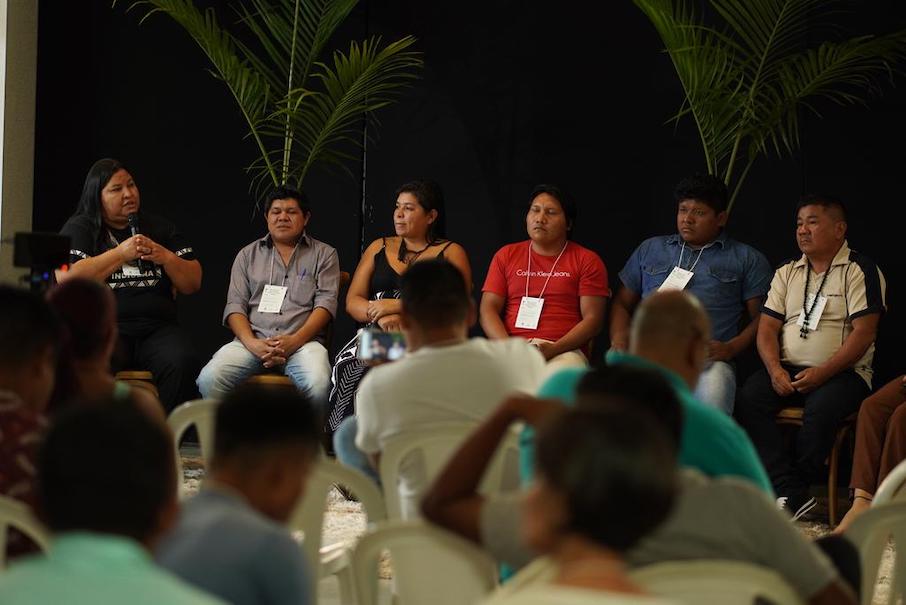
Attendees listen during the 22nd session of the Permanent Forum on Indigenous Issue at the United Nations headquarters in New York City on 20 April 2023. Photograph: Angela Weiss/AFP/Getty Images
Gunn-Britt Retter of the Saami Council, an organization representing the Sami peoples of Finland, Russia, Norway and Sweden, said she had been raising awareness about what she calls the “green colonialism” driving harmful sustainability projects on Sami and Indigenous lands. The most recent example has been the Fosen onshore windfarm that was built despite a supreme court ruling in Norway in defense of Sami reindeer herding grounds.
“They look to us to carry the heaviest burden and it’s a disproportionate part of the burden,” she said of Indigenous peoples caught in the middle of a climate conundrum. “We need to reduce CO2 emissions globally, and we need to seek alternative energy sources, but we also need to protect the Indigenous cultures because we are the guardians of nature, which is part of the solution.”
Mejía Montalvo, who belongs to the Zenú peoples of San Andrés Sotavento in Colombia, said global climate talks have failed to properly include Indigenous peoples, yet at the same time, such dialogue has relied on a well of Indigenous knowledge systems to imagine future climate goals. “The issue of climate change and biodiversity cannot be resolved without the real and effective participation of Indigenous peoples.”
He urged the 193 member states affiliated with the UN, as well as its international governing bodies, to set a quota for actions that guarantee Indigenous peoples can take part in decisions affecting our planet, and in a way that puts them “on equal footing” with states – meaning, voting power, which Indigenous peoples lack.
The most recent example of the disparity came last fall in the historic “loss and damage” fund for vulnerable countries reached at Cop27 in Egypt. Indigenous peoples lacked explicit reference in the agreement, despite many world leaders, including the US president, Joe Biden, acknowledging the importance of Indigenous peoples in mitigating and adapting to climate change.
But there has been progress. The rights-based Paris agreement within the UN Framework Convention on Climate Change (UNFCCC) – the environmental treaty to combat the climate crisis – has provided a rare opportunity for formal Indigenous participation in the creation of the Local Communities and Indigenous Peoples’ Platform (LCIPP). The constituent body held its first meeting as a recognized working group in 2019, and engaged in dialogue with the Cop presidency last year in Sharm El-Sheikh.
Of the short cast of international leaders who spoke at the start of the global event on Monday was the first ever appearance by a UN secretary general, António Guterres, at a permanent forum opening ceremony. Also present was Deb Haaland, US interior secretary and tribal citizen of the Pueblo of Laguna, who received a standing ovation following her remarks where she acknowledged a litany of historic injustices against Indigenous peoples and a collective need to heal, saying Indigenous peoples must be brought into the fold in global human rights decision-making.
Lahela Mattos of Ka’Lāhui Hawai’i and a representative of the Global Indigenous Youth Caucus, urged the permanent forum chair to work with UN agencies like the World Health Organization to develop and implement comprehensive policies to better protect the safety of Indigenous women and girls as a way to protect the planet. “The destruction of and violence committed against our Earth Mother perpetuates, violence against Indigenous peoples, specifically Indigenous women who are protectors and bearers of life on this planet.”
The recommendation regarding “environmental violence” on Indigenous women and girls was first featured in a recent human rights treaty body outcome and represents one of the first fundamental links between human rights abuses and environmental catastrophe – a connection that most stakeholders grappling with the climate crisis have yet to make.
“Let us not forget that climate is the language of Mother Earth,” said Mejía Montalvo.
Indonesia’s Ambition to Become a Big Player of Electric Vehicles
Profit for Industry Players, Profit for the People
President Jokowi’s ambition to make Indonesia a big player in electric vehicles is a big threat to the safety of citizens and the environment in the Sulawesi and Maluku Islands, to West Papua. Furthermore, the accelerated production of electric vehicles will also trigger an expansion in the demolition of coal-rich islands, such as Kalimantan.
As is known, President Jokowi has held a business meeting with three giant companies from Europe, starting from BASF, Eramet, to Volkswagen on Sunday, April 16, 2023, German time.
BASF—a company engaged in the chemical sector, will partner with a French multinational mining and metallurgical company, Eramet, to build a factory in favor of raw materials for electric batteries in Central Halmahera, North Maluku.
Meanwhile, Volkswagen through its subsidiary, PowerCo, will invest by collaborating with PT Vale Indonesia (INCO), US car manufacturer Ford Motor Co, and Zheijiang Huayou Cobalt from China to build an electric vehicle battery ecosystem in South Sulawesi. In addition, PowerCo will invest with other portfolios together with Eramet and Kalla Group for the development of the electric vehicle ecosystem, as well as working with Merdeka Copper (MDKA) for a nickel downstream project into electric batteries.
Eramet’s Awful Footprints in Central Halmahera The investment plan from BASF, which cooperates with Eramet, with an investment value of up to US$ 2.6 billion (Rp 38.39 trillion) to build an electric vehicle battery industry in North Maluku. In addition, BASF and Eramet claim to implement industrial practices that pay attention to ESG (Environment, Social and Governance) aspects.
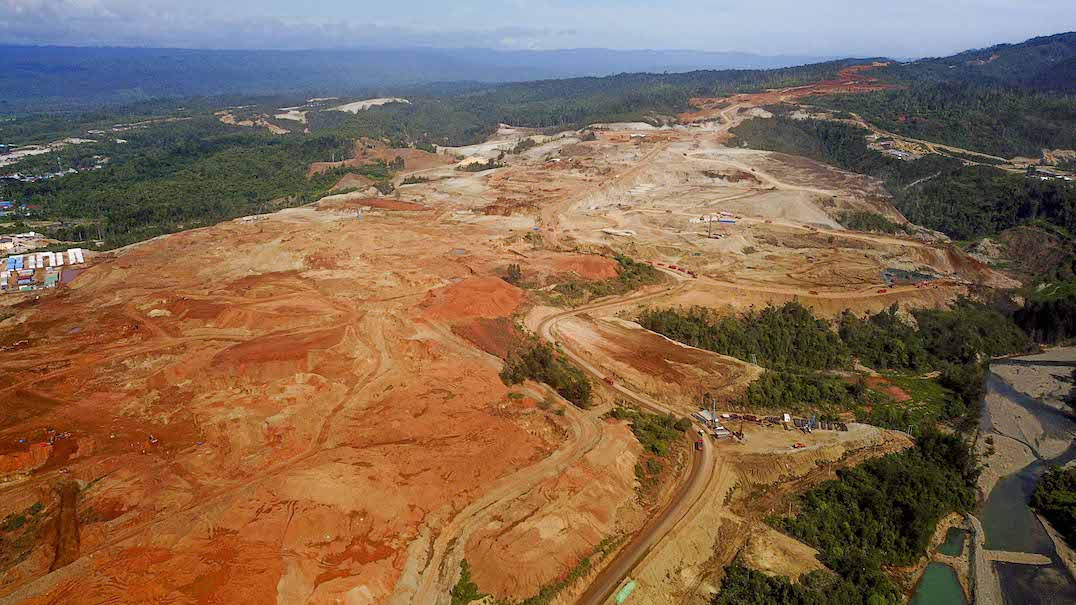
In fact, instead of implementing ESG in its operations, Eramet itself has a dirty footprint in its investment in Indonesia, particularly in nickel mining and smelters.
Since 2006, Eramet acquired PT. Weda Bay Nikel (WBN) and started exploring in the Weda Bay area, Central Halmahera Regency, North Maluku, in collaboration with PT. ANTAM. In 2008, Weda Bay Nickel began acquiring community land at a price of only Rp. 2,500 to Rp. 9,000 per square meter. During the land acquisition process, PT. IWIP field officers were suspected of frequently manipulating the land area of residents to reduce costs from the company.
Until 2017, Eramet collaborated with Tsingshan Group from China to form a joint company PT. Indonesia Weda Bay Industrial Park (IWIP) to manage nickel mining and processing in Weda Bay.
The process of land grabbing for the development of the PT. IWIP industrial area is also going fast, out of control. Residents’ lands in Lelilef Sawai Village and Gemaf Village, which were full of nutmeg, clove, coconut and langsa crops, were confiscated by the company. Residents who refused to have their land released were intimidated and criminalized, one of which was experienced by Hernemus, a resident of Lelilef Sawai who was jailed for a year in 2013. Hernemus was accused of making threats against company employees who carried out land grabbing.
IWIP’s activities have also polluted four rivers which are the main water sources for residents, namely Ake Wosia, Ake Sake, Seslewe Sini and Kobe. The same goes for the coastal and marine areas that were destroyed by PT. IWIP’s activities. The dam where PT. IWIP’s B3 waste was stored in Lelilef Village, Weda Tengah District, burst and allegedly spilled into the sea on January 30 2022. In addition, Lolaro sea waters, near PT. IWIP area, one of the fishermen’s fishing areas, since the operation of PT. IWIP, fisherwomen are experiencing difficulties due to diminishing fish because mining waste from land clearing pollutes the sea.
WBN’s mining activities in forest areas are also a cause of flooding which keeps recurring every year. The worst thing happened on September 8, 2021, a major flood submerged the houses of residents in Lelilef Woebulen and Trans Kobe in Central Weda District.
Expansion of the mining area by PT. WBN has also exiled the indigenous people group O’hongana Manyawa or Tobelo Dalam. One of them occurred in Ake Jira, a forest that is home and sacred to Tobelo Dalam, which was annexed by a company to expand the nickel demolition area.
Vale’s Awful Footprint in South Sulawesi In the meantime, Volkswagen through PowerCo will invest in the construction of a nickel smelter with High Pressure Acid Leaching (HPAL) technology in South Sulawesi for the production of electric vehicle battery components. PowerCo will cooperate with PT. Vale Indonesia, Ford and Huayou Group from China. Of course, this investment cannot be separated from the dirty footprint of the electric vehicle industry, especially PT. Vale and Huayou Group, which risk the safety of residents in East Luwu, South Sulawesi and Pomalaa, Kolaka, Southeast Sulawesi.
In 2018, PT Vale’s activities caused Lake Mahalona to be heavily polluted due to sedimentation of ex-mining soil. Until now, the mud is still in Lake Mahalona and triggers siltation of the lake. In August 2021, PT. Vale’s operations also polluted the waters of Mori Island, PT Vale’s Sulfur spilled and polluted the coast and Mori Island.
In 2016, PT Vale allegedly seized agricultural land and damaged the pepper plantations of the people of Asuli Village, Towuti District, East Luwu. At that time, PT Vale promised to provide the community with a temporary economic program, until the community received restoration of their economic and social rights, in accordance with PT Vale Indonesia’s standard of protection. However, at present, the compensation, alternative economy and restoration of socio-economic rights that were promised by PT Vale Indonesia to nearly 200 heads of families in Asuli Village have not been realized.
Moreover, PT. Vale criminalized seven activists and the indigenous people around the mine in March 2022. The criminalization of these residents began when the indigenous people around the mine held a demonstration demanding PT. Vale’s accountability for nickel mining activities on the community’s customary land. The community also demands PT. Vale Indonesia to make public data regarding the CSR programs that have been carried out by the company’s management.
Continue to Dredge Coal in the Name of Low Emission Electric Vehicles Ironically, all the devastation associated with the electric vehicle industry above, is covered by the mask of a low-carbon, environmentally friendly and sustainable label. In fact, to supply energy at the nickel smelter that produces electric vehicle battery components, it takes millions of tons of coal dredged from Kalimantan’s forests, sacrificing residents and their living space.
For PT. IWIP’s operational needs in Central Halmahera, for example, the company is building a coal-fired power plant with a total capacity of 750 MW. It powers up larger than the capacity of one of the main power plants in Java, PLTU Cilacap, which has a capacity of 700 MW.
The same is the case with PT. IMIP, a subsidiary of the Tsingshan Group in Morowali Regency, Central Sulawesi. For its operations, PT. IMIP requires a coal supply of up to 9 million metric tons annually to operate a PLTU with a capacity of up to 3,200 MW.
This situation is exacerbated by the provisions in Presidential Regulation No. 112 of 2022 concerning the Acceleration of Renewable Energy Development for the Provision of Electricity. Even though this Presidential Decree regulates the early retirement of coal-fired power plants, this Presidential Decree also provides privileges by still allowing the construction of new coal-fired power plants that are integrated with industries that are built oriented towards increasing added value or smelters for processing mining products.
The pace of investment in the electric vehicle battery sector, coupled with various policy incentives to continue building this coal-fired power plant, will further place areas where coal extraction sites, such as Kalimantan, are in a prolonged socio-ecological crisis.
In our opinion, President Jokowi’s invitation to invest in a number of giant companies from Europe, is not in the framework of the welfare of local residents, on the contrary, it is a source of new disaster for residents and their living space.
This fantastic value investment will only add to the profits for business industry players, including a handful of Jakarta’s political elite who are directly or indirectly involved in the investment chain for the electric vehicle ecosystem in Indonesia.
Contact Person:
Adlun Fiqri – Local People of Central Halmahera – +62 813-1401-2618 Muhmamad Al Amin – Director of WALHI South Sulawesi – +62 822-9393-9591 Ki Bagus Hadi Kusuma – JATAM – +62 857-8198-5822 Melky Nahar – JATAM – +62 813-1978-9181
At the world’s largest gathering of Indigenous peoples in New York, mining for critical minerals is at the top of the agenda as the push for the clean energy transition gains steam worldwide.
Indigenous leaders are calling on countries and companies to create binding policies and guidelines requiring the free, prior, and informed consent (FPIC) of communities over clean energy mining projects that seek to explore and extract these minerals on their lands or in ways that affect their livelihoods.
Such binding policies will be very difficult for government, companies and investors to abide by, says an executive, as it gives communities the capability to decline on highly-profitable projects and strategies part of national energy transition goals.
Indigenous leaders also highlight FPIC as a framework for partnership with such projects, including options for equitable benefit-sharing agreements or memorandum of understanding, collaboration or conservation.
NEW YORK — When Francisco Calí Tzay, the United Nations special rapporteur on the rights of Indigenous peoples, spoke at the 22nd United Nations Permanent Forum on Indigenous Issues, or UNPFII, he listed clean energy projects as some of the most concerning threats to their rights.
“I constantly receive information that Indigenous Peoples fear a new wave of green investments without recognition of their land tenure, management, and knowledge,” said Calí Tzay.
His statements — and those made by other delegates — at what is the world’s largest gathering of Indigenous peoples, made clear that without the free, prior, and informed consent of Indigenous people, these green projects have the capacity to seriously impede on Indigenous rights.
FPIC has always been an important topic at the UNPFII, but this year it’s taken on a renewed urgency.
“The strong push is because more and more of climate action and targets for sustainable development are impacting us,” said Joan Carling, executive director of Indigenous Peoples Rights International, an Indigenous non-profit that works to protect Indigenous peoples’ rights worldwide. Indigenous people around the world are experiencing the compounding pressures of clean energy mining projects, carbon offsets, new protected areas and large infrastructure projects on their lands as part of post-COVID-19 economic recovery efforts, according to The International Work Group for Indigenous Affairs (IWGIA) 2023 report.
As states around the world trend towards transitioning to clean energy to meet their national and international climate goals, the demand for minerals like lithium, copper and nickel needed for batteries that power the energy revolution are projected to skyrocket. The demand could swell fourfold by 2040 and by conservative estimates, pull in $1.7 trillion in mining investments. Although Indigenous delegates say they support clean energy projects, one of the issues is their land rights: more than half of the projects extracting these minerals currently are on or near lands where Indigenous peoples or peasants live, according to an analysis published in Nature.
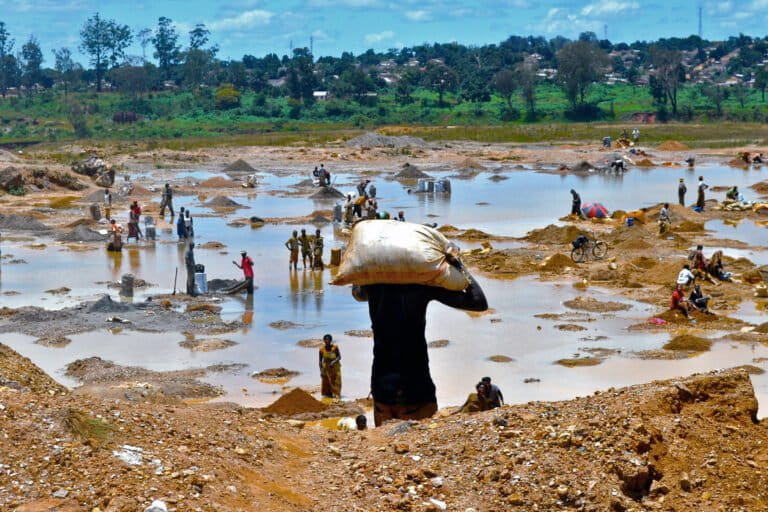
A cobalt mine in central Africa. Image by Fairphone via Flickr (CC BY-NC 2.0).
This can either lead to their eviction from territories, loss of livelihoods or the deforestation and degradation of surrounding ecosystems.
“And yet […] we are not part of the discussion,” said Carling. “That’s why I call it green colonialism — the [energy] transition without the respect of Indigenous rights is another form of colonialism.”
However, standing at the doorway of a just clean energy transition is FPIC, say Indigenous delegates. FPIC is the cornerstone of international human rights standards like the U.N. Declaration on the Rights of Indigenous Peoples (UNDRIP) and the International Labor Organization Convention 169 (ILO Convention 169). Though more than one hundred countries have adopted UNDRIP, this standard is not legally binding. It is rather an instrument to interpret national laws. ILO Convention 169 is legally binding, but only to the 24 states that have ratified the convention.
Because of this, delegates are calling on countries and companies to create binding policy and guidelines that require FPIC for all projects that affect Indigenous people and their lands, as well as financial, territorial and material remedies for when companies and countries fail to do so. According to Carling, this will be the mandatory inclusion of FPIC in international standards such as the OECD Guidelines for Multinational Enterprises and putting more pressure on national governments to implement policy reforms that include accountability.
However, there is undoubtedly some pushback. The free prior, informed consent process can lead to a wide variety of outcomes, including the right for communities to decline a highly profitable project, which can often be difficult for countries, companies, and investors to abide by, explains Mary Beth Gallagher, the director of engagement of investment at Domini Impact Investments, who spoke at a side event on shareholder advocacy.
Indigenous Sámi delegates from Norway drew attention to their need for legally enforceable FPIC protection as they continued to protest the Fosen Vind project farm that the country’s Supreme Court ruled was violating their rights. “We have come to learn the hard way that sustainability doesn’t end colonialism,” said a Sámi delegate during the main panel on Tuesday.
In the United States, the Reno-Sparks Indian Colony, the People of Red Mountain, and members of the Fort McDermitt Tribe filed lawsuits against the Bureau of Land Management for approving the permits for an open-pit lithium mine without proper consultation with the tribes. In the Colombian Amazon, the Inga Indigenous community presented a successful appeal for lack of prior consultation from a Canadian company that plans to mine copper, molybdenum, and other metals in their highly biodiverse territory.
Consternation over governments and multinational companies setting aside FPIC has long extended over other sectors, like conservation and monoculture plantations for key cash crops. In Peru, the Shipibo-Konibo Indigenous people are resisting several large protected areas that overlap with their territory and were put in place without prior consultation. In Tanzania and Kenya, the Maasai are being actively evicted from their landsfor a trophy hunting and safari reserve. Indigenous Ryukyuan delegates condemned the ongoing use of their traditional lands and territories by the Japanese government and the United States military for U.S. military bases without their free, prior, and informed consent.
Eyes on the private sector
While delegates put a lot of emphasis on the lack of FPIC, they put equal emphasis on FPIC as a crucial part of the long-term sustainability of energy projects.
“FPIC is more than just a checklist for companies looking to develop projects on Indigenous lands,” said Carling. “It is a framework for partnership, including options for equitable benefit sharing agreements or memorandum of understanding, collaboration or conservation.”
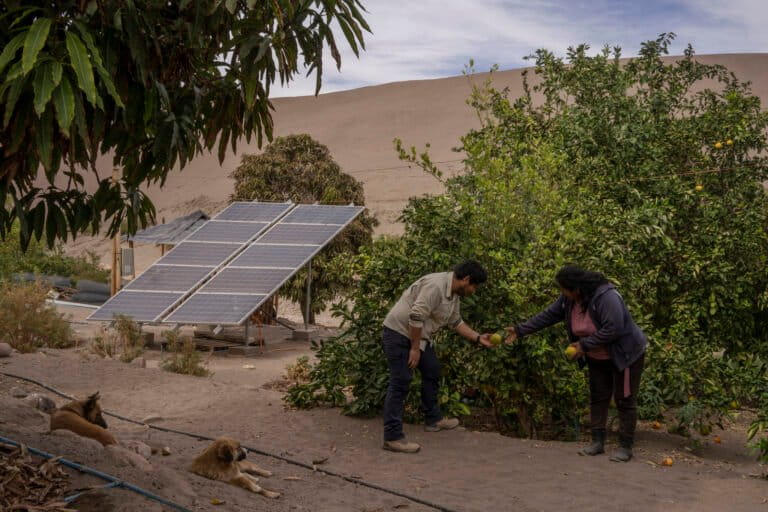
Mother and son harvest lemons from their plantation in Chile. This family of farmers obtained 10 solar panels, from the “Solar Energy Project for Farmers” provided by CONADI (National Corporation for Indigenous Development). Image by IMF Photo/Tamara Merino.
The focus of this year’s conference has emphasized the growing role of FPIC in the private sector. Investors and developers are increasingly considering the inclusion of FPIC into their human rights due diligence standards. Select countries such as Canada have implemented UNDRIP in full, although First Nation groups pointed out irregularities in how it is being implemented. The EU is proposing including specific mandatory rights to FPIC in its corporate sustainability due diligence regulation. Side events at the UNPFII focused on topics like transmitting FPIC Priorities to the private sector and using shareholder advocacy to increase awareness of FPIC.
Gallagher of Domini Impact Investments says companies have a responsibility to respect human rights, which includes FPIC. “If they have a human rights commission or they have a commitment in their policies not to do land grabs, we have to hold them to account for that.”
In 2021, the world’s largest asset manager, BlackRock, published an expectation that companies “obtain (and maintain) the free, prior, and informed consent of Indigenous peoples for business decisions that affect their rights.” Large banks like Credit Agricole have included FPIC in their corporate social responsibility policy. But in most cases, even when companies have a FPIC policy, it doesn’t conform to the standard outlined in UNDRIP and is not legally binding.
“It doesn’t do the work it’s supposed to do to protect self-determination. It becomes a check-the-box procedure that’s solely consultations and stakeholder consultation instead of protection of rights and self-determination,” says Kate Finn, director at First Peoples Worldwide.
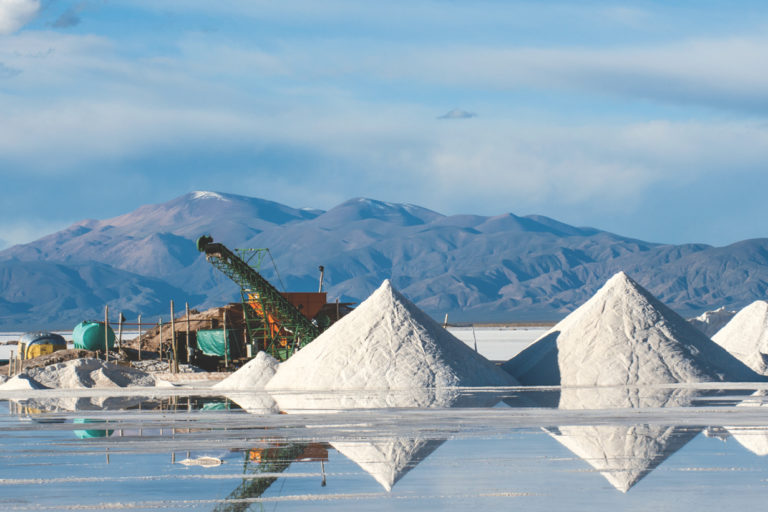
Lithium mine at Salinas Grandes salt desert Jujuy province, Argentina. Image courtesy of Earthworks.
If communities aren’t giving their consent, the company has to respect that, says Gallagher. “There’s obviously points of tension where investors have different agendas and priorities but ultimately, it’s about centering Indigenous leadership and working through that.”
Not properly abiding by FPIC can be costly to companies in countries that operate where it is a legal instrument. It comes with risks of losing their social operation to license, and financial damages. According to a study First Peoples Worldwide, Energy Transfer Partners and banks that financed the now-completed Dakota Access Pipeline, lost billions due to construction delays, account closures, and contract losses after they failed to obtain consent from the Standing Rock Sioux Tribe in the United States.
Ultimately, Indigenous people need to be part of decision-making from the beginning of any project, especially clean energy projects mining for transition minerals on their territories, said Carling. “For us, land is life, and we have a right to decide over what happens on our land.”
Activists worry the arrests are a move by the cash-strapped government to open the country to now banned metals mining
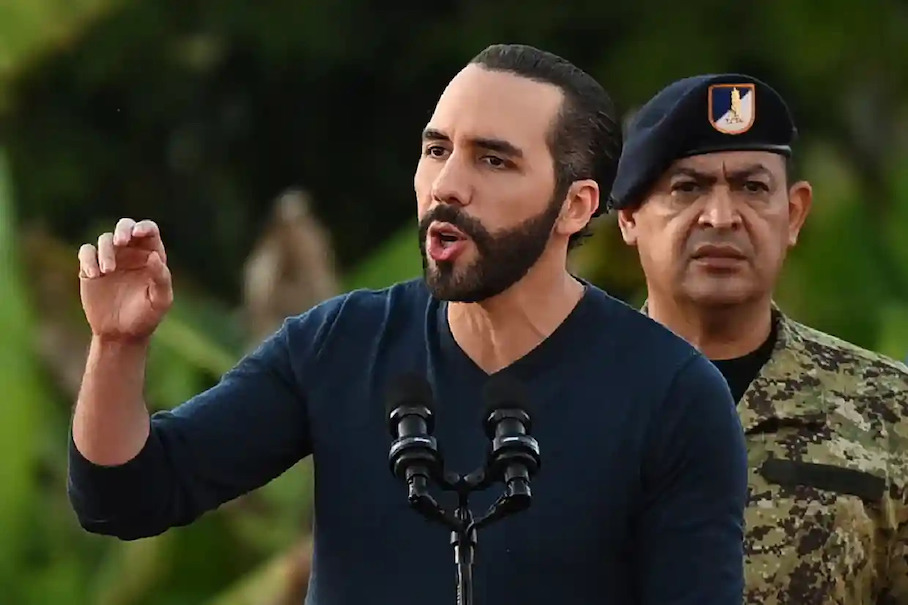
Five prominent environmental defenders who played a crucial role in securing a historic mining ban in El Salvador have been detained accused of civil war era and gang-related crimes, in what rights groups fear is a ruse to restart mining.
Miguel Ángel Gámez, Alejandro Laínez García, Pedro Antonio Rivas Laínez, Antonio Pacheco and Saúl Agustín Rivas Ortega were detained on Wednesday in Cabañas in northern El Salvador, accused of killing an alleged army informant more than 33 years ago during the brutal civil war that claimed 75,000 lives.
Nayib Bukele, the authoritarian populist president who swept to power in 2019, has repeatedly blocked attempts to seek justice for civil war victims – the vast majority of whom were civilians killed by the US-backed dictatorship and rightwing death squads.
The military is accused of dozens of human rights violations and crimes against humanity in Santa Marta, the community where the five detained defenders live and work, but no one has ever faced justice.
Hundreds of national and international activists and organisations have condemned the detention as politically motivated.
In a statement, the Washington-based Institute for Policy Studies (IPS) said the government’s decision to arrest the five men while blocking justice in high-profile cases like the El Mozote massacre “raises questions about whether the true motivation is to attempt to silence these water defenders”.
Without providing details, prosecutors have also accused the five men of illicit association – a crime which has been widely used by the Bukele regime to lock up more than 60,000 alleged gang members since March.
Rights groups fear that the community leaders, who are being held at a police station in the capital, San Salvador, could languish in overcrowded cells for months before formal charges are filed in court. The ongoing state of emergency has suspended a wide range of civil liberties and led to widespread arbitrary detentions and other abuses, according to United Nations experts.
The detained men are renowned community organisers and water protectors, who helped lead the historic and successful campaign that convinced the Salvadoran legislature to unanimously pass a ban on metals mining in 2017 to save that nation’s rivers. Amid worsening drought caused by the climate crisis, El Salvador could run out of drinking water by the end of the century unless radical action is taken to rehabilitate its contaminated waterways.
Environmental organisations fear that the arrests were a calculated attempt to destabilise community opposition as the economically stressed government seeks to overturn the mining ban.
Bukele is under enormous pressure to find new revenue streams after his ill-advised embrace of the cryptocurrency Bitcoin failed spectacularly.
In recent months, local officials in Cabañas have reportedly been approached about mining projects, while unknown individuals have offered to buy land where former mines are located.
Detainee Antonio Pacheco, director of the Association of Economic and Social Development (Ades) and former guerrilla leader, had alerted officials and organizations about these suspicious activities.
“It’s clear that the arrests are politically motivated,” said Pedro Cabezas, coordinator of the Central American alliance on mining. “All five leaders were part of the anti-mining movement which started in Cabañas, where it’s clear the current government wants to restart mining.”
Russia’s invasion of sovereign Ukraine opened the eyes of many to the imperial nature of the russian state. The expansion of the empire and strengthening of the “russkiy mir” ideology are, without a doubt, the key reasons for the Kremlin-perpetrated bloodshed and genocide in Ukraine.
The colonial and imperial nature of this war, in turn, amplified the voices of indigenous peoples of the lands colonized and appropriated by the russian state who have been subjected to racial discrimination and other systemic discriminatory barriers.
In defiance of these obstacles, many of us are getting involved in anti-war activism, uniting into foundations and movements and helping conscientious objectors to return home. We also work to fight propaganda in our regions where political repressions often prove to be far more rigorous than elsewhere in russia, but yet remain largely unnoticed by the general public.
Unfortunately, both the russian regime and the so-called liberal muscovite opposition treat the indigenous activists the same: they either choose to ignore us or try to use us as the pawns in their political games. While trying to be heard by the regime is no longer viable, to the liberal opposition we would like to say:
Nothing about us without us
— 1 —
WE, the indigenous and the decolonial activists, DEMAND to be included in all public discussions about our possible futures.
We understand that no one ethnic, national or decolonial initiative can solely represent the will of its peoples. But all such movements, without an exception, have an inextricable bond with their peoples and their land, which makes their expertise unique and essential.
The indigenous peoples and/or natives of national republics among us remember our histories. We remember that political decisions made without the involvement of the people in question always brought about political repressions, discrimination and colonial violence.
We consider this decision-making model to be undemocratic and deeply vicious.
— 2 —
WE ARE CONVINCED that a simple representation is not enough. Representatives of indigenous peoples, national republics and decolonial initiatives must be included in all decision-making processes and processes of distribution of material and social capital.
We consider the sudden interest in the decolonial agenda expressed by certain representatives of the liberal muscovite opposition to be a symbolic gesture rather than a sincere act of solidarity and support. We don’t want to become puppet activists whose presence is required for nothing more than a pretty picture.
True representation is not just a simple inclusion. True representation means participation on all levels of decision-making. True representation is much more than listing someone with a non-Russian name among your allies or having a person with non-Slavic facial features at a negotiation table.
— 3 —
WE ASK to speak of indigenous peoples without racist tropes, cliches, generalizations and exoticization. Here, we are not only talking about blatantly racist language but also about the words that reinforce colonial hierarchies, including using the word “minorities” when speaking of indigenous peoples or addressing people as “russkie” (ethnic Russians) instead of “rossiyane” (russian nationals regardless of ethnicity), etc.
We also ask to refrain from portraying the indigenous peoples as mysterious and exotic others who need to be civilized, enlightened and ridden of their savage habits.
We love our national dress and other elements of our material culture and ask those in question to do away with appropriating them for the exoticization of content they produce.
— 4 —
WE CALL for solidarity.
We ask to show solidarity with us not only through verbal condemnation of, but also by halting cooperation with any entities, organizations, initiatives or individuals (politicians, bloggers etc.) who systematically refuse to follow the principles outlined above and turn a deaf ear to public criticism.
We believe that providing those people and entities with material sponsorship or a platform or amplifying their voices in any other way increases the pressure on indigenous activist movements and makes their representatives ever more vulnerable.
WE NEED YOUR SUPPORT
Please share this letter and image sets on your social media. You can download them from @decolonialsolidarity Telegram channel.
A. Choybsonov, Buryat activist A. Erendzhenov, Oirat activist A. Gomboeva, decolonial researcher A. Yangulbaev, Chechen lawyer and human rights defender B. Matune, activists, Asians of Russia D. Badmaev, Oirat activist D. Khovalyg, Tuvan activist L. Latypova, Tatar activist L. Mongush, Tuvan activist S. Kondakova, Yukagir activist S. Jigjitova, Buryat activist V. Maladaeva, Buryat activist Asians of Russia Beda Media Editorial Buryad Global Free Kalmykia Free Yakutia New Tuva
Signatories:
M. Alexeeva, activist, creative producer, author A. Arsenian, theatrical producer and curator M. Vjushkova, scientist M. Rafail ulı Ganeyev, Tatar language and queer activist V. Dambaeva, accountant D. Tsyui, journalist and Buryad activist M. Zakharov, writer, film curator and translator A. Zueva, journalist from Buryatia A. Diudina, Suomen Inkeri-liitto E. Ishchenko, curator and researcher A. Kim, product designer V. Kravtsova, researcher at Feminist Translocalities M. Kurilov, curator and researcher M. Nasybullova, Tatar-Siberian artist V. Nore Mähäbbät, activist A. Makichyan, climate activist S. Manakina, activist N. Mendyaev, Oirat-Kalmyk activist of Free Kalmykia D. Mityushin, developer A. Mongush, activist N. Mongush, activist A. Kugasova, Sakha activist V. Dzhunko, Sakha activist Ğ. Ğaliev, Bashqort activist E. Ochir, Oirat-Mongol activist V. Petrova, activist RDS P. Rapoport, molecular biologist D. Rasuleva, Tatar writer and poet V. Son, activist of Invisible Rainbow M. Tay, Tatar trans activist A–M. Tesfaye, activist of Queer Svit D. Torokhova, activist of Vsio Odnoznachno V. Choinova, Sakha activist, S. Shestakova, researcher A. Shevchenko, activist of Voice of free Russia A. Vogel, German leftist and queer activist Zh. Batuev, citizen of Buryad-Mongolia D. Dugarova, doctor M. Kruchinski, curator at Typography Collective, researcher V. Charniauski, decolonial activist from Belarus A. Takkeze, researcher from Tatarstan B. Takshina, Altai-German musician Y. Tannagasheva, Shor activist G. Konstandi, founder of the Voices from the Drina project. M. Sarycheva, Bashqortostan-born researcher and cultural worker A. Bogomolova, feminist Z. Bocheeva, activist N. Shamgunova, Tatar researcher of history of empire A. Saifullin, researcher E. Atlasova, Sakha activist L. Zhirkova, Sakha activist P. Zherebtsov, curator S. Atlasova, Sakha activist I. Dzhunko, activist from Republic Sakha V. Kondakov, Sakha activist A. Burliuk, curator T. Baktemir, Astrakhan regionalist G. Iakhiaev, Tabasaranian, software developer m. irekleh, queer and decolonial analyst of russian cinema and tv C. Pislari, activist, designer H.Otchyk, Belarusian/Turkmen activist, poet A. Khachikian, journalist Decolonize Russia solidarity network @decolonize_russia DOXA Feminist Transclocalities Indigenous Peoples Movement global coalition Invisible Rainbow Queer Svit Voices of Indigenous People of Russia International Committee of Indigenous Peoples of Russia (ICIPR)
To the International Day for the Elimination of Racial Discrimination
Marking March 21 – the International Day for the Elimination of Racial Discrimination, ADC Memorial and the International Committee of Indigenous Peoples of Russia have prepared an alternative report to the UN CERD, informing the Committee about the violation of the rights of ethnic minorities, indigenous peoples and migrants by the Russian regime. The criminal war unleashed by Russia against Ukraine has spread discrimination and repression to the occupied territories, aggravated the situation of the Crimean Tatars in the annexed Crimea, and caused irreparable harm to indigenous communities and ethnic minorities. Conscription and the imposition of contract army service mostly affected the poorest regions of Russia – exactly those where ethnic minorities live, thus they disproportionately suffer from mobilization. For indigenous peoples, involvement into the war threatens their physical survival, while mining companies continue to destroy their traditional territories.
Over the past decade, state propaganda has been shaping a discourse about Russia’s exclusivity, its “unique historical path” and “traditional values”, superiority in the possession of natural resources. By 2022, civil society and opposition movements were practically suppressed, independent media were closed and/or expelled from the country, anti-war and in any other civil activity criticizing the actions of the authorities and expressing solidarity with Ukraine is being persecuted. The repressive legislation on “foreign agents” has affected the rights of dozens of individuals and organizations. Leading human rights organizations have been liquidated or restricted in their work, including leading experts in the field of combating racism and discrimination. Recently it became known that the Ministry of Justice filed a lawsuit to liquidate the SOVA Center for Information and Analysis, that has been analyzing the problems of racism, xenophobia, and human rights violations in Russia for many years.
The gradual degradation of Russian society under the influence of the state propaganda and the tightening regime took place in an atmosphere of escalating hatred and discrimination against various vulnerable groups.
Russia’s migration policy remains extremely harsh, and numerous migrant workers from Central Asian countries face racial profiling, police and judicial arbitrariness. Structural discrimination of Roma population has not been overcome; in recent years there have been massive interethnic conflicts that turned into violent pogroms; thousands of Roma were forced to flee from their places of residence. Russia’s repressive policy has spread to the newly occupied territories: Crimean Tatars are now being persecuted not only in Crimea, but also in the South of Ukraine.
The massive propaganda of national exclusivity and xenophobia inevitably legitimizes direct violence and permit aggressive nationalists to move from words to deeds. Hate-motivated conflicts, including among children and youth, often occur, and there is every reason to expect an increase in the number of ideologically motivated attacks against foreigners, migrants, and representatives of minorities.
Tatiana Tintino, Verena Manolis and Cheyenne Coxon
For indigenous and local communities, climate finance is often an unwelcoming space. Climate finance programs are technical, with complicated methodologies and legal agreements. Most do not disperse funds directly to indigenous peoples and local communities (IPLCs), leaving millions stuck in bureaucratic distribution systems. A minimal percentage of aid money for climate mitigation reaches IPLCs , despite initiatives that pledge billions to the cause – some estimate as little as under 1% goes directly to communities.
With momentum and interest in biodiversity and carbon offsets gaining after the UN Biodiversity Conference in December 2022, and the Lula administration in Brazil signaling intention to act on conservation and human rights, it is essential that IPLCs have the resources they need to navigate new opportunities and rapidly changing contexts.
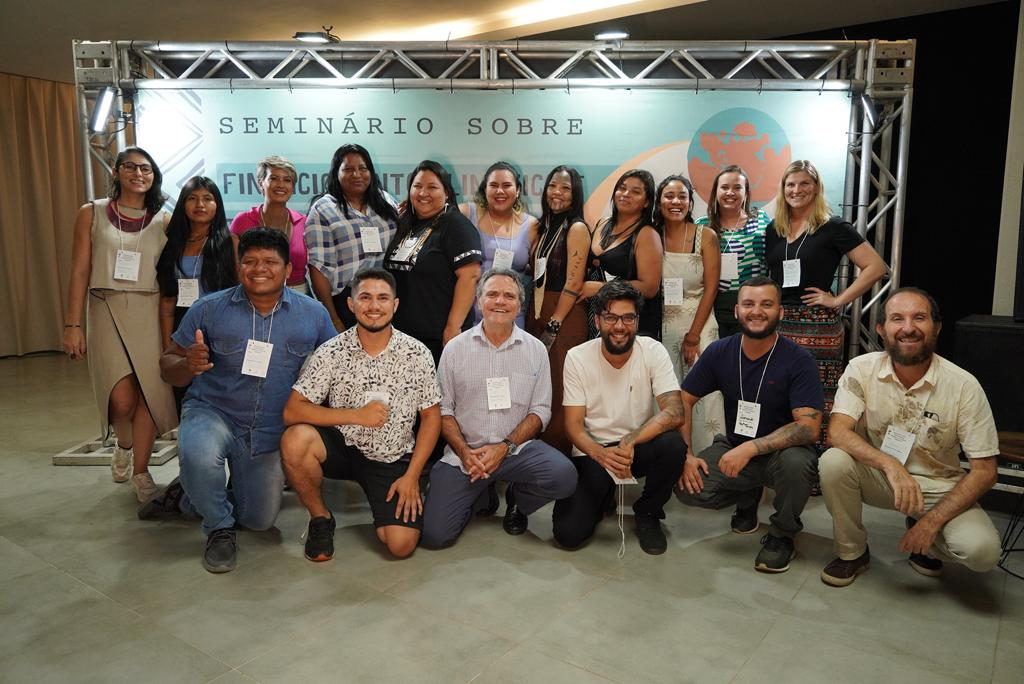
On February 14th and 15th in Cacoal, Rondônia, Brazil, our Communities and Territorial Governance Initiative held a seminar on climate finance and Indigenous Territories, in partnership with Greendata. The goal of the Cacoal gathering was to exchange ideas and increase community knowledge on REDD+ and other jurisdictional and private climate finance mechanisms, including voluntary carbon markets. Our team presented updated information on climate finance, discussed opportunities for community engagement that prioritize safeguards and indigenous rights, and conducted trainings with indigenous and non-indigenous experts.
Credit: Jony Wagner
Over 100 participants joined from across Brazil, including representatives of 25 original peoples of the Brazilian Amazon; members of indigenous organizations, such as the Coordination of Indigenous Organizations of the Brazilian Amazon (COIAB), the Federation of Indigenous Peoples and Organizations of Mato Grosso (FEPOIMT), the National Articulation of Indigenous Women Warriors of Ancestrality (ANMIGA), the Association of Indigenous Warrior Women of Rondônia (AGIR), and the Indigenous Youth of Rondônia (JIR); legal experts; and representatives from regional and national agencies, including the Coordinating Body for Indigenous Peoples of Rondônia (COPIN), the State Secretariat for Environmental Development of the State of Rondônia (SEDAM), the Federal Public Ministry (MPF), Wildlife Works (WWC), the Pro-Indian Commission of Acre (CPI-AC), and the Platform Partners for the Amazon (PPA).
“In order for indigenous organizations and communities to evaluate climate finance opportunities, assess their territories’ carbon stocks and flows, negotiate with governments and private carbon market actors, understand their legal rights and the regulatory environment, and so forth, they need to have quality, tailored information and the appropriate tools and capacities,” says Beto Borges, Director of Forest Trends’ Communities and Territorial Governance Initiative.
“Forest Trends is here to support this information sharing, and this seminar is an important part of that training.”
Four key lessons from this event for the global climate finance community:
1. Climate finance will flow into communities at the speed of trust, and trust requires information.
“At present, many companies do a poor job of conveying their intentions with communities, and they make promises that can’t be fulfilled,” says Nedina Luisa Yawanawa, an indigenous teacher from the Rio Gregório Indigenous Land in Acre, Brazil.
Nedina believes it is essential to have more training initiatives made available to communities that emphasize the protection of community rights and resources. Community members having a deep understanding of the consultation process and the relationship between companies and communities is essential to setting expectations and creating an equitable partnership from day one.
“It’s no use just saying that [communities] need to be careful,” says Nedina. “We can’t go on accepting the first company [that makes a proposal]. We have the [land and resources], so we have to be comfortable making the best choice…We need to operate in a way that all communities receiving proposals are aware of the risks, and if they are going to move forward, they do so consciously and with preparedness on community management, accompaniment of important institutions, like FUNAI and the MPF, and legal support so that the communities are not alone.”
“Information on jurisdictional REDD+ and carbon markets is often presented in very technical or legal language, and not necessarily in indigenous peoples’ first language,” said Marcio Halla, Director of the Territorial Governance Facility and Economic Initiatives Lead at Forest Trends. “More concerningly, we have sometimes seen information on risks de-emphasized in proposals to communities or hidden in the fine print.”
To better equip communities with the knowledge needed to evaluate and negotiate carbon finance opportunities, Forest Trends just launched a new project, with support from the Climate and Land Use Alliance, that will offer carbon finance training programs, data, and technical assistance to indigenous communities in Brazil and Panama. We hope to expand this work to additional geographies in the near future.
Credit: Jony Wagner
2. Communities can speak for themselves in global fora.
Marciely Ayap Tupari, secretary coordinator of Coordination of Indigenous Organizations of the Brazilian Amazon (COIAB) and active member of several movements in the state of Rondônia, said that the best way for the international community to support the struggle of indigenous peoples in defense of their territories is to bring them into the discussion.
“Many times, when we participate in these international meetings, we see little participation of indigenous leaders who are working with the territories. We need to participate in these spaces. Not only the leaders, but women and youth [as well] … We need to be there to talk about what our demands really are.”
Upfront investment is needed to strengthen IPLC governance so they can continue to protect their territories and participate as equal partners in climate and conservation finance. Vehicles like the Territorial Governance Facility[link in Spanish] can provide financial and technical support for governance capacity-building.
3. The relationship between communities and jurisdictional and national governments is being rebuilt.
A new administration in Brazil offers opportunities to begin building trust between indigenous communities and government agencies, after a long history characterized by neglect, colonialism, and outright aggression.
Looking forward, regional, and national governments can play a critical role helping to protect indigenous rights and promoting equitable benefit sharing of any value generated by projects. Leonardo Trevizani Caberlon, prosecutor for the Federal Public Ministry (MPF) of Rondônia, explains, “One of the roles of the Federal Public Prosecutor’s Office is defending indigenous peoples and enforcing the laws [already in place to protect their rights]. The MPF also monitors any projects that involve indigenous populations, and if the indigenous people have an interest in consultation, a [second] opinion, or monitoring, the MPF is at their disposal. The MPF will also have the important role of supervising and investigating any irregularities that may occur during the course of these procedures and could request conviction of those who may be [in violation].”
“We are encouraged that at the Federal level, Marina Silva is back as Minister of Environment and Climate Change, and the new Ministry of Indigenous Peoples is led by Sonia Guajajara, the first indigenous person to head a Ministry in Brazil. It is also the first time in Brazilian history that FUNAI is presided by an indigenous person: Joênia Wapichana, another prominent indigenous leader, who is completing her term as the first indigenous woman deputy in the Brazilian Federal Congress,” added Beto Borges.
4. Public and private finance need to align with indigenous cultures, not the other way around.
Marciely Ayap Tupari explains why the seminar’s conversations are so important for shaping how companies should interact with indigenous partners: “The whole world sees that indigenous peoples protect the forest without [asking for] money. We do it in our own way because nature is our life. Seeing this, companies often end up coming to us with a proposal, wanting to finance, wanting to supposedly protect nature, but in their own way. When we explain our vision as indigenous peoples, many do not understand. That is why we talked about this issue of companies enticing leaders, offering money to implement carbon credits, but without really talking to the people who live there. This is worrying.”
Beto Borges also emphasizes the need for culturally appropriate jurisdictional finance, adding that state governments should also adapt how they interact with indigenous communities: “While these are promising developments at the Federal level to uphold the rights of indigenous peoples, including their carbon ownership rights, we hope to see the same level of recognition and commitment by the state governments in the Amazon. Most of the state governments in the Brazilian Amazon submitted proposals to the LEAF program; it is very important, however, that they consult with indigenous peoples and involve them in the design and implementation of safeguards and fair benefit sharing mechanisms in jurisdictional climate funding. Otherwise, jurisdictional funding will fail indigenous peoples.”
A set of core principles for working with forest communities on carbon offsets and conservation projects was recently published by the Peoples Forest Partnership, a coalition of indigenous organizations, companies, investors, and nonprofits (Forest Trends is the current Secretariat). We believe these offer a useful model for the entire climate finance field to follow in partnering with indigenous and traditional communities.
Credit: Jony Wagner
Our priorities in 2023
Our team has come out of the Cacoal gathering even more energized to keep supporting our IPLC partners with these priorities. This year, we are ramping up our existing resources geared towards providing accessible, culturally appropriate information and capacity building on climate finance programs. In late 2021, we launched the Territorial Governance Facility with four IPLC organizations to strengthen the governance capacity necessary for successful participation in climate finance. February marked the beginning of a new initiative with the Climate and Land Use Alliance to co-create technical tools and other training resources with IPLCs to navigate carbon markets. We look forward to continuing our work with indigenous partners in Brazil and around the world to prioritize the resources, information, and direct support they are calling for.
Uncontacted tribal people face total destruction from mining for electric car batteries
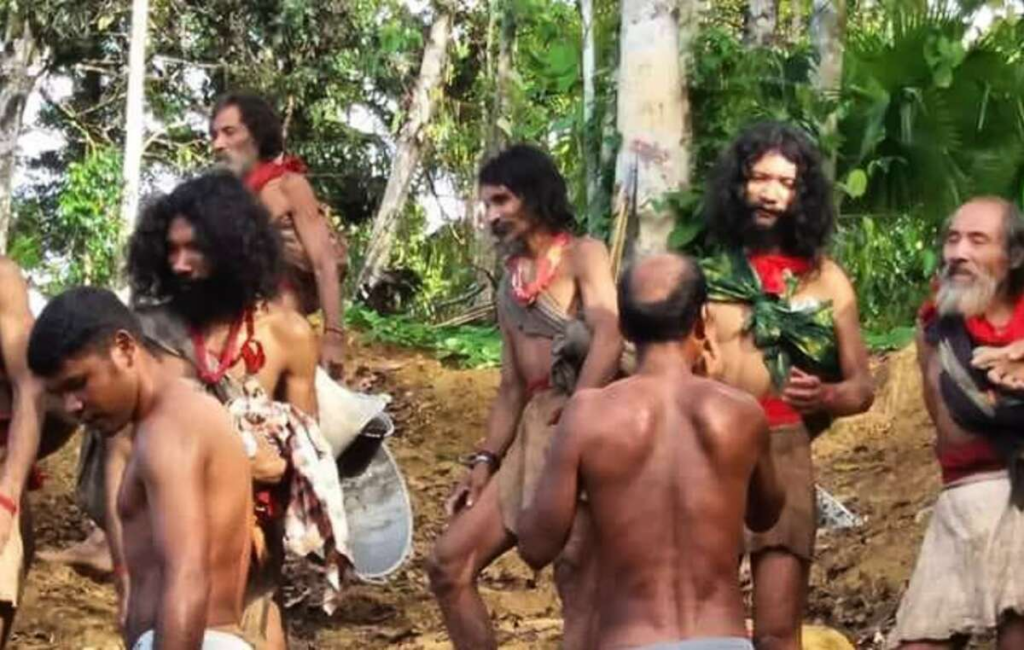
Uncontacted tribal people in Indonesia who choose to live in the rainforest far from outsiders could be wiped out by a massive nickel mining project. Many are already on the run from mining which is tearing up their ancestral lands and damaging their rivers.
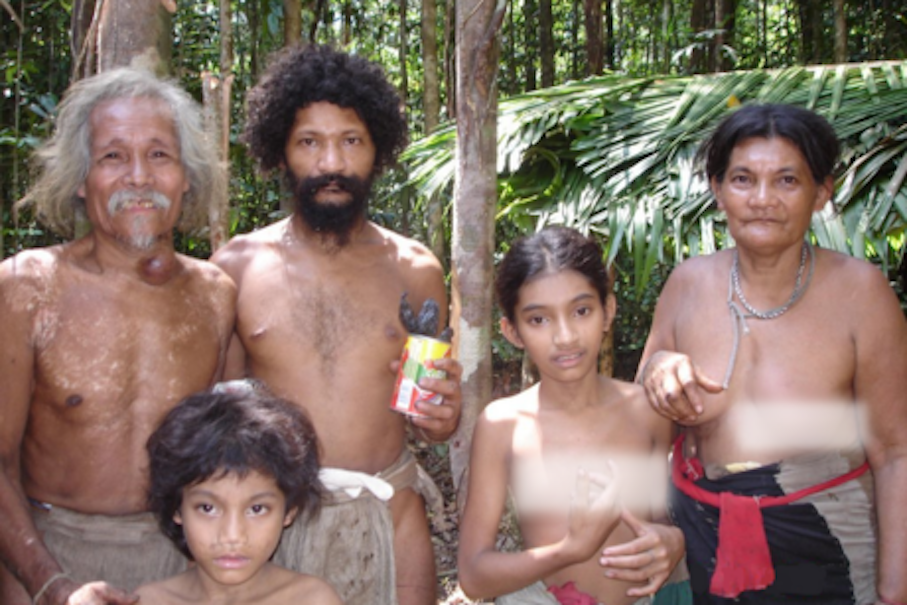
An estimated 300 to 500 uncontacted Hongana Manyawa people live in the forested interior of the island of Halmahera. Huge areas of their territory have now been allocated to mining companies, and in some areas the excavators are already at work.
The project is part of Indonesia’s plan to become a major producer of electric car batteries, by mining and smelting nickel and other minerals – a plan into which international companies like Tesla are already pouring billions of dollars. French, German and Chinese companies are involved in mining in Halmahera. The uncontacted Hongana Manyawa, despite contributing nothing to climate change, now risk being wiped out by the industrialized world’s switch to electric cars. The Hongana Manyawa need our urgent support.
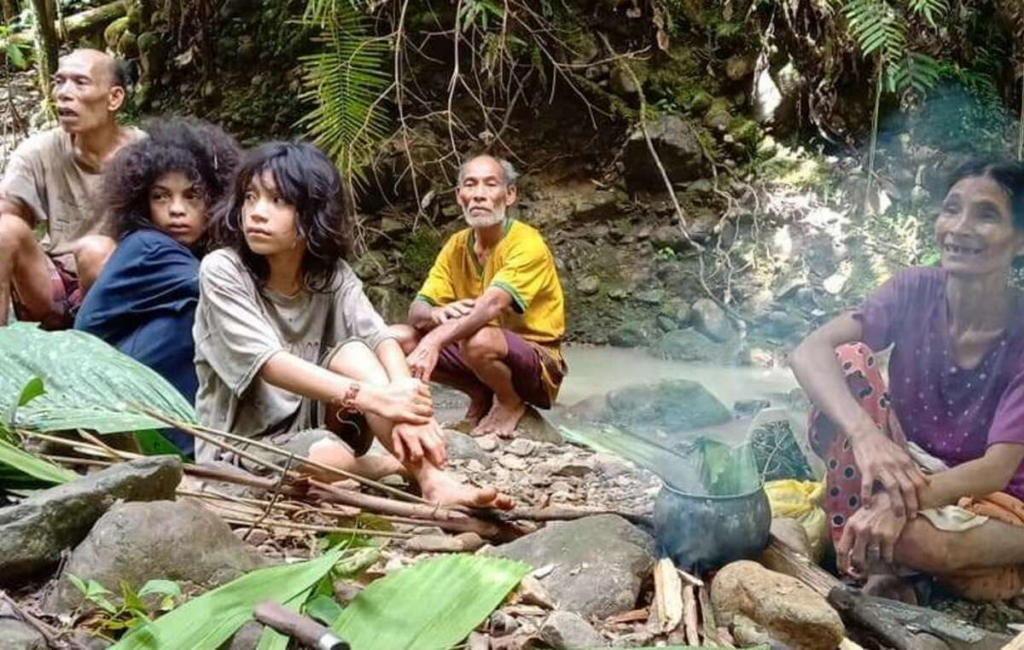
The Hongana Manyawa – which means ‘People of the Forest’ in their own language – are one of the last nomadic hunter gatherer tribes in Indonesia, and many of them are uncontacted.
They have a profound reverence for their forest and everything in it: they believe that trees, like humans, possess souls and feelings. Rather than cut down trees to build houses, they make their dwellings from sticks and leaves. When forest products are used, rituals are performed to ask permission from the plants, and offerings are left out of respect.
The Hongana Manyawa root their whole lives to the forest, from birth to death. When a child is born, the family plant a tree in gratitude, and bury the umbilical cord underneath: the tree grows with the child, marking their age. At the end of their lives, their bodies are placed in the trees in a special area of the forest that is reserved for the spirits.
If there is no more forest, then there will be no more Hongana Manyawa.
Hongana Manyawa man
Providing for themselves almost entirely from hunting and gathering, the Hongana Manyawa are nomadic; setting up home in one part of the forest before moving on and allowing it to regenerate. They have unrivalled expertise in the Halmahera rainforest, hunting wild boar, deer and other animals and maintaining a close connection with the sago trees – now threatened by deforestation from mining – which provide their main source of carbohydrate. They also have incredible medicinal knowledge and can treat many sicknesses with local plants, although this has become increasingly difficult following the new diseases brought by forced contact and resettlement in villages.
It’s more convenient for me to keep moving because the food is much more diverse and available, I can go hunting regularly. Permanently staying in the village is very uncomfortable and there is a lack of food.
This incredible footage, taken in 2021, shows an uncontacted Hongana Manyawa man, throwing things and singing angrily to ward off the outsiders who have come into his territory:
The arrival of the mining companies is just the latest threat to the Hongana Manyawa and their land. In recent decades, Indonesian governments have repeatedly tried to force contact onto the Hongana Manyawa, with the aim of stopping their nomadic way of life and evicting them from their ancestral forest home. They say this is to “civilize” them: they have tried to settle the Hongana Manyawa and have built Indonesian-style houses for them. The Hongana Manyawa say these new houses, with roofs made of metal sheets rather than palm leaves, made them feel “like animals in a cage”.
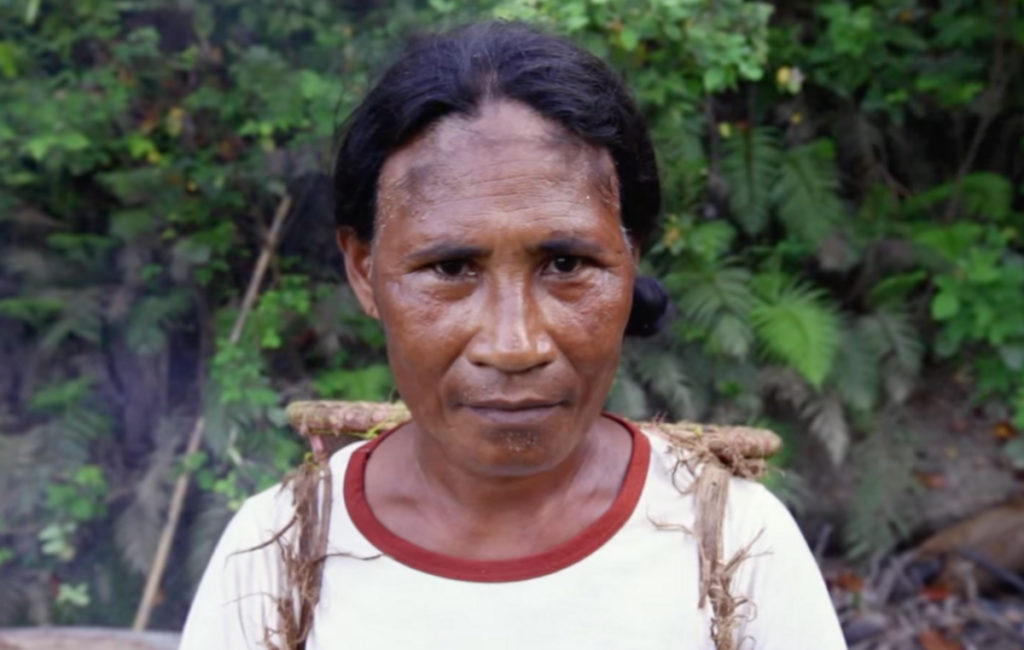
One Hongana Manyawa woman told Survival:
We are so happy living by the forest with different kinds of meat and food, where we can collect roof materials so we can replace the zinc roof the government has built for us.
Hongana Manyawa woman
As with uncontacted tribes the world over, forced contact has proved disastrous for the Hongana Manyawa. They were immediately exposed to diseases to which they had no immunity – from the late 1970s to the early 1990s, terrible outbreaks of diseases which the Hongana Manyawa refer to as “the plague” affected the newly-settled villages, leading to widespread suffering and even death.
We had many different diseases when first settled, some of the sickness led to deaths, some people had fever that went on for days and nights and endless coughing for days and even weeks.
The contacted Hongana Manyawa also serve as convenient scapegoats for the police, who frequently blame them for crimes they have had nothing to do with. Several of them have been imprisoned for murders they did not commit and have languished in jail for many years.
It’s better to live in the forest so we don’t get accused of these things. We feel unsafe and many of the men moved into the forest and then came to get their wives and families. Some are deep in the forest…they are deeply traumatized.
Hongana Manyawa woman
Far from being respected for their unique and self-sufficient ways of living, the Hongana Manyawa experience severe racism and are regularly described by Indonesian officials and the media as ‘primitive’. There is a widespread belief that they would benefit from ‘integration’ into wider society: a belief that comes with disastrous and deadly consequences.
Many Hongana Manyawa are now living in government-built villages. Many others – traumatised by the government’s forced settlement attempts, like other peoples around the world who have experienced forced contact – have returned to their forest.
The uncontacted Hongana Manyawa have made it clear time and time again that they do not want to settle or have outsiders coming into their forest. They are very much aware of the dangers – including fatal epidemics of disease – which forced contact brings. As with the uncontacted Sentinelese tribe of India, it is little wonder that they are defending their lands and shooting arrows at those who force their way in.
But now they face the threat not just of being forced out of the forest that sustains them, but of seeing it all destroyed by corporations rushing to provide a supposedly ‘sustainable’ and “environmentally friendly” lifestyle to people thousands of miles away.”
‘Green’ mining threatens the lives of uncontacted tribal people
The greatest threat to the Hongana Manyawa today comes from a supposedly ‘green’ industry.
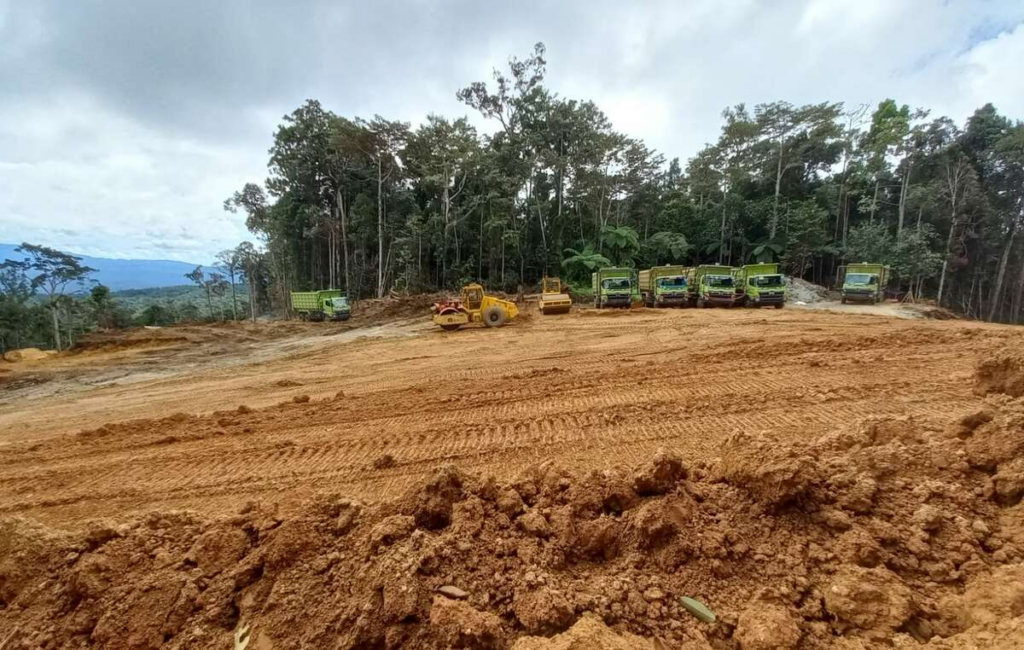
Their rainforest sits on lands rich in nickel, a metal increasingly sought after as an ingredient in the manufacture of electric car batteries. Indonesia is now the world’s largest producer of nickel, and Halmahera is estimated to contain some of the world’s largest unexploited nickel reserves. Nickel is not essential for these batteries, but now that the nickel market is booming, mining companies are homing in and tearing up huge swathes of rainforest.
The uncontacted Hongana Manyawa are on the run. Without their rainforest, they will not survive. These cars are marketed as ecofriendly alternatives to fossil fuel powered cars, but there is nothing ecofriendly about the way nickel is being mined in Halmahera.
It goes without saying that uncontacted tribes cannot give their Free, Prior and Informed Consent to exploitation of their land – which is legally required for all ‘developments’ on Indigenous territories under international law.
Nevertheless, Weda Bay Nickel (WBN) – a company partly owned by French mining company Eramet – has an enormous mining concession on the island which overlaps with Hongana Manyawa territories. WBN began mining in 2019. Since then, huge areas of rainforest which the Hongana Manyawa call home have already been destroyed. The company plans to ramp up the mining to many times its current rate and operate for up to 50 years.
We still have a sacred forest but there are not many animals there. Now it is peatlands, it is no longer good forest.
Hongana Manyawa man
The Indonesian government claims that nickel mining is “critical for clean energy technologies” yet coal-fired power stations are being constructed at IWIP to process the nickel. The International Energy Agency estimates that 19 metric tons of carbon are released for every metric ton of nickel smelted and there is evidence from a similar project in Sulawesi of this leading to respiratory diseases for locals. Not only is this mining (accompanied by roads, smelters and other huge industrial projects) devastating the Hongana Manyawa’s rainforests, it is also polluting the air and damaging the rivers. The processing of nickel is often highly toxic, involving a host of chemicals which produce almost two metric tons of toxic waste for every metric ton of ore processed.
They are poisoning our water and making us feel like we are being slowly killed.
Hongana Manyawa woman
Eramet, Tesla and connected companies
International companies are involved, directly or indirectly, in the mining of uncontacted Hongana Manyawa land.
WBN is a joint venture between several companies, but French company Eramet is part-owner and responsible for the mining itself. Eramet prides itself on its environmental and human rights credentials, claiming that it will “set the standard” and “be a benchmark company” when it comes to human rights. Yet it continues to mine on the territory of the uncontacted Hongana Manyawa.
Survival has learned that German chemical company BASF is also planning to partner with Eramet to build a refinery in Halmahera and that a possible location for this may be on uncontacted Hongana Manyawa territory. This would be devastating for the uncontacted Hongana Manyawa in the area, who are already in hiding from mining.
Watch this Tribal Voice interview with two Hongana Manyawa elders, decrying the destruction of their rainforest and stating plainly that they do not give consent for nickel mining companies to take their land:
Survival has been told that uncontacted Hongana Manyawa are now fleeing further and further into the rainforest, traumatized by the attacks on their forests and way of life.
Trees are gone and replaced with the big road, where giant machines go in and out making noise and driving the animals away.
Tesla, the world’s largest electric vehicle company, has signed contracts worth billions of US dollars to buy Indonesian nickel and cobalt for its batteries. Its CEO Elon Musk has also had high level negotiations with the Indonesian government to open an electric car battery factory in the country. Indonesia’s President Joko Widodo has even offered Tesla a ‘nickel mining concession.’
Tesla’s Indigenous rights policy states: “For all raw material extraction and processing used in Tesla products, we expect our mining industry suppliers to engage with legitimate representatives of indigenous communities and include the right to free and informed consent in their operations.”
Yet Tesla has now signed deals with Chinese companies Huayou Cobalt and CNGR Advanced Material, both of which have links to nickel mining in Halmahera. While supply chains are secretive and often obscure, Tesla’s interests in Indonesia and the scale of the planned mining in Halmahera make it likely that nickel mined from Halmahera could well end up in Tesla cars.
I do not give consent for them to take it…tell them that we do not want to give away our forest
Hongana Manyawa woman
Demand for electric cars is driving the destruction of uncontacted people’s lands.
Rather than destroying yet more of the natural world, and the people who defend it, in the name of combating climate change, we should be supporting uncontacted tribes to defend their rainforests and their land rights; they are the guardians of the green lungs of the planet.
We the Hongana Manyawa, do not want a mine to come, because it will destroy our forest. We will really defend this forest. If the forest is damaged, then where will we live?
Hongana Manyawa man
Take Urgent Action for the Hongana Manyawa
The Hongana Manyawa are running out of forest and running out of time. They desperately need international support to stop the destruction of their homelands before it’s too late.
The Hongana Manyawa’s land rights must be recognised. Survival is calling for the declaration of an emergency zone for the uncontacted Hongana Manyawa. Around the world, Survival has successfully campaigned for the land rights of uncontacted tribes, defending them from outsiders bringing in deadly diseases and devastating development projects which could destroy them.
We are calling for:
– Eramet and the other companies mining in Halmahera, to immediately abide by international law and stop mining and other developments on the lands of uncontacted tribal people. – Tesla and other car companies to publicly commit to ensure that none of the nickel or cobalt they buy ever comes from the lands of the uncontacted Hongana Manyawa in Halmahera. – The Indonesian government to establish an ‘Uncontacted Tribe No-Go Zone” to protect the uncontacted Hongana Manyawa and their territories.
With your support, the territories of the uncontacted Hongana Manyawa can be protected from mining so that they can continue to live as they choose on their own land.
I want to share my knowledge with my grandchildren and those who want to learn how to eat and live in the forest.
After decades of demands by Indigenous people, Vatican ‘repudiates’ theories that backed colonial-era seizure of lands.
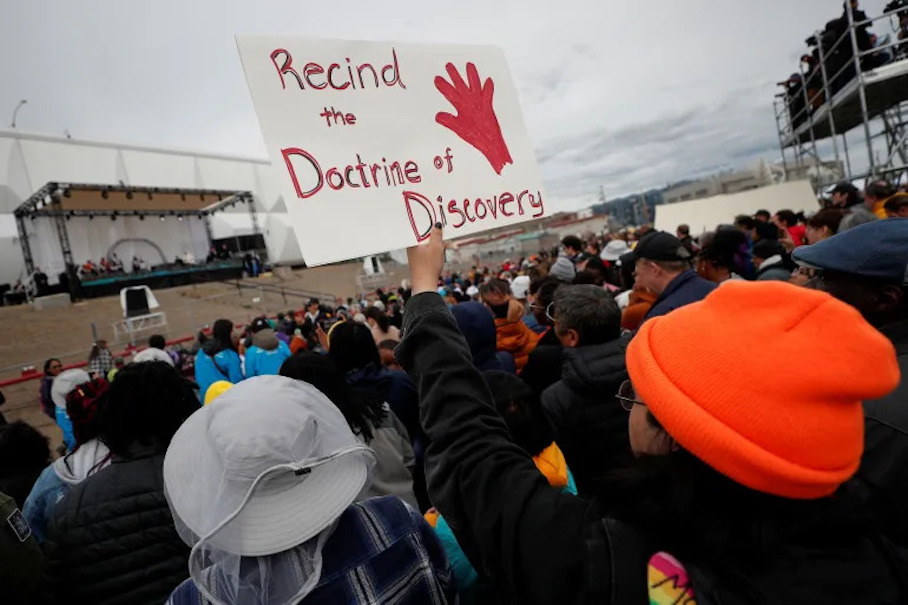
The Vatican has rejected the “Doctrine of Discovery”, a 15th-century concept laid out in so-called “papal bulls” that were used to justify European Christian colonialists’ seizure of Indigenous lands in Africa and the Americas.
In a statement on Thursday, the Vatican’s development and education office said the theory (PDF) – which still informs government policies and laws today – was not part of the Catholic Church’s teachings.
It said the papal bulls were “manipulated for political purposes by competing colonial powers in order to justify immoral acts against Indigenous peoples that were carried out, at times, without opposition from ecclesiastical authorities”.
“In no uncertain terms, the Church’s magisterium upholds the respect due to every human being,” the statement reads. “The Catholic Church therefore repudiates those concepts that fail to recognize the inherent human rights of Indigenous peoples, including what has become known as the legal and political ‘doctrine of discovery’.”
For decades, Indigenous leaders and community advocates had urged the Catholic Church to rescind the Doctrine of Discovery, which stated that European colonialists could claim any territory not yet “discovered” by Christians.
The papal bulls played a key role in the European conquest of Africa and the Americas, and their effects are still felt by Indigenous people.
Calls to rescind the Doctrine of Discovery grew louder last year when Pope Francis made a trip to Canada during which he apologised for the Catholic Church’s role in widespread abuses that took place at so-called residential schools.
Between the late 1800s and 1990s, more than 150,000 Inuit, First Nation and Metis children across Canada were taken from their families and communities and obligated to attend the forced-assimilation institutions, which were rife with physical, psychological and sexual violence.
The Haudenosaunee External Relations Committee said at the time of the pope’s residential school apology that more action was needed from the church – notably, the revocation of the papal bulls.
“An apology to Indigenous Peoples without action are just empty words. The Vatican must revoke these Papal Bulls and stand up for Indigenous Peoples’ rights to their lands in courts, legislatures and elsewhere in the world,” the committee said in a July 2022 statement.
Indigenous leaders welcomed Thursday’s Vatican statement, even though it continued to take some distance from acknowledging actual culpability.
Phil Fontaine, a former national chief of the Assembly of First Nations in Canada who was part of the delegation that met with Pope Francis at the Vatican before last year’s trip and then accompanied him throughout, said the statement was “wonderful”.
He said it resolved an outstanding issue and now put the matter to civil authorities to revise property laws that cite the doctrine.
“The Holy Father promised that upon his return to Rome, they would begin work on a statement which was designed to allay the fears and concerns of many survivors and others concerned about the relationship between their Catholic Church and our people, and he did as he said he would do,” Fontaine told The Associated Press news agency.
“Now the ball is in the court of governments, the United States and in Canada, but particularly in the United States where the doctrine is embedded in the law,” he said.
“Today’s news on the Vatican’s formal repudiation of the Doctrine of Discovery is the result of hard work and advocacy on the part of Indigenous leadership and communities,” Canadian Justice Minister David Lametti wrote on Twitter. “A doctrine that should have never existed. This is another step forward.”
The Doctrine of Discovery was cited as recently as a 2005 US Supreme Court decision involving the Oneida Indian Nation and written by the late Justice Ruth Bader Ginsburg.
On Thursday, the Vatican offered no evidence that the three papal bulls (Dum Diversas in 1452, Romanus Pontifex in 1455 and Inter Caetera in 1493) had themselves been formally abrogated, rescinded or rejected, as Vatican officials have often said.
But it cited a subsequent papal bull, Sublimis Deus in 1537, that reaffirmed that Indigenous peoples should not be deprived of their liberty or the possession of their property, and were not to be enslaved.
Cardinal Michael Czerny, the Canadian Jesuit whose office co-authored the statement, stressed that the original papal bulls had long ago been abrogated and that the use of the term “doctrine” — which in this case is a legal term, not a religious one — had led to centuries of confusion about the church’s role.
The original papal bulls, he said, “are being treated as if they were teaching, magisterial or doctrinal documents, and they are an ad hoc political move. And I think to solemnly repudiate an ad hoc political move is to generate more confusion than clarity”.
He stressed that the statement was not just about setting the historical record straight, but “to discover, identify, analyse and try to overcome what we can only call the enduring effects of colonialism today”.
Michele Audette, an Innu senator who was one of the five commissioners responsible for conducting the National Inquiry into Missing and Murdered Indigenous Women and Girls in Canada, told the Canadian Broadcasting Corporation that the announcement left her in disbelief.
“It’s big,” she said in an interview on CBC Daybreak. “That doctrine made sure we did not exist or were even recognised … It’s one of the root causes of why the relationship is so broken.”
In December 2022, the United States Supreme Court adopted changes to its rules. The Native American Rights Fund (NARF) is happy to report that in those changes is a big win for Indian Country, one for which NARF actively advocated on behalf of tribal nations. Specifically, in the 2023 rules, tribal governments will be allowed to file longer amicus briefs, in recognition of their status as governmental entities. This change comes after NARF submitted comments to the Court urging that tribal governments be treated equally to federal, state, and local governments.
In 2019, the Court adopted rules that reduced the length allowed for many amicus briefs filed with the Court. However, briefs filed by federal, state, and local governments were permitted a much higher word count. Notably, tribal governments were not included in the list of governmental entities exempted from the restrictions. Therefore, during the next revision process (held in 2022), NARF submitted comments addressing this disparity.
NARF’s comments to the Court detailed why the change was right and needed. On a basic level, including tribes in the list of governmental entities is consistent with how other branches of the federal government treat tribes. However, it also addresses several unique issues faced by tribal interests in the Court. For example,
The higher word count for governments recognizes their unique interests in participating as amici curiae out of respect for their inherent sovereignty and/or their exercise of governmental authority. Like other governments, tribes have an interest in advocating for their powers and advancing the unique interests of themselves and their members.
Cases related to tribes’ authority, treaty rights, and resources frequently do not include tribes as parties. In those cases, tribes participate as amici, and it is critical that tribal perspectives be fully heard on those issues. The United States does not always adequately represent tribal interests in a case. In fact, the positions of the United States and tribes are not always aligned.
Similarly, in the context of Federal Indian Law, cases often address foundational constitutional law principles. Facilitating tribal participation allows tribes to provide important information and context to the Court.
NARF appreciates the opportunity to comment on the Court’s proposed rule changes and commends the Court on making this important change to properly recognize tribal sovereignty.