Author: Viktor

  • First Nations police launch human-rights complaint against Ottawa over funding

    First Nations police launch human-rights complaint against Ottawa over funding

    Police chiefs presiding over First Nations police forces in Ontario have launched a human-rights complaint alleging that the federal government is placing reserves in crisis by failing to deliver adequate funding.

    The claim, which was obtained by The Globe and Mail, was filed last week at the Canadian Human Rights Tribunal (CHRT) by police chiefs at nine First Nations police forces in Ontario. It also has the support of a group representing 22 First Nations police forces in Quebec. Altogether, the groups in both provinces make up the vast majority of self-administered Indigenous police forces in Canada.

    The police chiefs in the claim allege that Ottawa has allowed“chronic underfunding and under-resourcing of the safety of Indigenous communities,” which they say is discriminatory because it contributes to high crime in communities that were promised equitable levels of safety to communities outside reserves.

    The claim says Prime Minister Justin Trudeau and his cabinet have not followed through on public pledges to bring in legislation to improve security by enshrining First Nations policing programs into law as an essential service, which could lead to greater levels of funding.

    “Despite these commitments made by the leader of this country, the complainants now find themselves in a manufactured public safety crisis,” reads the 32-page filing to the CHRT. In the complaint, the police chiefs say that inflexible federal civil servants are crafting deals through “negotiation tactics aimed at forcing First Nations to sign unfair, discriminatory funding agreements.”

    The complaint seeks damages of $40,000 per reserve resident as well as orders directing Ottawa officials to negotiate deals in better faith.

    The police chiefs’ claim echoes a similar case over alleged underfunding of the Indigenous child-welfare system. A CHRT ruling in 2016 led to a $40-billion compensation plan announced five years later. That complaint also sought $40,000 for each affected person.

    Last year, the CHRT ruled that government underfunding of the Mashteuiatsh Police Service in Pekuakamiulnuatsh First Nation in Quebec was discriminatory.

    The new complaint amounts to an indictment of the federally runFirst Nations and Inuit Policing Program (FNIPP), a 30-year-old funding formula created to put more police on Canada’s reserves by splitting costs with provinces.

    The federal government now pays about $200-million each year into the program, which has created nearly 40 Indigenous police forces. But police chiefs leading most of these organizations support the new rights complaint. The federal Department of Public Safety did not immediately reply to e-mailed questions about the legal action.

    The police chiefs said in interviews that frustrations have been building for years because funding is discretionary and never guaranteed by government. They argue the program’s short-term deal-making processes also means that Indigenous police forces may find themselves without any money at all if bargaining for a new deal breaks down.

    “We have a federal government with this First Nations and Inuit Policing Program that essentially allows the contract to expire without any mechanisms to continue the funding – that’s unconscionable,” Police Chief Kai Liu,who runs the Treaty Three Police Service across a sprawling part of northwestern Ontario, said in an interview.

    Police Chief Liu, who is also president of the Indigenous Police Chiefs of Ontario, is the lead complainant in the CHRT claim. He said his own police force is one of three in Ontario whose funding agreements expired at the end of the fiscal year this past weekend without any arrangements assuring future funding being put in place. Negotiations with the federal government are continuing for a new deal.

    Federal civil servants, he said, have told him that government funds cannot be used to pay for lawyers who act for Indigenous communities and policing services in these negotiations. The money also comes with restrictions that it cannot be used to create police squads such as tactical units or canine teams.

    He and other forces are demanding change. Such positions “make no logical sense when it comes to policing,” said Chief Liu. He said, the lack of a deal in his jurisdiction risks demoralizing overworked officers who are already struggling to respond to emergency calls in a timely manner.

    While police response times are at issue across rural Canada, First Nations can face much higher crime rates than other communities. Last September, a man killed 11 people and wounded 18 others in a mass stabbing centred on the James Smith Cree Nation in northern Saskatchewan. That violent rampage drew national attention and raised questions about why nearest police were posted at a detachment 45 kilometres away.

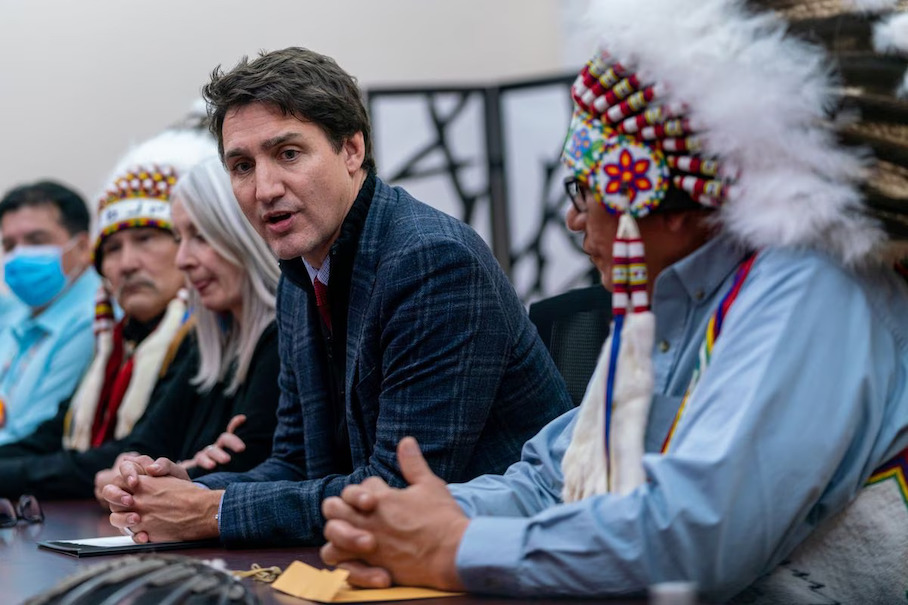
    The CHRT complaint points out that Mr. Trudeau promised new policing measures when he visited the James Smith in the aftermath of the rampage. “Prime Minister Trudeau announced a renewed commitment to ensuring First Nations benefit from the same standard of policing available to non-Indigenous communities,” the complaint says.

    In 2019, the final report of the National Inquiry into Missing and Murdered Indigenous Women and Girls urged the federal government to replace the FNIPP with legislation that would “immediately and dramatically transform Indigenous policing.” Later that year, Mr. Trudeau wrote a mandate letter directing his cabinet ministers to develop that law but federal officials last month told The Globe they cannot give any timelines.

    The police chiefs at several First Nations forces say they cannot wait for a bill. “It’s like saying the cheque is in the mail,” said Chief Shawn Dulude of the Akwesasne Mohawk Police Service.

    He leads the First Nations police chiefs’ organization in Quebec and said the 22 forces intend to intervene at the human-rights tribunal in support of the Ontario complaint.

    “I’m afraid that we’re going to see a third mandate go by and what they promised us will not have materialized,” he said, referring to Mr. Trudeau’s Liberal government.

    Last month, a Globe investigation into First Nations policing in Saskatchewan revealed how the FNIPP is not reaching residents of many reservesin that province. Citing The Globe’s reporting, the new rights complaint says this is just one example of a program that has gone off track.

    Julian Falconer, the lawyer acting on behalf of the First Nations police chiefs in Ontario, says the FNIPP was created with the stated goal of ensuring that residents of reserves are as safe as Canadians living outside of them.

    But federal officials have stopped using this language, he said, and that’s significant. “We call it the phantom policy. It’s concealed from public view.”

    Source

  • Sámi rights must not be sacrificed for green energy goals of Europe

    Sámi rights must not be sacrificed for green energy goals of Europe

    • Last week, the European Commission released the Critical Raw Materials Act for minerals used in renewable energy and digital technologies.
    • It mandates that EU countries should be extracting “enough ores, minerals and concentrates to produce at least 10% of their strategic raw materials by 2030,” and part of that looks likely to come from mines on Indigenous Sámi land.
    • Mines already sited there have caused pollution, devastated ecosystems, poisoned reindeer forage, and taken away their reindeer grazing areas. “How can this transition be sustainable if it destroys our land and violates our Indigenous and human rights?” a new op-ed asks.
    • This post is a commentary. The views expressed are those of the author, not necessarily of Mongabay.

    Growing up in Gällivare/ Váhtjer, a Swedish village in Sápmi, north of the Arctic Circle, the threats facing Sámi people were a daily reality.

    We are Europe’s only Indigenous people, but colonialism means our territory, Sápmi, is split across four countries: Sweden, Finland, Norway and Russia.

    But across these national borders, the same pressures bear down on us, from mining to forestry and wind farms.

    Dry pike. Image by Jan-Eerik Paadar / Sámediggi Saamelaiskäräjät (the Sámi Parliament) via Flickr (CC BY-NC-SA 2.0).
    Fish drying outside a Sámi cabin. Image by Jan-Eerik Paadar / Sámediggi Saamelaiskäräjät (the Sámi Parliament) via Flickr (CC BY-NC-SA 2.0).

    For outsiders’ commercial gain, our land has been seized, our people displaced, and the reindeer herding that’s been the foundation of our lives for millennia, eroded.

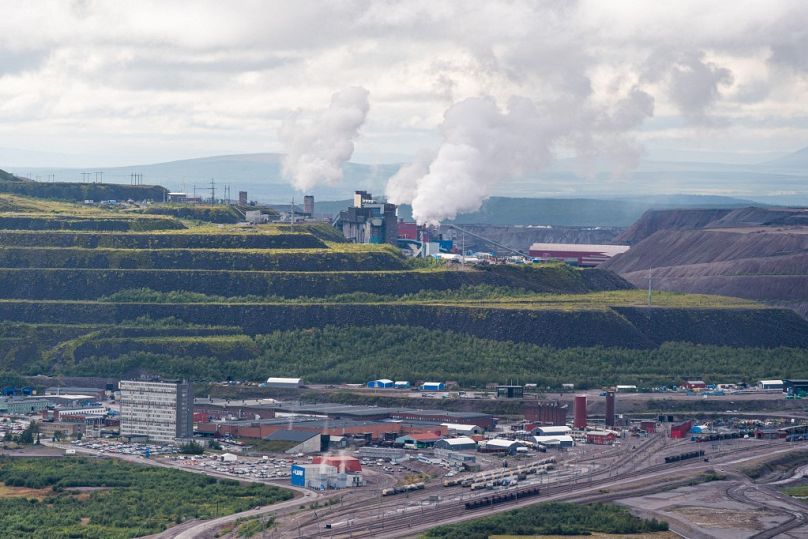
    Adjacent to my village is Malmberget, a scene of deep mine iron ore extraction, and a little over 100 kilometers away is Kiruna, the world’s largest underground iron mine. Both are owned by Luossavaara-Kiirunavaara AB (LKAB), the 100% state-owned Swedish mining company.

    Kiruna is one of the nine out of 12 mines in the north of Sweden which are on Sámi land. These mines – as well as the infrastructure accompanying them – have caused pollution, devastated ecosystems, poisoned the lichen that our reindeer survive on, and  taken away our reindeer grazing areas.

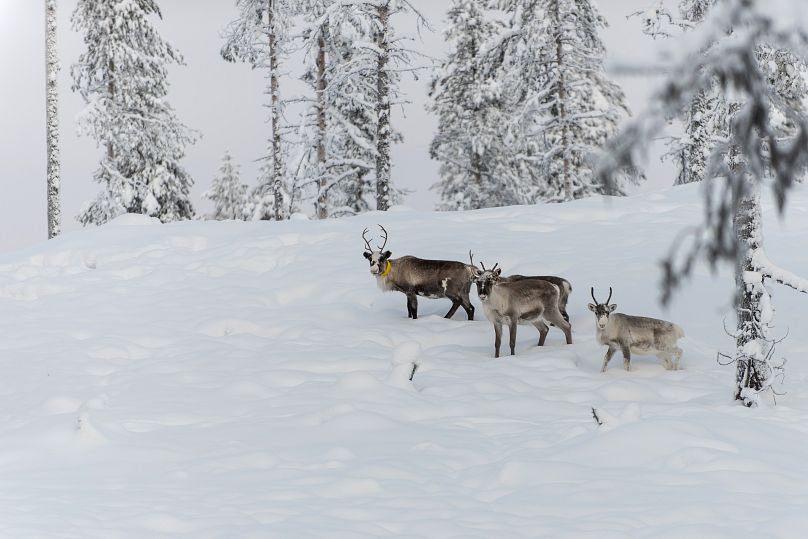
    Herd of Finnish forest reindeer in Finland. Image by Sámediggi Saamelaiskäräjät (Sámi parliament) via Flickr (CC BY-NC-SA 2.0).
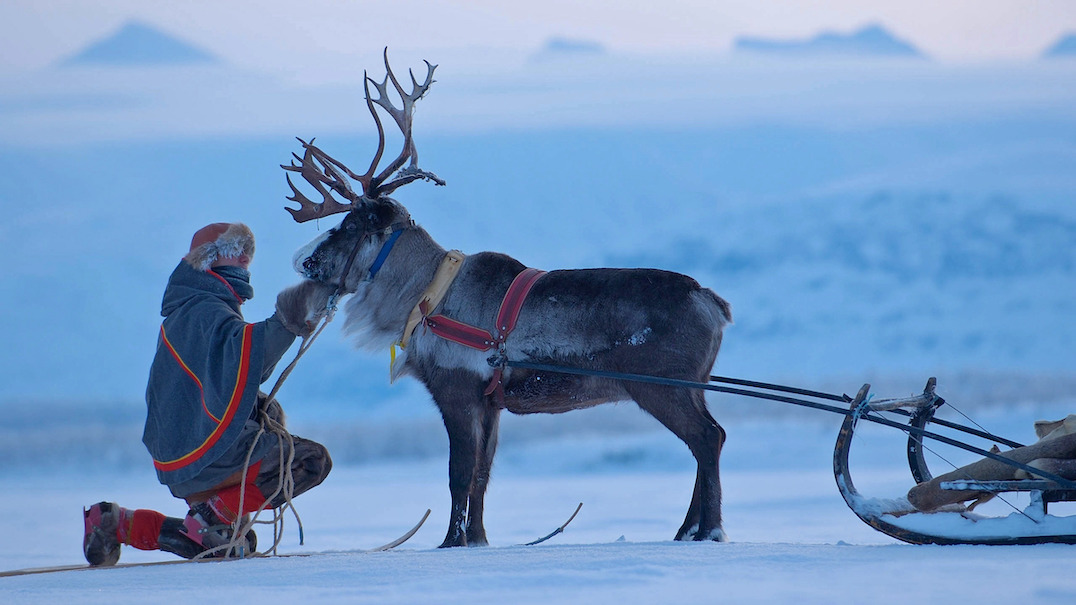
    A Sámi herd of reindeer in Finland. Image by Sámediggi Saamelaiskäräjät (the Sámi parliament) via Flickr (CC BY-NC-SA 2.0).

    More mining

    Now a new danger has emerged.

    European Union policymakers want to secure the ‘critical raw materials’ which its Member States need for the green energy and digital transitions. They’ve identified 30 raw materials as being of vital strategic and economic importance.

    By 2030, according to a report based on the draft text of the European Commission’s Critical Raw Materials Act (CRMA), which was just released on March 16, EU countries should be extracting “enough ores, minerals and concentrates to produce at least 10% of their strategic raw materials by 2030.”

    This will mean that they want to increase mining on our land.

    Mineral rush

    In January, LKAB announced that it had found Europe’s largest deposit of rare earth elements north of Kiruna. They calculated that the deposit contains at least one million tons of rare earth oxides, minerals used in everything from electric vehicles to wind turbines to mobile phones.

    As the rush to extract these and other critical raw materials intensifies, the Sámi people are being told that we have to ‘co-exist’ with mining. Yet co-existence always means us moving and changing our traditional way of life: a way of life that has existed alongside nature for a long, long time.

    We are also told that these operations are sustainable and part of the green energy transition. But how can this transition be sustainable if it destroys our land and violates our Indigenous and human rights?

    Conference of Sámi parliamentarians in Inari on 19 May 2022. Image by Johanna Alatorvinen / Sámediggi Saamelaiskäräjät (the Sámi Parliament) via Flickr (CC BY-NC-SA 2.0).
    Conference of Sámi parliamentarians in May 2022. Image by Johanna Alatorvinen / Sámediggi Saamelaiskäräjät (the Sámi Parliament) via Flickr (CC BY-NC-SA 2.0).

    The United Nations has criticized the Swedish, Finnish and Norwegian governments for violating  Sámi rights in the past. For example, in 2020 the UN Committee on the elimination of Racial Discrimination condemned Sweden for ignoring Sámi rights by establishing a mine in Rönnebäck. It also called on Sweden to revise its mining legislation to ensure that it respects and complies with the Sámi people’s rights, saying that Swedish law didn’t provide the Sámi reindeer herding community with a real opportunity to have the legality of the mining project tested before the courts.

    And earlier this month, the Norwegian government was forced to apologize to Sámi reindeer herders for violating their rights by issuing licenses to operate  wind farms on the Fosen peninsula, after the Supreme Court ruled in the herders’ favor.

    The overwhelming message in these cases – and throughout Sámi history – is  that we must have a say in any decisions that fundamentally affect our lives.

    As such, our right to Free, Prior and Informed Consent (FPIC) to any mining, wind farms or forestry on our land should be sacrosanct: FPIC is a fundamental right, not merely a principle, as the Swedish government claims.

    The EU must also recognize and support this right. A good start would be by enshrining FPIC in the CRMA.

    Source

  • Polarization in Siberia: Thwarted Indigeneity and Sovereignty

    Polarization in Siberia: Thwarted Indigeneity and Sovereignty

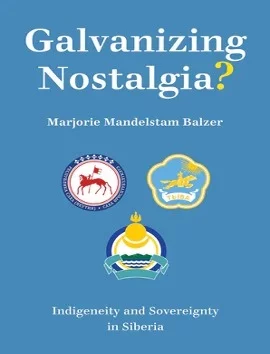
    Marjorie Mandelstam Balzer updates her monograph Galvanizing Nostalgia?  to explore why many in the republics are against Russia’s war in Ukraine.  Drawing on long-term fieldwork in Sakha, Tyva and Buryatia and with diaspora communities, she outlines an uneven legacy of revitalization and grievances in relation to the Kremlin and its policies.

    As we rethink our approaches to Russia, its colonizing history, and its current leaders’ aggressions against Ukraine, we must also consider vast parts of Russia’s eastern lands that are understudied and too often misunderstood. A Sakha (Yakut) engineer explains that most of his mining friends abhor Russia’s war in Ukraine. A creative gaming company founded in Yakutsk has decamped to Thailand with hundreds of its IT workers’ families. COVID crisis call centers in some republics have switched to mobilization information, fielding calls mostly from frantic women trying to save their husbands and sons. Women protesters in Yakutsk braved cold and jail to stage an antiwar dance chant (ohuokhai) in the main square; many were arrested.

    Such narratives challenge surveys and publicity asserting that most “Russians” (Rossiyane) patriotically support the war or are not courageous enough to oppose it. Resistance, including arson against military recruitment offices, has diversified. Are non-Russians inside the republics, given their disproportionate mobilization, the exception to generalizations about citizen support for Putin’s fatal regime? Could Russia’s faltering “Federation” fall apart? These and other hot issues regarding the peoples of Siberia are explored in my Galvanizing Nostalgia? Indigeneity and Sovereignty in Siberia, featuring long-term anthropology fieldwork in three republics, Sakha, Buryatia and Tyva. I argue that Northeastern territories, disproportionately influenced by climate change, hold important keys to Russia’s wealth, development, and stability.

    One theory about the timing of the invasion of Ukraine suggests that Putin hoped for a diversionary victory that could unite Russia’s multiethnic peoples against an artificial outside enemy, staving off domestic political, economic and ecological discontent. Instability and dissent have been building in the republics since Putin came to power and abrogated Yeltsin’s 1990s negotiated bilateral treaties. Polarization has grown, although secessionist claims were rare until the Ukraine war, and today are expressed mostly by diaspora politicians without relatives inside who could be punished.

    Sakha: Resource Rich and Pivotal

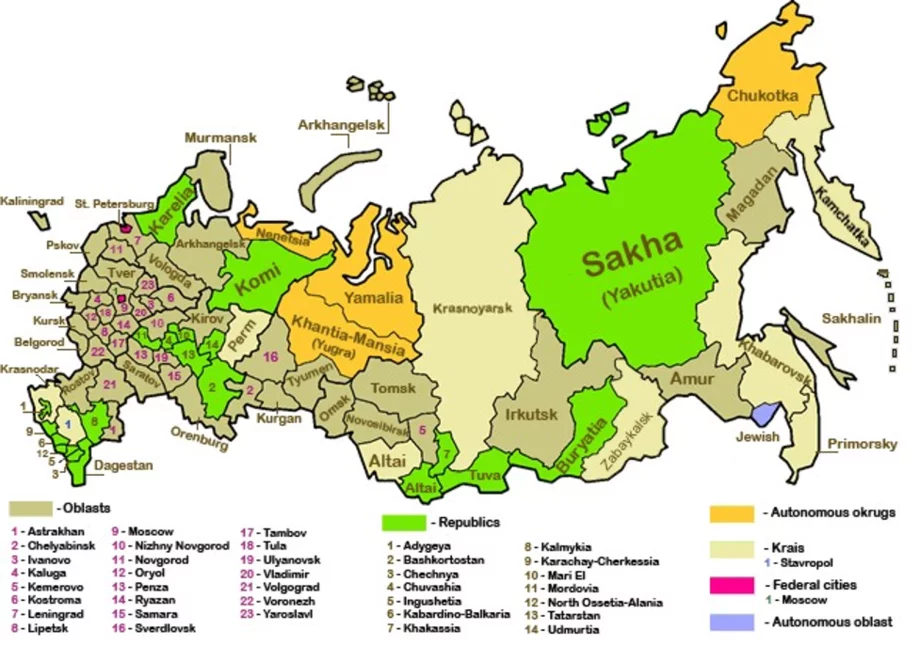
    The Sakha Republic, said to contain most of Mendeleev’s table, is crucial for Russia’s war economy. Its Putin-appointed yes-man leader Aisen Nikolaev has conformed to central pressures, including at a Northern Forum conference in late 2022, where a Soviet-style panel celebrating “100 years of republic sovereignty within Russia” lauded a history of mutually beneficial federal relations enabling “massive investment projects, social programs, increased infrastructure, resource innovation, spiritual development and the growth of unique culture.”

    “But this paternalistic propaganda is belied by resentments against resource extraction without environmental protections and by economic recentralization that has robbed the republic of their cuts of diamond profits.”

    Sakha citizens use an old Sakha word “Il Darkhan” (Elder-Leader) for their head of government to cleverly avoid the forbidden term President, and are proud of their Turkic language. The Sakha have regained a slim majority in the republic over the plurality Russian and Ukrainian population, in addition to Even, Evenki and Yukaghir Indigenous minorities. Many republic citizens, sometimes calling themselves Yakutiane, dream of greater negotiated sovereignty and hide their sons in disgust against a war they refuse to gloss as a righteous “military operation.”

    Buryatia: Gerrymandered and Struggling

    Buryatia, impoverished and gerrymandered, has a legacy as a once powerful Mongolic Buddhist state on the border with Mongolia. The dismemberment of “Greater Buryatia” began in the early Soviet period precisely because Russian central authorities perceived Buryat-Mongols as a serious threat. Today the Buryat constitute about a third of the Republic of Buryatia. They lost under Putin two satellite regions, Ust-Orda and Aga, sequentially amalgamated by rigged referenda in 2006 and 2008 into neighboring Irkutsk and Chita (now Zabaikalsk Krai) regions. Powerless to resist, many Buryat nonetheless resent land claims, privatization, non-negotiated development, and propaganda since 2014 that has proclaimed them “Putin’s Militant Buryats.” While Buryatia is known for high education rates and pervasive Russification, Buryats have fought for their language rights and the ecology of Lake Baikal together with some Russian allies. Their first President Leonid Potapov in the 1990s was a Buryat-speaking Russian. The initial post-Soviet period enabled conditions for successful revival of shamanic and Buddhist spirituality in the republic, and also for an influx of Chinese and other outsiders.

    Tyva: A Borderline State with Demographic Advantages

    Tyva (Tuva), nestled in the Altai-Sayan Mountains, came into the Soviet Union as a mere oblast at approximately the same time as the Baltic States. From 1921-44, the country of Tannu (Taiga)-Touva had its own monetary unit called aksha, and collector-worthy stamps. With longer borders than the current republic, it had been a protectorate of Mongolia in the early twentieth century. It became a republic inside Russia (RSFSR) quite late, 1961. Empowered by demographics but not mineral wealth, the republic is well over three quarters Tyvan. Many Russians fled its territory after anti-Russian unrest as the Soviet Union dissolved. In the early 1990s, a party called “Khostug Tyva” (Free Tyva) advocated separation from Russia, but cooler heads prevailed, such as that of activist Kadyr-ool Bicheldei, and Tyva accepted its economic dependency on Moscow. It is native son Sergei Shoigu has become Putin’s friend and Minister of Defense. Many of its impoverished unemployed youth have become soldiers on the front lines of the Ukraine war, despite their Buddhist backgrounds. Sadly, some became targets of seemingly racist Donetsk republic militias’ brutalization.

    Soviet-style repressions and Revitalization

    Cultural and civilizational ties among citizens of the eastern republics have been alternately ignored or considered threatening at various levels of government. Practicing divide and rule strategies, Soviet authorities repressed pan-Turkism, pan-Mongolism and homegrown Eurasianism without valuing their potential influence in defusing chauvinist types of more narrow nationalism. All three of these crossover ideologies have blossomed in the post-Soviet period with horizontal contacts, fluctuating degrees of official support, attempted cooption and understanding. People are nostalgic for various pasts, differentially interpreted and used in leaders’ rhetoric in various ways. Multiple and situational identities have flourished as many Siberians have become increasingly cosmopolitan. Particularly fascinating have been cross-republic revivals of shamanic and Buddhist activism, enabling all three republics to open themselves to mutual cultural pilgrimage, tourism and international spiritual seeking. The popular movement of shaman Alexander represents an example of the Putin regime’s return to Soviet-style repression of dissent using punitive psychiatry.

    The China factor

    A controversial aspect of politics and economic dependencies involves the degree of China’s influence in Russia’s eastern territories. While the Chinese presence is significant, it is crucial for analysts to be geographically nuanced, differentiating regions from sub-regions, republics from oblasts, and Siberia from the Far East, two separate mega-zones in official Russian conceptions. China has historical claims on certain territories north of the Amur River, but is far less interested in occupying all of Siberia in the Western sense. The presence of seasonal Chinese traders and workers in the Sakha Republic hardly makes it a target of territorial expansion. A Power of Siberia pipeline running to China does not give the Chinese territorial rights, nor does their observer status in the Arctic Council.

    Ethnonational fault lines

    Further interethnic complexities are built into Russia’s legal definition of “Indigenous people,” which diverges from international usage. Russian law defines its “Native” (korennye, from ‘rooted’) peoples as only “small-numbered” (under 50,000), while United Nations definitions incorporate larger non-state ethnonational groups with long-recognized homelands, such as the Sakha, Buryat, Tyvans, Khakas and Altaians. While recognition as Indigenous can be beneficial in the international context, it is less commonly used by peoples with named (titular) republics. A two-tiered system exists within the republics for “small-numbered” peoples, such as the Even, Evenki, Yukaghir, Todja, Akha and Soyot, some of whom complain of dual assimilation pressures. These are compounded by restrictive 2022 registration procedures, and new decrees that mobilize previously exempt Siberian Natives into the war in Ukraine. Many groups claim victimization with discourses raging along ethnonational lines. This influences how non-Russian elites in the republics think about their relationships with the federal center.

    Russia’s valiant but dispersed opposition and its multinational “matryoshka doll” composition reveal fault lines in Russian society. While wide-ranging protests have been repressed, hopes for cultural, personal and societal dignity have not. Each republic within Russia valorizes different legacies, and has had various relationships with Moscow in the past century. Some are more polarized than others, especially those in the North Caucasus. Russia’s society is more fragile than many analysts realize. Whether Russia eventually will fragment along the lines of its republics, or hold at least partly together in a real federation through negotiation and nested sovereignty depends on its peoples pulling back from dangers of violence that result from mutual polarization. Siberians merit being on the map of international awareness, for their striking multiethnic histories and their strategic significance for Russia’s survival.

    As the most enterprising and morally attuned of Russia’s multiethnic intelligentsia and workers abandon the country, recovering intertwined cultural, societal, political, ecological and economic conditions that could heal Putin’s authoritarianism becomes increasingly unrealistic. Russia may spiral out of any single leader’s control.

    Source

  • Dmitry Berezhkov. Indigenous peoples is an integral part of the Arctic security

    Dmitry Berezhkov. Indigenous peoples is an integral part of the Arctic security

    Today the Arctic security is threatened on all fronts, from extractive industries development and toxic contamination to the world’s fastest climate change. Recent political tensions between the West and Russia and the start of the war in Ukraine are putting Arctic security in a condition similar to the most hectic times that Arctic stakeholders experienced 40 years ago and earlier. And once again, as decades ago, the most vulnerable are becoming the most affected ones, including the Arctic indigenous communities.

    In Russia, the Arctic is a home to multiple indigenous peoples. According to Russian official statistics, about one-third of the small-numbered indigenous peoples of the Russian North, Siberia, and the Far East live in the Arctic environment.

    The Russian indigenous movement is a relatively young one. It emerged after the collapse of the Soviet Union based on international law and the rapidly developing democratization of regional processes in 1990s Russia.

    The Arctic has always been a focus of the Russian indigenous self-determination agenda. Following the wave of Gorbachyov’s democratization, the Russian Government agreed to include the newly established Russian indigenous peoples’ organization, RAIPON, as a Permanent Participant in the Arctic Environmental Protection Strategy from the Russian side in 1991. As a result, the Arctic became the only region where Russia recognized indigenous peoples as valuable stakeholders of the international development agenda.

    Further established Arctic Council became a unique interstates organization that recognized indigenous peoples as almost equals in decision-making. Unfortunately, it was the only Russian experience, as nowhere else Russia considered indigenous peoples as equal partners or even stakeholders in decision-making.

    In general, negotiations with indigenous peoples within the Arctic Council have always been used by Russia as a presentational model for foreign officials and investors rather than as an actual pilot project for building partner relations with indigenous peoples.

    But since the returning Vladimir Putin to the Kremlin in 2012 and especially after the annexation of Crimea in 2014, the Russian Government tightened its control over the non-governmental sector and ethnic organizations, so today, RAIPON’s role has primarily been reduced to rubber-stamping government decisions.

    After the war in Ukraine started in February 2022, the Western segment of the Arctic Council officially put the Arctic cooperation on hold. As a result, the Arctic Council and its unique model of interstate negotiations, with the involvement of the Indigenous organizations in decision-making, stepped into a zone of turbulence. Later it was announced the Council would ‘implement a limited number of projects that do not involve Russian participation. Meanwhile, Russia, who ironically holds the Council’s two-year rotating chairmanship, is doing it in complete solitude.

    The Russian invasion influenced the country’s indigenous peoples on various fronts: through division of the indigenous movement, censorship, and silencing of indigenous representatives who opposed the war or even protecting their environmental rights, as Russian authorities now widely consider such actions as an antistate activity.

    As the Russian-Ukranian conflict rages, the following questions are being raised: How will the conflict influence Russia’s and Arctic indigenous communities? How will it impact the states’ approach to indigenous peoples’ political development? How does it reflect on Arctic international relations and the Arctic Council, which has been perceived as one of the last major West-involved international platforms in which the Russian Federation remained a significant partner?

    Notably, the seven Western states decided to boycott the Arctic Council without consultations with the Permanent Participants. For indigenous organizations, it signals a tectonic shift in regional governance and international legal practice and jeopardizes the hard-won slot of indigenous voices at the Arctic decision table.

    Russia’s attack on Ukraine provoked a split among Arctic indigenous organizations themselves. The two-decade efforts to build up and strengthen relationships were torn down overnight. RAIPON openly aligned with the Government and supported Vladimir Putin’s actions in Ukraine. Saami Council suspended formal relations with Kola Sámi in the Murmansk region. At the moment, the Russian Government turned the Arctic Council’s indigenous agenda into a platform for aggressive propaganda under the RAIPON flag.

    It is hard to tell precisely what Russia’s current indigenous policy is being aimed at. While seemingly aimed at the conservation of certain elements of indigenous cultures and symbolic markers of national identity like folklore, museums, languages and others, it takes the focus away from more substantive discussions regarding the reclamation of indigenous territories, livelihoods, natural resources, and self-government, and most importantly, from the discourse of rights per se. Instead, indigenous issues are handled in an increasingly paternalist manner.

    Before February 2022 country’s strong paternalism was tempered by the presence of international actors in the region. Today, the Russian state is relentlessly nullifying any indigenous self-governance progress by tightening the state’s control over the lands and resources.

    At the same time, we continue to believe that the region’s future cannot be discussed without Indigenous Peoples’ direct participation. Instead of fitting indigenous peoples into an existing system, states must change institutional arrangements and transfer control over indigenous lands and development agenda to indigenous institutions and actors. The legal framework must accommodate, advocate, and even take on indigenous forms instead of holding the implementation of Indigenous Peoples’ fundamental rights. The practice of indigenous rights must be in the control of indigenous people themselves.

    Then, there is always a concern about how governing structures within indigenous groups truly reflect the interests and concerns of the indigenous communities. The internationally recognized implication is that the state must engage with self-organized indigenous representative bodies and with grassroots community members to avoid the cultivation of pro-government indigenous politicians and ensure the representation of the true indigenous interests. To magnify indigenous voices and support human rights in general, Arctic stakeholders, including states, must be ready to stand up as an ally with indigenous peoples organizations or their initiatives which governments do not control in one way or another.

    What is known today is that the Arctic is heading into dark times. The region lost its status as a space immune from political tensions and matters of security and militarization. Arctic Council lost one member and is currently considering adapting its work to the new reality. The Russian Federation lost its place in the Arctic Council and its partner status in a number of strategic spheres. Permanent Participants are losing their collective voice and a hard-won seat at the table. Russian indigenous peoples lost a vital platform to address the international community, while RAIPON lost the legitimacy to represent the country’s indigenous voices.

    We all have already heard Putin’s idea of creating a multiply diverse world that will be separated into “zones of responsibility,” like Germany was divided after the Second World war. And this is an attractive concept for many. At the same time, we need to remember that there are universal values and challenges like human rights, climate issues, our connected environment, which through their nature, are not dependent on the concrete political regime in the country.

    We also heard some international voices which propose to return to the pre-Russian-Ukrainian-war model in the Arctic negotiations “to keep a channel of free-from-conflict negotiations with Russia”. This is natural when conflict sides, trying to avoid the “hot phase”, seek peaceful solutions. This is a natural form of compromising when military confrontation is at stake. At the same time, we cannot tolerate such compromises again at the expense of the most vulnerable stakeholders, including indigenous peoples.

    Dmitry Berezhkov, member of the International Committee of Indigenous Peoples of Russia (ICIPR), 10.03.2023

  • One year after Russia’s Ukraine invasion, circumpolar diplomats take stock

    One year after Russia’s Ukraine invasion, circumpolar diplomats take stock

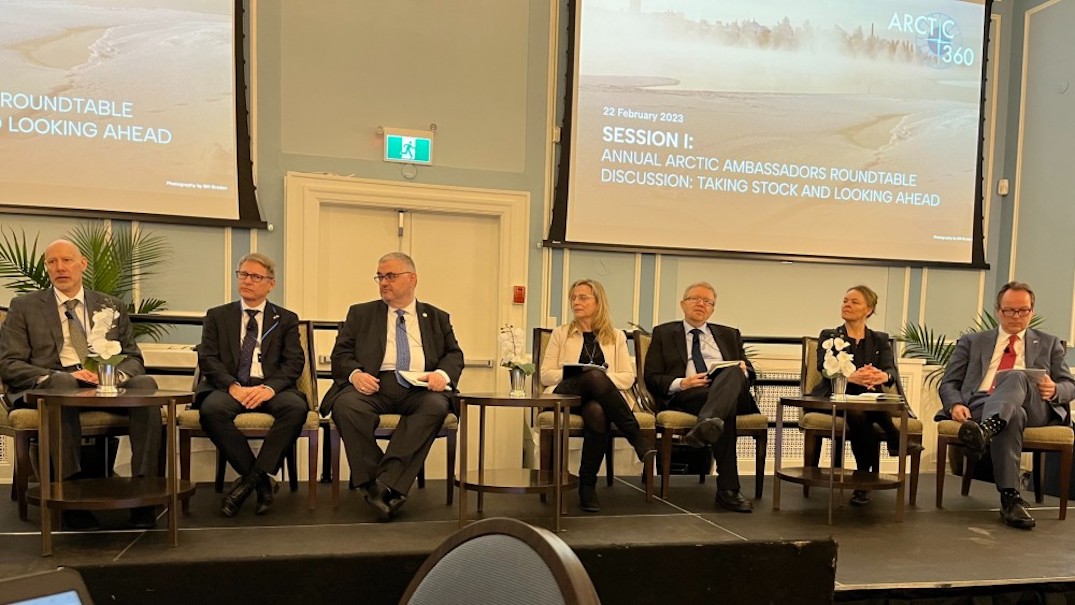
    TORONTO — Russia’s invasion of Ukraine last year upended almost 30 years of Arctic cooperation, but it’s also brought northern allies even closer together, a group of diplomats from the world’s circumpolar countries told a Canadian conference on Wednesday.

    By Eilís Quinn 

    “It’s been a very dramatic year for the world, for Europe and for North America,” Jon Elvedal Fredriksen, Norway’s ambassador to Canada, told the Arctic360 conference in Toronto. 

    “Having said that, I think it’s also important to realize that we have energized a lot of partnerships between friends in the North. I think we’ve all demonstrated that we are eager to work with each other and have a lot of themes, problems and challenges we need to work with in the Arctic regardless of what’s going on elsewhere.”

    The seven western states, often referred to as the Arctic 7, suspended their participation in the Arctic Council’s work in March 2022 in protest against Russia’s invasion saying the war undermined many of the founding principles of the Arctic forum, which include sovereignty and territorial integrity based on international law.

    In June, the A7 announced they’d resume work together on some of the forum’s projects, but without Moscow.

    Heidi Kutz, Canada’s senior arctic official and the director general of Arctic, Eurasian, and European Affairs at Global Affairs Canada, says this was an important signal to the international community and northern residents. 

    “Like-minded states reactivated their cooperation,” Kutz said. “It can’t be business as usual with Russia, and that’s obvious because of the action that they took, but in June of last year we’ve been working across our partnerships and reactivated all of those … and I think that was important.”

    Strengthening the western alliance 

    Russia’s invasion of Ukraine this year has transformed the security picture in Europe and prompted both Sweden and Finland to apply for NATO membership.

    Their applications were approved and the accession protocols for both countries were signed on July 5. Twenty-eight of the 30 member countries have ratified the protocols so far. Turkey and Hungary are the remaining two countries that need to do so.

    “What the Russian aggression on Ukraine brought forth is that I don’t think NATO, and the western alliance, has ever been so closely linked,” Roy Eriksson, Finland’s Ambassador to Canada, said. “We kind of found each other again.”

    Opportunity for closer ties with Canada 

    Eriksson said that includes bilateral relations between Ottawa and Helsinki.

     “I don’t think Finnish-Canadian relations have ever been so close as they are now,” he said.

    Norway’s Fredriksen agrees.

    “Cooperating with Russia was the centre of Norwegian High North policy. There is always limited capacity, and with that focus, there was perhaps less attention on what we could do with Canadian partners, or partners from Alaska or other partners in the western Arctic.

    “In the current situation, there can be no business as usual with Russia, so there should be capacity now to look at some of those partnerships and personally, I think we should spend a lot more time moving that forward.” 

    The Arctic360 conference is put on by the eponymously named think tank.

    This year’s theme is Tilting the Globe: Accelerating Cooperation, Innovation and Opportunity and focuses on business development and the changing geopolitical context in the North.

    Source

  • Instead of planting trees, give forests back to people

    Instead of planting trees, give forests back to people

    Forests flourish under community control, and NASA has the satellite imagery to show it.

    It might sound counterintuitive, but empowering locals to manage forests is an excellent way to preserve them. That strategy can even bring dwindling forests roaring back, NASA Earth Observatory’s recent “image of the day” shows us.

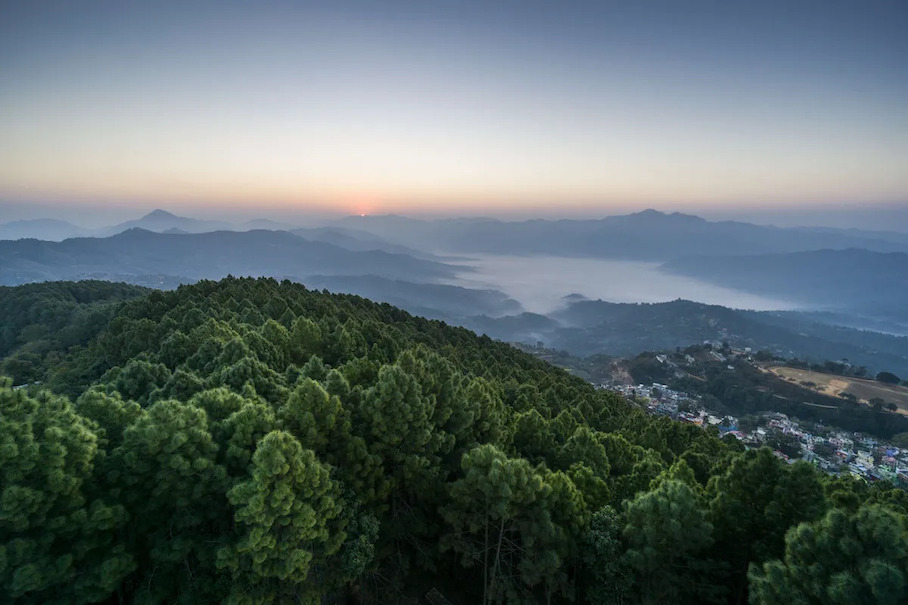
    NASA published a set of maps yesterday showing the incredible recovery Nepal’s forests have made over the past several decades thanks to a plan to put nearby communities in charge of conservation. You can see thin forest cover in the early 1990s, followed by a lush resurgence by the late 2010s. Forest cover almost doubled across the country between 1992 and 2016, the satellite imagery shows.

    “Once communities started actively managing the forests, they grew back mainly as a result of natural regeneration,” Jefferson Fox, deputy director of research at the East-West Center in Hawaii, says in NASA’s blog post. Fox was on the NASA-funded research team that documented the remarkable comeback.

    One map at the top shows Nepal shaded in light green, indicating little forest cover in 1992. A map below shows the country colored dark green, indicating increased forest cover in 2016.
    Forest cover across Nepal in 1992 and 2016. Image: NASA Earth Observatory

    In the late 1970s, a World Bank report issued a dire prediction that forests would mostly vanish from Nepal’s hills by 1990. Its plains would be similarly barren by 2000. After being nationalized decades earlier, forests were rapidly falling to agriculture and chopped down for firewood. But the country changed course in 1978, when it launched a community forestry program.

    The plan was to put local groups in charge of managing large areas of land. That allowed people to use the forests to gather food or firewood, for example. But they were also charged with developing plans to make sure those resources stayed plentiful. It was in their best interest to keep forests healthy.

    Now, some 22,000 local groups manage roughly 2.3 million hectares (5,683,424 acres) of community forests in Nepal. That’s about 3 million households maintaining around one-third of all of Nepal’s forests. And they’ve had incredible results. Forest cover in the community-governed area of Devithan grew from 12 percent to 92 percent over a few decades.

    One map on the left shows a region spotted with green, indicating dwindling forest cover in 1992. A map on the right shows the area colored in with much more dark green, indicating increased forest cover in 2016.
    Forest cover east of Kathmandu.  Image: NASA Earth Observatory

    This kind of success isn’t necessarily unique to Nepal. In the Amazon rainforest, Indigenous management of land has also curbed deforestation. That’s something to keep in mind now that tree planting schemes have become all the rage with brands and billionaires who want to show that they care about our planet and climate change. And world leaders have committed to conserve 30 percent of the world’s land and waters by 2030.

    Sure, forests are in dire straits across the world, and repairing them brings the added benefit of trapping carbon dioxide that would otherwise heat up the planet. But so many forestry projects fail without community buy-in. Seedlings die and trees are cut down, often because there isn’t a plan in place to manage them for the long haul.

    In worst-case scenarios, Indigenous peoples and other residents have been kicked off their lands in the name of conservation. What decades of experience and research actually show us is that they were the best stewards of the forest in the first place.

    Source

  • Influence of Putin’s aggression against Ukraine on Indigenous Peoples of Russia

    Influence of Putin’s aggression against Ukraine on Indigenous Peoples of Russia

    Dear colleagues, brothers and sisters,

    Tomorrow is the first anniversary of the bloody Russian aggression against Ukraine, unleashed by the imperial policy of dictator Putin. This war has already cost the Ukrainian nation tens of thousands of lives, including the lives of the indigenous peoples. This war is a tragedy for the Ukrainian Nation.

    In this war, are also dying representatives of the indigenous peoples of Russia succumbed to state propaganda and went to the war as soldiers of the Russian army. We, in cooperation with the Anti-Discrimination Centre Memorial, decided to prepare a report on the impact of this injustice war on the indigenous peoples of Russia to show that this war is also a tragedy for small-numbered indigenous nations of Russia. 

    The first edition of the iCIPR report on the war’s influence on the indigenous peoples of Russia was published on 24 August 2022. You can see it at https://indigenous-russia.com/archives/27991.

    Here is the second edition.

    Dmitry Berezhkov – editor-in-chief of the Indigenous Russia information center, member of the International Committee of Indigenous Peoples of Russia (iCIPR)


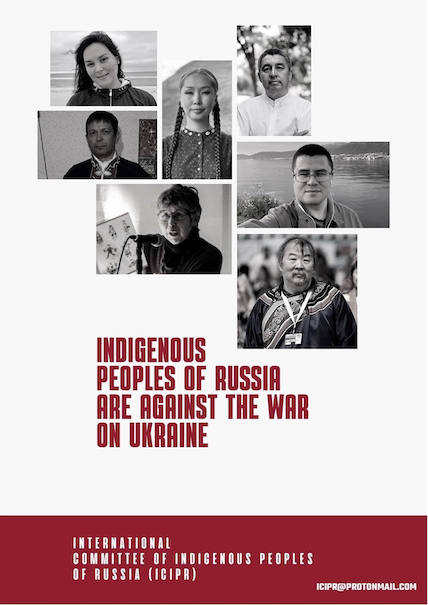
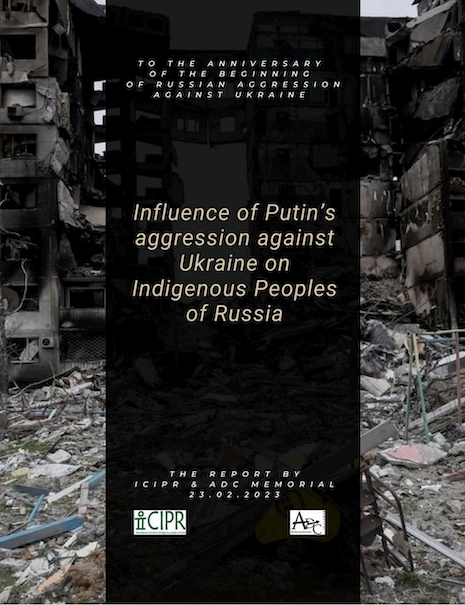
    The report by the International Committee of Indigenous Peoples of Russia (iCIPR) and the Anti-Discrimination Centre Memorial to the anniversary of the beginning of Russian aggression against Ukraine. 

    Second edition, 23 February 2023

    Introduction 

    After Vladimir Putin’s return to the presidency in 2012, the Russian Government turned its attention to civil society organizations. Draconian laws enacted since 2012 regulate the work of organizations engaged in activities deemed political by the Government. The constant harassment of these organizations by the authorities has made it next to impossible to openly and freely discuss Indigenous Peoples’ rights, especially land rights and self-determination. A particularly worrisome aspect was the accelerating expansion of extractive industries on Indigenous Peoples’ traditional lands, regulated and encouraged by the Government, without their Free, Prior, and Informed Consent (FPIC) and paying neglect attention to the environmental standards.

    As a result, today, the once vibrant Indigenous activist movement in Russia has been reduced to a handful of people. Those activists must be extremely careful, as anyone who openly questions the authorities’ political and economic choices is at risk of criminal prosecution. A number of prominent Indigenous rights defenders left the country[1], fearing for their safety. Some who stay in Russia experience arbitrary criminal prosecution initiated by the state or extractive industries.

    After the start of the Russian invasion of Ukraine in February 2022, the repressive Russian legislation was much strengthened, and critical Indigenous voices fear persecution can no longer effectively stand up for their rights and publicly criticize the Government, its proxy organizations, and crony extractive businesses. 

    Indigenous soldiers in the war

    The war’s most direct and unfortunate impact on Indigenous peoples is the participation of Indigenous soldiers in the Russian army fighting in Ukraine. Many experts and mass media have repeatedly pointed to the disproportionate conscription of Russian ethnic minorities and indigenous peoples into the army compared with the titular population of Russia. For example, according to the “Ethnic and regional inequalities in the Russian military fatalities in the 2022 war in Ukraine”[2] report, a soldier drafted into the war from Buryatia is about 100 times more likely to die than a resident of Moscow.

    The other visible example is the drafting campaign in the Udege indigenous community Gvasugi in the Russian Far East (Khabarovsk krai). According[3] to the Russian Ministry of Defense, Sergey Shoigu, only about one percent (300 thousand persons) of the total Russian mobilization resource (25 million people) were mobilized. At the same time, in Gvasugi village, where only two hundred persons live, 14 men were mobilized[4]. That consists[5] of 11 percent of the total male population of the village and about 30 percent of the mobilization resource (men who could be sent to war according to their age and other standards).  

    Hundreds of deaths of Indigenous soldiers from Chukotka, Khabarovsk Krai, Tyva, Yakutia, and other Russian regions have already been confirmed[6]. However, the total number of Indigenous soldiers’ deaths is difficult to estimate as many Indigenous peoples in Russia have Russian names, making it impossible to distinguish them from non-Indigenous servicemen in open databases. The Russian Government does not publish reliable data on fallen soldiers and makes no statistics on Indigenous Peoples’ share in its rare information reports[7]. 

    Most Indigenous Peoples officially recognized[8] by Russia are numbered several thousand or even hundreds of people. So while any loss of life is a tragedy, for small-numbered Indigenous Peoples, it could be a question of their very survival. Tragically, many who return home alive will likely suffer from injuries and mental health problems. At the same time, Russia’s healthcare infrastructure in remote areas where most Indigenous peoples live has minimal capacity[9] to address these issues.

    In many poor remote areas where Indigenous Peoples live, even in the usual time, the military contract service was one of the few paid jobs available and better paid than many other public jobs. Today the Russian Government is attracting[10] disadvantaged and underserved people for the war in Ukraine, promising them a salary several times higher than the average wage in the region while does not provide[11] potential recruits with realistic information about what to expect in the war. 

    Still, a lot of male Indigenous Peoples’ representatives attempted to avoid forced mobilization of the Russian army. While some[12] tried to disappear into forests pursuing their usual traditional activities, others had to leave[13] Russia, which again will negatively reflect on the general statistics of their small-numbered nations.   

    Influence of the war on the social and economic life of Indigenous communities 

    Since the beginning of Russia’s invasion of Ukraine, sanctions by Western governments were quickly followed by foreign businesses choosing to leave[14] the Russian market. International trade links between Russia and the West based on the exchange of raw materials mined mainly on the lands of the indigenous peoples of the Russian Arctic, Siberia, and the Far East for Western goods and technologies were almost destroyed during the war.

    In an economy like Russia’s one, closely linked to international trade, this led to immediate economic consequences felt by many within Russia. The country is already experiencing shortages of some essential supplies like medicines[15] and aircraft[16] produced by Western companies. The lack of such goods is hitting remote Indigenous communities especially hard, as many are only accessible by air transport much of the year and cannot receive high-level medical services in remote villages. According to our indigenous informants’ reports from Russia, their communities have already met with the problem of runaway inflation and rising prices of consumer goods, especially in remote villages which do not have year-round access to the rest of Russia, except by air transport.

    The sanctions influence various aspects of indigenous peoples’ life differently in Russia. For example, indigenous hunters in Siberia were unable[17] to sell peltries, while fur hunting is the basis of their traditional economies. The cause of the problem is that Russia has lost access to the European fur auctions, which were the primary consumers of Russia’s furs. 

    In other regions, indigenous communities met with the problem[18] of a lack of access or high prices on the western-produced equipment, which has long been used in the daily lives of Indigenous reindeer herders, hunters, fishermen, including snowmobiles, off-road transportation, satellite communications etc. 

    The war and Russian extractive industry: lowering environmental and human rights standards

    Using the “wartime” and sanctions pretext, Russian authorities and mining businesses are subsequently lowering[19] environmental standards in the country to “support the Russian economy”. According to the Russian Socio-Ecological Union (RSEU)[20], this trend includes: reducing mandatory requirements for ensuring ecological safety; complicating access and depriving citizens of the right to participate in issues related to nature and habitat protections; reducing state oversight over the activities of environmentally hazardous facilities; reduction or cancellation of the legislative ban on economic development of protected areas and requirements for forest conservation; extension of deadlines for federal environmental projects and state programs beyond the responsibility of the current generation of officials.

    One of the most dangerous tendencies is the intentional shrinking of the State Environmental Impact Assessment (SEIA) requirements. Aleksandr Fedorov, a member of the Russian Ministry of Natural Resources and Ecology’s Public Council, mentioned[21] several weakening procedures for the state environmental assessments initiated by state or business: reduce the scope of specific SEIAs, dilute the range of issues addressed by SEIAs, decrease the importance of SEIAs in decision-making; limit civil society participation during SEIAs and other assessments; depriving citizens of the right to organize their own public environmental impact studies.

    For example, in November 2022, in Lovozero village in the Murmansk region where Russian Sami live, the regional Government organized public hearings[22] on changing the status of the Seydyavr State Nature Reserve. This Natural Reserve has created near Lovozero village around the sacred Seidozero lake, where several Sami historical and religious significance sites are located. 

    According to the regional Government, the main idea[23] of the reorganization is the increasing tourist traffic to Seydozero and the possibility of rare-earth metals mining for Lovozero mining and processing plant on the Natural Reserve territory. Expanding the potential of rare-earth metal mining became necessary for Russia due to Western sanctions on the supply of microelectronics, which Russia needs[24] primarily to develop its military industry. Thus, the reorganization of the reserve threatens by mass tourism on the sacred lake (to which the Sami themselves have limited[25] access), on the one hand, and pollution of the territory due to the expansion of mining operations in this area on the other hand.  

    The weakening of the SEIAs’ procedures led to formalizing public hearings, now the almost only approach for local communities, including indigenous ones, to participate in decision-making regarding new development projects on their communal lands. Considering the Lovozero example, the local authorities gave only six days[26] after the public hearings for local residents to study a rather complex, technical 170-page document of the Natural Reserve reorganization rationale and present their opinion. 

    Similar nominal public hearings procedures are applied to other indigenous communities around the Russian Arctic, Siberia and the Far East, including among reindeer herders[27], who rarely have the opportunity to visit villages to participate in the public hearings. 

    The other significant tendency is escaping Western mining companies, investors and buyers from Russia and their replacement by Russian, Chinese, and other non-Western businesses. For example, this summer, president Putin raised the stakes[28] in his economic war against the West and signed a decree that seized complete control of the Sakhalin-2 gas and oil project in Russia’s Far East to force the oil Shell company out of Russia. Today the Sakhalin-2 project operates by Russian natural gas state monopoly Gazprom which has been repeatedly proven to violate[29] the rights of indigenous peoples. 

    That means Russian indigenous communities lost their opportunity to apply to Western mining businesses on international human rights and environmental standards, which they follow more thoroughly than Russian or non-Western companies. 

    The other challenge connected to the war is today’s impossibility of organizing independent research on mining business influence on indigenous communities or verifying the Russian stakeholders’ information. The country is closed to international field visits. During the war, several international institutions, including the Initiative for Responsible Mining Assurance (IRMA)[30] and the Council of Europe Framework Convention for the Protection of National Minorities, canceled their country visits. 

    Victimization of civil society institutions

    The war in Ukraine has provided the Russian Government with a new opportunity to tighten an already minimal civic space in Russia. Soon after the start of the war, Russian authorities blocked[31] the last remaining independent media outlets in Russia, Russian language media based abroad, and access[32] to various social media outlets. The Government continues[33] its destructive campaign to expel from the country the independent human rights, environmental and expert organizations that, in the past, have provided invaluable assistance to Indigenous communities in defending their rights to lands, resources, and self-determination. As a result, the overwhelming majority of Russia’s Indigenous population lost access to independent sources of information except for the government ones, while indigenous communities lost the opportunity to apply for help from independent media and human rights organizations. 

    The criminal prosecution of Segey Kechimov[34] could be considered an example. 

    Sergey Kechimov is a Khanty indigenous person who lives with his wife near the sacred Khanty lake Numto in Khanty-Mansiisk autonomous region. This region is the most oil-rich in Russia. One of the biggest Russian oil companies, “Surgutneftegas,”[35] has been exploring and extracting oil near the lake since 2012. Since then, Sergey Kechimov has been trying to protect Khanty’s traditional lands against oil pollution near his reindeer herding camp. In 2017 after a conflict with oil workers whose dog mauled his reindeer, Sergey Kechimov was sentenced by a local court for threatening oil workers. 

    In those days, indigenous communities, independent media, human rights and environmental organizations were able to create a powerful public campaign to protect Kechimov’s rights as a victim of authorities and the oil industry on national[36] and international[37] levels. Even though Sergey was finally sentenced, the sentence was relatively painless – 30 hours of communal work only. 

    But in December 2022, he was sentenced[38] again for threatening oil workers with already six months of liberty restriction, and immediately after the court, he was again arrested by the local police, which brought an accusation against him for police disobedience. 

    Today the investigation against him continues, and nobody from human rights organizations or independent media can support him as there are no remaining such organizations in the region now. In 2022 Sergey Kechimov didn’t receive any legal support or media attention, as well as support from his own community. While some local indigenous organizations serve[39] the interests of the regional authorities and oil companies, others are intimidated by the recent strengthening[40] of the repressive Russian legislation and can not support Sergey Kechimov in his fight. 

    Intimidation of indigenous critique voices 

    Indigenous activists and indigenous rights defenders also didn’t avoid prosecution from authorities. 

    In February 2022, the next day after the Russian invasion of Ukraine, Chukchi student Mark Zdor who studied at the St. Petersburg University named after AI Herzen, was arrested[41] by the police after he, with his classmates, participated in the antiwar protest action in St. Petersburg. Mark was fined to 10 thousand rubles. Several days later, after the police came to his house to continue the investigation, he left Russia, fearing for his safety.  

    In May 2022, an indigenous activist from Pevek (Chukotka region), Igor Ranav, was fined[42] for his antiwar position (the exact perpetration was the phrase “Yes to the peace! No to the War!” / “Миру — Мир, нет, Войне!”), which he published on one of the social networks).

    Several days later, the other indigenous activist from Nenets okrug Konstantin Ledkov has also been fined[43] for the second time for the phrase “Crimea belongs to Ukraine” / “Крым это Украина”. 

    In July 2022, during the session of the UN Expert Mechanism on the rights of indigenous peoples in Geneva, a representative of Shor peoples, Yana Tannagasheva, made a presentation on violations of the indigenous peoples’ rights by coal companies in the Kemerovo region. After the presentation, Ms. Tannagasheva was approached by a Russian diplomat, who acted in an intimidating manner by asking for her name, phone number and her business card in a reportedly aggressive way. Numerous delegates of the session, including representatives of indigenous peoples, NGOs, and the UN Special Rapporteur on the rights of indigenous peoples, witnessed[44] this incident. The same Russian diplomat later approached the Secretariat of the EMRIP session, asking for information about the list of speakers, including the speakers’ names and the organizations they represent. 

    Later during the session, several states and indigenous delegations made statements condemning the inappropriate behavior of the Russian state representative just in the UN building. 

    Fortunately, Yana Tannagasheva received[45] political asylum today in Sweden, where she had been forced to escape from Russia after years of intimidation by authorities and coal companies. She is safe now and does not fear threats from the Russian side. But according to her, the Russian diplomat who threatened her during the EMRIP session didn’t know that fact as he supposed she continued to live in her village in the Kemerovo region. In this light, the attempt to intimidate the delegate and receive personal data could definitely be considered a severe threat to any indigenous activists who continue to live in Russia and trying to inform international human rights bodies about violations of their indigenous rights. 

    Immediately after the incident, the International Committee of Indigenous Peoples of Russia (ICIPR), the organization Ms. Tannagasheva is part of, issued a statement[46] condemning the assault on the website[47] “Indigenous Russia” that is today become the only media that specialize in publishing information about violations of Indigenous rights in Russia. Just after posting the statement, the director of Indigenous Russia received an email from the website’s hosting provider, saying it had received[48] a request from the Russian Government to remove the page from the Internet within 24 hours.

    The other side of this problem is that Indigenous leaders and IP rights defenders in Russia are afraid now to express their opinion publicly, especially on the international level where RAIPON’s and other Russian propagandists’ voices[49] are primarily heard. Considering the latest restrictive wartime legislation according to which persons who critique the political regime and authorities could be imprisoned for a long term, the voice of indigenous peoples in Russia is now at the lowest level since the Soviet Union. 

    Polarization of the indigenous movement

    Before Vladimir Putin came to his third presidential term in 2012, the indigenous movement in Russia was more or less united behind the idea of protecting Indigenous rights and didn’t afraid to confront the state or business if such rights were violated. The biggest Indigenous organization – the Association of Indigenous Peoples of the North, Siberia and the Far East (RAIPON)[50], which has regional departments in all regions where indigenous peoples live, represented the interests of most indigenous communities in Moscow. 

    But this organization came under the complete control of Putin’s regime in 2013 after Russian authorities promoted[51] Grigory Ledkov, a member of the Russian Parliament, to the RAIPON’s leadership. After that, the RAIPON’s role was primarily reduced to rubber-stamping government decisions institution.  

    In 2022 while some rare indigenous activists or alliances protested[52] against the war, RAIPON, in partnership[53] with some smaller indigenous organizations, since the first days of the war, approved[54] president Putin’s operation against Ukraine. In order to give the impression that all Russian ethnic groups supported the war, Raipon joined with the authorities in numerous patriotic actions in remote indigenous communities[55] and cities[56]. 

    War propaganda became not the only concern of RAIPON in 2022. The other important activity became manhunting and reports to the authorities against those criticizing President Putin’s policy. For example, it was Raipon’s representatives who provided[57] the authorities with information about the protest activities of student Mark Zdor, after which the police began to investigate him. 

    The other example is a decision[58] of RAIPON’s Coordinating Council in April 2022, which applied to the Russian general prosecutor’s office to check the website “Indigenous Russia” on extremism that finally came to a decision of the Russian authorities to ban[59] access to the website from the territory of the Russian Federation. 

    Divided peoples

    Indigenous peoples whose ancestral lands are divided by national borders suffer additional impacts of the war due to suspending their cross-border cognate ties. The cross-border dimension is particularly evident with the Arctic Indigenous Nations living in Russia and other Arctic countries. 

    For example, the war in Ukraine has resulted in a suspension[60] of all cooperation between Russian and non-Russian members of the Sámi Council, the Sámi’s main representative body. The break followed an explicit expression of support by some[61] Sámi leaders in Russia for the Russian Government’s decision to launch the war against Ukraine. And although not all Russian Sámi organizations endorsed the Government on that issue, the decision to suspend Russian participation was made unanimously by the Executive Board of the Sámi Council, a body that consists of four people, one of which is a representative of Russian Sámi.

    In a similar situation are the Russian and foreign parts of the Aleut International Association and Inuit Circumpolar Council. While they didn’t announce the break in cooperation with their Russian members officially, the actual contacts are extremely limited. 

    The growing isolation of the Russian political regime and escalation of its antagonism with the West will likely lead to a further reduction in transborder contacts.

    Conclusions

    Indigenous peoples in Russia are among the most vulnerable groups in the Russian population. Dispossessed of their ancestors’ lands, they have minimal access to their traditional resources for hunting, fishing and other traditional economic activities. They are also excluded from industrial development decisions on their traditional territories. As a result, many Indigenous communities depend on the state’s meager allowance for subsistence. 

    Since the Russian invasion of Ukraine in February 2022, Russian indigenous communities have been experiencing increased pressure from the state and businesses, which announced the war support as a main priority of the Nation’s current development. While corrupt Russian bureaucrats and extractive companies, using the pretext of wartime, lowering environmental standards for accessing the indigenous traditional lands, the indigenous communities themselves suffer heavy losses due to the unprecedented drafting to the Russian army and the negative influence of the rapidly degrading Russian economy and living standards. 

    Most remote Indigenous communities of the Russian Arctic, Siberia and the Far East are cut off from alternative sources of information other than state TV channels. Unfortunately, due to the poor quality of life, many indigenous soldiers and their families, drugged by propaganda, see military service as a tool to improve their economic situation. 

    Proved human losses among indigenous peoples of the Russian Arctic, Siberia, and the Far East because of the war numbered today hundreds of lives. This is a particular disaster for small-numbered indigenous nations for which the loss of any community member is a tragedy. 

    All the new repressive laws initiated by President Putin to intimidate the Nation, increase Russia’s isolation, and expel the last independent media, human rights, and environmental institutions from Russia are incredibly disastrous to the ability of indigenous communities of the Russian Arctic, Siberia, and the Far East to defend their rights and provide information on violations of such rights at international venues, including the UN.  

    [1] New Report Highlights Indigenous Rights Violations in Russia – https://www.culturalsurvival.org/news/new-report-highlights-indigenous-rights-violations-russia

    [2] Ethnic and regional inequalities in the Russian military fatalities in the 2022 war in Ukraine – https://osf.io/preprints/socarxiv/s43yf

    [3] ‘Partial mobilisation’ of Russian reservists – a sign of Putin’s desperation? – https://www.france24.com/en/europe/20220921-partial-mobilisation-of-russian-reservists-may-reveal-putin-s-desperation

    [4] Подарки для семей мобилизованных доставили в национальное село Гвасюги – https://indigenous-russia.com/archives/29376

    [5] Война и коренные народы России: проблемы статистического анализа – https://indigenous-russia.com/archives/30103

    [6] Представители коренных народов России, погибшие на войне против Украины (список) – https://indigenous-russia.com/archives/29542

    [7] Russia says 89 troops were killed in New Year’s attack, blames use of mobile phones – https://www.reuters.com/world/europe/russias-defence-ministry-says-89-killed-makiivka-blames-use-mobile-phones-2023-01-03/

    [8] Federal Law No. 82-FZ on ensuring traditional rights of sparsely distributed indigenous peoples of the Russian Federation – https://www.fao.org/faolex/results/details/en/c/LEX-FAOC079128/

    [9] The COVID 19 impact on indigenous peoples of the Russian Arctic, Siberia, and the Far East – https://indigenous-russia.com/archives/6552

    [10] ‘They’re mostly after loans’ Tuvans, trying to scramble out of poverty, are dying in a foreign war – https://meduza.io/en/feature/2022/09/15/they-re-mostly-after-loans

    [11] Demoralised Russian soldiers tell of anger at being ‘duped’ into war – https://www.theguardian.com/world/2022/mar/04/russian-soldiers-ukraine-anger-duped-into-war

    [12] В карельском селе мужчины ушли в лес за клюквой и избежали мобилизации – https://m.pln24.ru/allworld/462494.html

    [13] “I just want to help my people,” says exiled Sámi leader – https://thebarentsobserver.com/en/indigenous-peoples/2023/02/i-just-want-help-my-people-says-exiled-sami-leader

    [14] Более 40% иностранных компаний решили уйти из России – https://www.dw.com/ru/s-nacala-vojny-bolee-40-inostrannyh-kompanij-resili-ujti-iz-rossii/a-63639653

    [15] Прокладки и сахар снова на полках. Дефицита больше не будет? – https://meduza.io/feature/2022/04/28/prokladki-i-sahar-snova-na-polkah-defitsita-bolshe-ne-budet

    [16] Авиакомпания на Камчатке закрылась из-за отсутствия самолетов – https://ria.ru/20220520/kamchatka-1789782772.html

    [17] Бардалеев: Санкции США и ЕС виноваты в падении цен на забайкальскую пушнину – https://chitamedia.su/news/1415937/

    [18] «В Россию и на Запад едут разные контингенты украинских беженцев» – https://iz.ru/1351412/sergei-gurianov/v-rossiiu-i-na-zapad-edut-raznye-kontingenty-ukrainskikh-bezhentcev

    [19] Russia slashes environmental protections as war rages, economic crisis looms – https://thebarentsobserver.com/en/industry-and-energy/2022/06/russia-slashes-environmental-protections-war-rages-economic-crisis-looms

    [20] Российский социально-экологический Союз и Госсовет России – за экологическое благополучие – https://rusecounion.ru/ru/deecologicalization

    [21] Environmental lawlessness during wartime – https://uwecworkgroup.info/environmental-lawlessness-during-wartime/

    [22] В Ловозере прошли общественные слушания по созданию природного парка «Сейдъявврь» – https://www.hibiny.com/lovozero/news/item-v-lovozere-proshli-obshchestvennye-slushaniya-po-sozdaniyu-prirodnogo-parka-seydyavvr-277394/

    [23] Отчет о научно-исследовательской работе по теме «Обследование и обоснование реорганизации государственного природного заказника регионального значения «Сейдъявврь» в одноименный природный парк». Книга 2. – https://indigenous-russia.com/wp-content/uploads/2022/11/materialy_keo_seydyavr.pdf

    [24] Корпоративный конфликт недели: как делят Соликамский магниевый завод – https://ko.ru/articles/korporativnyy-konflikt-nedeli-kak-delyat-solikamskiy-magnievyy-zavod/

    [25] Саами запретили посетить сакральное место!!!! – https://indigenous-russia.com/archives/26392

    [26] How Russia Implements the Free, Prior and Informed Consent Principle – https://indigenous-russia.com/archives/29948

    [27] «Газпром» ответил на претензии ямальских КМНС – https://uralpolit.ru/news/yanao/06-01-2023/268139

    [28] Russia seizes control of Sakhalin gas project, raises stakes with West – https://www.reuters.com/business/energy/russia-decree-sakhalin-2-project-knocks-mitsui-mitsubishi-shares-2022-07-01/

    [29] Как национальный вопрос стал головной болью для эвенков Хандинской общины – https://baikal.mk.ru/social/2021/12/15/kak-nacionalnyy-vopros-stal-golovnoy-bolyu-dlya-evenkov-khandinskoy-obshhiny.html

    [30] Initiative for Responsible Mining Assurance – https://responsiblemining.net

    [31] Russian liberal radio mainstay Ekho Moskvy closes  after pulled off air – https://www.themoscowtimes.com/2022/03/03/russian-liberal-radio-mainstay-ekho-moskvy-closes-after-pulled-off-the-air-a76730

    [32] Russia bans Instagram and Facebook as court declares Meta an ‘extremist organisation’ – https://www.euronews.com/next/2022/03/21/ukraine-war-facebook-temporarily-allows-posts-calling-for-violence-against-russians-or-put

    [33] Moscow Helsinki Group banished by court order in Russia – https://www.euronews.com/2023/01/25/moscow-helsinki-group-banished-by-court-order-in-russia

    [34] Indigenous Russia – Cергей Кечимов tag – https://indigenous-russia.com/archives/tag/кечимов-сергей

    [35] Surgutneftegas company – https://www.surgutneftegas.ru/en/

    [36] Один на озере нефти – https://www.svoboda.org/a/27199956.html

    [37] The reindeer herder struggling to take on oil excavators in Siberia – https://www.theguardian.com/world/2017/mar/17/reindeer-herder-oil-excavators-siberia

    [38] Сергей Кечимов вновь признан виновным в угрозе убийством сотрудникам нефтяной компании “Сургутнефтегаз” – https://indigenous-russia.com/archives/28640

    [39] Депутат окружной Думы Александр Новьюхов: «Югра единственный регион в мире, где есть таежное оленеводство» – https://indigenous-russia.com/archives/9456

    [40] Russians laws on civil society are becoming more repressive – https://www.nhc.no/en/russian-foreign-agent-law-becoming-more-repressive/

    [41] Марк Здор. Биография – https://docs.google.com/document/d/1KI0xNapCVbgnBvfULDfGSdGCOh-bh4Sx9YUx2mF57cE

    [42] Чукотский активист обвиняется в дискредитации Вооруженных сил РФ – https://sm.news/chukotskij-aktivist-obvinyaetsya-v-diskreditacii-vooruzhennyx-sil-rf-71340-u3t5/

    [43] В Нарьян-Маре мужчину оштрафовали на 35 тысяч рублей из-за высказываний о Крыме – https://ovd.news/express-news/2021/05/28/v-naryan-mare-muzhchinu-oshtrafovali-na-35-tysyach-rubley-iz-za-vyskazyvaniy

    [44] The letter of the Special Rapporteur on the situation of human rights defenders; the Special Rapporteur on the issue of human rights obligations relating to the enjoyment of a safe, clean, healthy and sustainable environment; the Special Rapporteur on minority issues and the Special Rapporteur on the implications for human rights of the environmentally sound management and disposal of hazardous substances and wastes to the Russian Federation – https://spcommreports.ohchr.org/TMResultsBase/DownLoadPublicCommunicationFile?gId=27565

    [45] The cost of fighting for Indigenous people and environmental rights in Russia – https://www.iwgia.org/en/news/4394-the-cost-of-fighting-for-indigenous-people-and-environmental-rights-in-russia.html

    [46] ICIPR statement against intimidation of indigenous delegates by the Russian state’s representative during the EMRIP 15th session in Geneva – https://indigenous-russia.com/archives/22619

    [47] Indigenous Russia – https://indigenous-russia.com

    [48] ICIPR statement at EMRIP 15th session. Agenda # 10. Future work of the Expert Mechanism – https://indigenous-russia.com/archives/22796

    [49] Дебаты на Форуме ООН по вопросам коренных народов: переселение Норникелем ненцев на Таймыре – https://sakhalife.ru/debaty-na-forume-oon-po-voprosam-korennyh-narodov-pereselenie-nornikelem-nenczev-na-tajmyre

    [50] Russian Association of Indigenous Peoples of the North – https://arctic-council.org/about/permanent-participants/raipon/

    [51] Moscow staged RAIPON election thriller – https://barentsobserver.com/en/politics/2013/04/moscow-staged-raipon-election-thriller-03-04

    [52] Statement of the International Committee of Indigenous Peoples of Russia – https://indigenous-russia.com/archives/19347

    [53] Открытое заявление лидеров Федеральных национально-культурных автономий и институтов гражданского общества в поддержку решений Президента Российской Федерации – https://domnarodov.ru/events/news/otkrytoe-zayavlenie-liderovfederalnyh-nacionalno-kulturnyh-avtonomij-i-institutov-grazhdanskogo-obschestva

    [54] RAIPON supports the decision of President Putin to start the war in Ukraine – https://indigenous-russia.com/archives/19434

    [55] Старейшины коренных малочисленных народов Севера и краеведы Олы сняли клип в поддержку России – https://magadanmedia.ru/news/1274286/

    [56] Нина Вейсалова: “Наши северяне сегодня героически защищают безопасность России, выполняя высокую миссию и государственные задачи” – https://indigenous-russia.com/archives/24747

    [57] Марк Здор. Биография – https://docs.google.com/document/d/1KI0xNapCVbgnBvfULDfGSdGCOh-bh4Sx9YUx2mF57cE

    [58] Ассоциация КМНСС и ДВ РФ обратится в Генпрокуратуру РФ с просьбой о проверке iRussia на экстремизм – https://indigenous-russia.com/archives/20923

    [59] Федеральная служба по надзору в сфере связи, информационных технологий и массовых коммуникаций. Универсальный сервис проверки ограничения доступа к сайтам и (или) страницам сайтов сети «Интернет» – https://blocklist.rkn.gov.ru

    [60] Cooperation with Russian side on hold – https://www.saamicouncil.net/news-archive/cooperation-with-russian-side-on-hold

    [61] Samerådets vicepresident hade Z på gitarren – allt samarbete stoppas – https://www.svt.se/nyheter/sapmi/sameradet-stoppar-samarbete-med-ryssland

  • Nine ways to support the rights of indigenous people

    Nine ways to support the rights of indigenous people

    What are the practical steps to push for recognising the rights of indigenous people around the world? Our expert panel shares their thoughts

    1. Focus on the priorities

    Indigenous people can’t choose their own way of life, get control over their own education, healthcare and so on, unless their lands are secure. That’s the overwhelming priority. All other issues are secondary. If their land rights are recognised, tribal peoples thrive. If they’re not, the outlook is bleak. Jonathan Mazower, advocacy director, Survival International, London, UK. @Survival

    2. Include indigenous people in discussions of land use

    Without land, indigenous peoples have no livelihood, no identity, no means of survival. In this context, states need to respect the principle of free, prior and informed consent. Indigenous peoples need to be consulted about use of their land and included in development processes. Companies need to take this on board too and conduct proper due diligence prior to embarking on, and during, investment projects. Lucy Claridge, legal director, Minority Rights Group International, London, UK. @ClaridgeLucy

    3. Apply the law to ensure land rights are protected

    Laws on land rights are often good, but they’re universally flouted. Brazil’s an example – all Indian tribes in Brazil should have had their land protected in law by 1993 according to the constitution, but dozens are still waiting. In the meantime many, like the Guarani, live in dire circumstances – often camped by roadsides, in terrible conditions, with levels of disease and suicide that are off the scale. And when they try to re-occupy small bits of their lands, they’re frequently shot at. Jonathan Mazower, advocacy director, Survival International, London, UK. @Survival

    4. Build public awareness

    Informed public education and awareness building is critical to the implementation of indigenous rights. This is a responsibility of all. There is a lot of mistrust for good reason. But how we inform ourselves and understand our own complicity in consumption and policies that sustains the need for production, profit, and exploitation is absolutely necessary. We can then began to understand the on impact on indigenous peoples, their territories and lands. As an indigenous person our relationship to the land is the heart and soul of who we are, our identity, and our survival. Suzanne Benally, executive director, Cultural Survival, Boulder, Colorado, US.

    5. Recognise their role in conservation

    Indigenous peoples’ key role in conservation – which is often one of the reasons used for their eviction – needs to be recognised. Indigenous peoples’ dependence on the land for food, shelter, identity and survival has resulted in a deep respect for that land and a need to conserve it. Indigenous peoples traditionally develop a set of conservation measures that are passed down from one generation to the next, and as a result they should be seen as the best people to conserve that land. Lucy Claridge

    6. Bridge the gap between policy and practice

    Another major challenge is the gap between policy and law and practice. There are many excellent examples of rulings by international courts on the rights of indigenous peoples including the Endorois case and others such as Saramaka in Suriname which are legally binding on governments but yet years later many of these cases remain unimplemented. The same gap exists at the level of policies and safeguards held by multilateral agencies like the World bank and other international finance institutions which govern how they can lend for projects that effect indigenous peoples. The policies often have shortcomings but are broadly speaking vast improvements on the situation 20 or 30 years ago. Yet despite this the policies and safeguards are frequently unimplemented or disregarded in some way. Conrad Feather, project officer, Forest Peoples Programme, Oxford, UK.@ForestPeoplesP

    7. Encourage the state to fulfil wider rights

    There is a human right to education, and a human right to an adequate standard of living – and there is also a right to development: the right to be included in development processes which affect you. The right to development includes the fulfilment of civil, political, economic, social and cultural rights and freedoms. States bear the duty to bear the burden for creating conditions favourable to a people’s development. Lucy Claridge

    8. Don’t speak for indigenous people

    Perhaps the greatest obstacle to advancing indigenous peoples interests is the slow process of building coalitions between “fourth world” (indigenous) nations and between fourth world NGOs. NGOs tend to be focused on their priorities and often “speaking for” fourth world peoples generally. We have generalised the many nations into “indigenous peoples” and forgot that what is important in central Africa may not be a priority in Asia. Rudolph C Ryser, chairman of the CWIS board of directors, Center for World Indigenous Studies (CWIS), Olympia, US.

    9. Learn from stories of progress

    Notwithstanding the dire situation for many peoples there are also some incredibly inspiring stories. From Peru where I work mainly there is the story of the Achuar people in the north who have come together to defend their territory and implement their own vision for self government. For over 15 years they have successfully resisted the efforts of various oil companies and the government to explore for oil on their territory. Conrad Feather

    Source

  • Mining Europe’s biggest rare earth deposit could make life ‘impossible’ for Sámi communities

    Mining Europe’s biggest rare earth deposit could make life ‘impossible’ for Sámi communities

    In January, Swedish state-owned mining company LKAB discovered more than 1 million tonnes of rare earth minerals in Kiruna, Sweden’s northernmost city.

    These rare earth minerals are key components in everything from electric vehicle batteries to mobile phones to wind turbines. And the discovery of this deposit – just 30 kilometres from the Arctic circle – prompted a slew of celebratory headlines.

    Many see the newly found resources as a way of ending Europe’s reliance on Russia and China for the rare earth minerals needed to fuel the green transition.

    But it’s a different story for the Indigenous Sámi population that lives near the site. 

    Local Sámi communities are already affected by an existing Kiruna iron ore mine – and fear the new deposit discovery will threaten their traditional migration routes.

    What impact has mining already had in Kiruna?

    The Sámi people are spread across four European countries: Russia, Finland, Norway and Sweden. Their languages and culture are deeply linked to their reindeer herds, the land and their way of life.

    “Sámi culture is based on a traditional way of land use that has taken place long before Norway became Norway or Sweden became Sweden,” Karin Kvarfordt Niia, a spokesperson for the Gabna Sameby one of the local reindeer communities, tells Euronews Green.

    “It’s a way of using land that is by definition green because we are actually letting the animals graze and find food for themselves in their surroundings.”

    Her Sameby start their year in May in the mountains near the Norwegian border. Then in August, the reindeer start to move east and they follow them.

    AP Photo/Malin Moberg
    Reindeer roam the forest close to a weather station near Kiruna.AP Photo/Malin Moberg

    To access the winter grazing lands they have been using for hundreds of years, the herders have to move from one side of Kiruna to the other.

    “It was important land for us and now this. We have a city and a huge mine,” Karin says.

    The mine and the town have left the Gabna Sameby with just a small strip of land, a few kilometres wide, for their reindeer herd to migrate through. Infrastructure for the industry cuts across their historic routes, with railways and roads crisscrossing the land.

    “We’re extremely impacted by the mine, LKAB has already cut off our different migration routes, and then the mine has caused damage to the lakes so we are not able to fish there,” Karin explains.

    “It isn’t only a matter of our reindeer, It’s a matter of our way of living, our culture and the possibility to keep our language alive.”

    Why is the discovery of rare earth minerals being celebrated?

    The discovery of rare earth minerals means the state-owned mining operation, home to the largest underground iron-ore mine in the world, is set to expand.

    LKAB’s CEO Jan Mostrom described the discovery as “good news” not just for the company, the Kiruna region and the people of Sweden but also for Europe and the climate.

    “It could become a significant building block for producing the critical raw materials that are absolutely crucial to enable the green transition,” he said in a statement.

    Jonathan NACKSTRAND / AFP
    The iron mine of Swedish state-owned mining company LKAB in Sweden’s northernmost town of Kiruna.Jonathan NACKSTRAND / AFP

    Rare earth minerals aren’t currently mined in the EU and the bloc’s industries are heavily reliant on imports from other countries like China and Russia. It’s no surprise, then, that this discovery and others like it have cheered those looking to cut dependence on outside sources – particularly in the wake of the war in Ukraine.

    The company has also promised fossil fuel-free extraction of the minerals as part of the EU’s green transition.

    According to Sweden’s Minister for Energy, Business and Industry Ebba Busch, the “EU’s self-sufficiency and independence from Russia and China will begin in the mine”.

    More mining could cut grazing lands in two

    Karin says the promise of European independence from Russia and China puts the Indigenous population in a difficult position.

    The Sámi people are experiencing the consequences of climate change first-hand, and they more than understand the need to mitigate its effects.

    “In January, LKAB suddenly launched this idea of a new mine, that they say would save Europe. They would also cut our land, our Sameby in two pieces because it would be impossible for us to graze our Sámi lands.”

    She believes that the industry is looking to exploit the green transition for profit, at least in this part of Sweden. Karin says there must be other ways to get rare earth minerals, like reprocessing the 130-year-old waste that is piled up around the iron mine.

    “What’s green and what will stop climate change?” she asks.

    “Is it to dig out more iron and possibly find more rare earths? Or is it to focus on not polluting more land, destroying more of the fragile ecosystems that you find in the mountains in this part of the EU?”

    Source

  • Indigenous Of Russia, The Silent Victims Of Putin’s War

    Indigenous Of Russia, The Silent Victims Of Putin’s War

    The number of indigenous people in Russia has been declining for decades, but the war in Ukraine has accelerated the trend. Already vulnerable, indigenous groups are more likely to be mobilized and bear the brunt of Western sanctions.

    While Russia continues its supposed mission to “denazify” Ukraine, back on home turf its own indigenous people are bearing what may be the heaviest consequences of the Kremlin’s war.

    There are 47 indigenous groups living in Russia, some of them with populations of less than a hundred or even a few dozen. The 2021 All-Russian Population Census showed that the number of indigenous people has substantially declined in the last 10 years.

    Russian independent news site Vazhnyye Istorii (Important Stories) reports on certain groups that were already on the verge of extinction, and how their situation has gotten even worse after Russia unleashed a full-scale war in Ukraine.

    The tragedy for these peoples is not only the disproportionately high numbers of mobilized men, but also the effect of Western sanctions as well as the reduction of state benefits that are now being spent on war.

    Extinction risks

    According to the 2021 All-Russian Population Census, 67% of indigenous groups have substantially decreased in size compared to the previous census in 2010. Most of them have been decreasing in number throughout the history of modern Russia, but the trend has accelerated in the last decade.

    Dmitry Berezhkov, editor of the Russia of Indigenous Peoples website, and a representative of one of the indigenous groups, the Itelmens, says that census data should be treated with a certain degree of skepticism. The government has been known to “draw up” figures for the sake of propaganda or solving government budget tasks. For example, according to the 2010 census, the smallest indigenous group was the Kereks living in Chukotka. There were only four of them a decade ago, but in the 2021 census they numbered 23.

    Another example is the Nenets, the largest of the indigenous peoples. In the 2021 census, 49,787 people were recorded as Nenets. “There is a big suspicion that this is a political figure that has been drawn up,” Berezkhov said. “If the Nenets cross into 50,000, they will no longer be considered an indigenous people under Russian law.

    Berezkhov said he believe that their number has already grown beyond 50,000 but the authorities have artificially reduced it in order to maintain this indigenous status for them — as they are one of the groups most involved in traditional nature management, reindeer herding and other types of traditional economic activities.

    “Removing them would affect the government’s framing of indigenous people,” he explained

    However, the state also plays an insidious role. There are, for example, no state benefits that come with identifying oneself as an indigenous person. A different state policy is required, different legislation and basic principles in the country so that the rights of minorities, the rights of vulnerable groups of the population are respected.

    Uprooted and assimilated

    The authorities consider indigenous peoples to be an objectionable obstacle blocking up these territories: they shouldn’t be there, they’re unnecessary and interfering with the development of the country. This leaves indigenous people with nowhere to earn money, nowhere to live and develop: they are driven out of their own land.

    Berezhkov cites the example of the village of Kazas in the Kemerovo region, which used to be a national village where the Shors lived. Most of its inhabitants were engaged in traditional crafts — hunting, fishing etc. In 2012, the Yuzhnaya coal company commissioned a pit in the area. Because of this, the ecology suffered greatly, the Lysaya mountain, sacred to the Shors and whose spirit was considered the guardian of the village and keeping in touch with the world of their ancestors, was destroyed.

    In the same year, the company demanded that the residents of the village sell their houses to it in order to develop coal deposits. Under pressure, the residents were forced to move. “The village was destroyed, houses were burned, these families were forced to leave. They moved to the cities, and their children assimilated in the urban environment, they forgot the language,” says Berezhkov.

    Men disproportionately drafted

    The war in Ukraine has and will continue to hit Russia’s indigenous people hard, most of all because indigenous men are being disproportionately mobilized for the war.

    “If losses in war affect large ethnic groups for generations, then for small groups, even the death of several people is already a great tragedy,” Berezhkov says. “If the group is made up of only 200 people, and two young men died in the war, that’s two ethnic families that won’t ever exist,” he laments.

    According to Berezhkov, it is the male population that suffers the most in the war and this has a particular influence on the preservation of indigenous peoples. “Men [among representatives of indigenous peoples] are more involved in traditional nature management: their activities allow them to maintain the status of a people who conduct traditional hunting, fishing and forest activities,” the expert explains.

    “Women are much more mobile, in many cases they choose more comfort for their children: they move to larger villages, and from larger villages to cities, where it is easier for them to start a family. They marry representatives of other nations and to a greater extent [than men] assimilate.”

    Mobilization is taking place disproportionately in the country’s ethnic outskirts, Berezhkov says. The expert cites the example of Gvasyugi in the Khabarovsk Territory — this is a national Udege village. A local television report said that 14 representatives of the Udege people were mobilized from there, and judging by the size of the male population of the village, this constitutes 30% of those in the village who are potentially eligible for mobilization. “This is a gigantic figure, which, of course, does not compute with the data given by Shoigu and Putin [that the mobilization will affect 1% of the population],” says Berezhkov.

    “Ethnic activists say that the authorities are purposefully destroying these peoples, calling up as many of them as possible,” continues Berezhkov. “However, this may also be due to the fact that indigenous peoples live in poor suburbs, where people have poverty and loans, and they trust the authorities, they believe they can make money from fighting.”

    He explains that indigenous peoples have fewer sources of information than the rest of the population: they watch and trust one state propaganda channel. “And this is natural, because the main concern for them is to hunt, fish and think less about politics,” says Berezhkov.

    A photo of a reindeer herder and reindeer
    A reindeer herder and reindeer near the Merlenke nomadic school in Eveno-Bytantaysky, Russia Sergei Karpukhin/TASS via ZUMA

    Economic concerns

    This thesis is confirmed by the data of other researchers. Aleksey Bessudnov, Associate Professor at the Faculty of Sociology at the University of Exeter in England, revealed ethnic disparity in the mortality of Russian military personnel in Ukraine. He found out that, for example, a man from Buryatia is 100 times more likely to die in a war in Ukraine than a man from Moscow.

    “I am, however, skeptical about the idea that the state deliberately conducts ethnic cleansing,” says Berezhkov. “The state, by and large, does not care about the small indigenous peoples.”

    The situation of indigenous peoples is also affected by the economic situation that has developed in the country due to the war. “In remote villages where indigenous people live, this is manifested in the fact that planes no longer fly there so frequently: it has become unprofitable for businessmen to take food to shops, people have to get to larger villages for food themselves. There are problems with medical equipment and modern medicines,” says Berezhkov.

    Indigenous peoples were also hit by the withdrawal from the Russian market of Western companies that worked in their places of settlement. “Western business meant Western standards. We, the indigenous communities, could approach these Western companies with demands to comply with the standards of international law in terms of the environment, and the rights of indigenous peoples. Now they have left, the standards are rapidly falling. Indigenous peoples can no longer appeal to international law. And Russian companies do not take into account our interests,” Berezhkov says.

    No money, no language

    In 2023, the authorities also reduced the amount of subsidies to support indigenous peoples. According to Berezhkov, cuts in spending on indigenous peoples are also due to the war, which is of course affecting the country’s budget dearly.

    “This language is our greatest cultural wealth, but, unfortunately, we are losing it.”

    “Financial support from the state has always been insufficient,” says Berezhkov. According to him, in Russia, regional authorities use money to support indigenous peoples but only if it comes with benefits for themselves. For example, in the Murmansk region, under a program for indigenous peoples, an apartment building was constructed. But in the end only one Saami family was settled there. The rest of the apartments were given to non-indigenous people on a waiting list.

    Support from the state is not enough for the preservation of languages. Berezkhov says that the preservation of such languages is highly dependent on government programs; in foreign countries, unlike Russia, attention is paid to dying languages. For example, in Scandinavia, the Sami language is now being revived. In Russia only 10% of the Sami people use it, according to the census data.

    Even Vladimir Putin admitted that little attention is paid in Russia to the preservation of indigenous languages. At the request of a resident of the Udege village of Krasny Yar in Primorsky Krai to introduce teaching of the Udege language, Putin replied: “This [the languages of the minority peoples of Russia] is our greatest cultural wealth, but, unfortunately, we are losing it.”

    Source